
Kitting is the fulfillment process of grouping multiple individual products or components into a predefined set that can be sold, stored, tracked, and shipped as one unit. Common examples include starter kits, subscription boxes, gift sets, sample packs, promotional packs, and recurring multi-product orders.
A kit may be assembled in advance or built after an order is placed. The finished kit may receive its own SKU and a scannable barcode label, while the warehouse management system continues tracking the component SKUs and quantities used to create it.
For ecommerce brands that repeatedly sell the same product combinations, kitting can reduce individual picks, standardize packaging and quality checks, and make high-volume fulfillment more predictable.
This guide explains what kitting means, how the process works, how kits are tracked in inventory, the difference between kitting, bundling, and assembly, and when it makes sense to outsource kitting to a 3PL.
Kitting at a Glance
| Question | Answer |
|---|---|
| What is kitting? | Grouping multiple products or components into one predefined set |
| Common examples | Starter kits, subscription boxes, gift sets, sample packs and promotional packs |
| How is a kit defined? | Through kit instructions or a bill of materials listing components and quantities |
| When is it assembled? | In advance, on demand, or through a hybrid workflow |
| How is it tracked? | Often through a finished-kit SKU linked to individual component SKUs |
| Primary operational benefit | Fewer repetitive picks and a more standardized packing process |
| Primary operational risk | A shortage or error involving one component can prevent completion of the entire kit |
Example of Kitting in Ecommerce
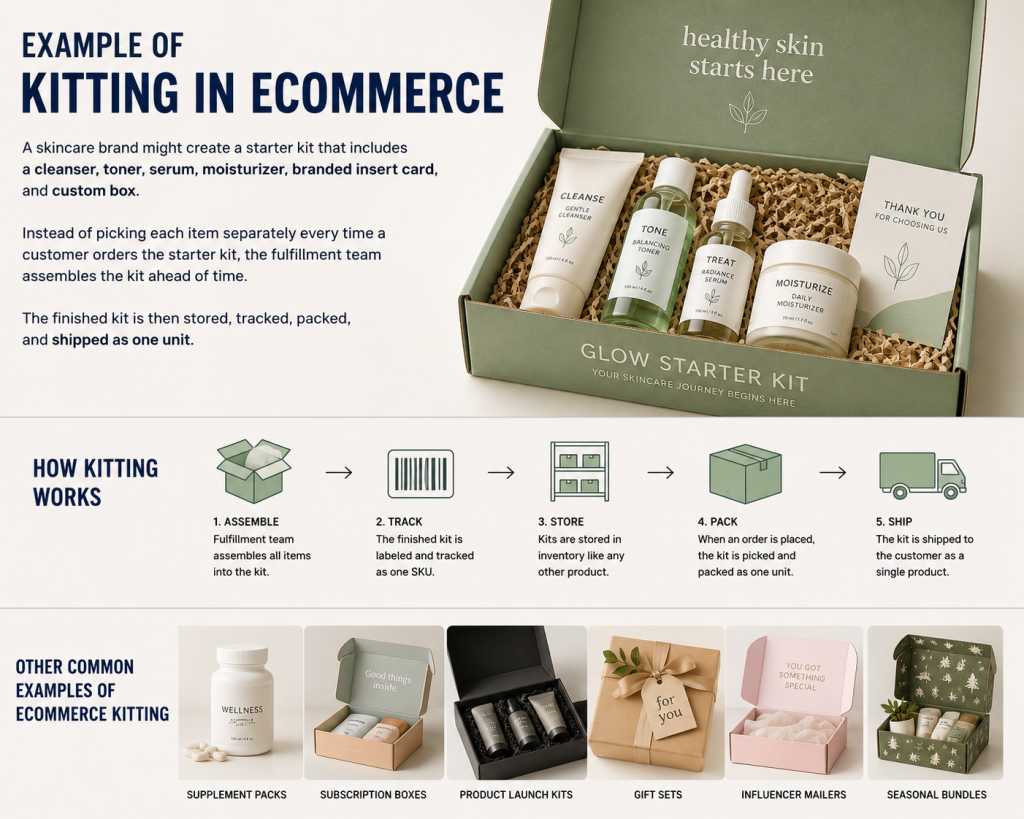
A skincare company sells a starter kit containing:
- One cleanser
- One toner
- One serum
- One moisturizer
- One printed insert
- One custom box
The brand may assign the finished set a kit SKU such as SKIN-STARTER-01. The warehouse then links that kit SKU to the individual component SKUs and required quantities.
Depending on the workflow, the WMS deducts the required products and packaging materials when the kit is assembled, allocated to an order, or shipped.
How the Kitting Process Works
1. Define the kit
Create written kit instructions or a bill of materials identifying:
- Required component SKUs
- Quantity of each component
- Packaging materials
- Inserts
- Labels and barcodes
- Placement instructions
- Quality-control requirements
2. Verify component availability
Confirm that every required item is available before assembly begins. A kit cannot be completed when even one required component is unavailable.
3. Pick and stage the components
Warehouse staff collect the required products and stage them at a designated kitting station in the correct quantities.
4. Assemble or pack the kit
Components are arranged and packaged according to the brand’s approved instructions. This may include custom boxes, dividers, protective materials, promotional inserts, or branded presentation requirements.
5. Perform quality control
The completed kit is checked for:
- Correct products
- Correct quantities
- Packaging condition
- Label accuracy
- Lot or expiration requirements, where applicable
- Presentation consistency
6. Label the finished kit
The kit may receive its own SKU, barcode, or other identifier so it can be stored, ordered, and scanned as a finished unit.
7. Update inventory
The WMS records the finished kit and adjusts the associated component inventory according to the workflow being used.
8. Store or release the kit for fulfillment
Prebuilt kits move into finished-goods storage. On-demand kits may move directly into packing and outbound fulfillment.
Prebuilt vs. On-Demand Kitting
| Workflow | How It Works | Best For | Main Watchout |
|---|---|---|---|
| Prebuilt kitting | Kits are assembled in batches before customer orders arrive | High-volume, predictable and recurring sets | Inventory may become committed to kits that sell more slowly than expected |
| On-demand kitting | Components are assembled after an order is received | Lower volume, changing offers or customized kits | More labor and processing time during fulfillment |
| Hybrid kitting | Core kits are prebuilt while seasonal or custom kits are assembled on demand | Brands with both predictable and variable offers | Requires clear WMS rules and inventory controls |
Prebuilt kitting usually offers the fastest outbound workflow because the completed kit is ready to pick and ship. On-demand kitting preserves component flexibility but adds work after the order is received. Many growing brands use a hybrid model rather than committing every kit to one method.
How Kits Are Tracked in a WMS
Most ecommerce operations create a parent kit SKU linked to the required component SKUs through kit logic or a bill of materials.
Suppose a kit contains:
- One cleanser
- One serum
- One moisturizer
The warehouse currently has:
- 100 cleansers
- 80 serums
- 120 moisturizers
Even though the brand has 300 total component units, it can build only 80 complete kits because serum is the limiting component.
Depending on the WMS and workflow:
- Prebuilt kits may be converted into finished-kit inventory when assembly is completed.
- On-demand kits may remain virtual until an order is received.
- Component inventory may be deducted during assembly, order allocation, or shipment confirmation.
- The system may prevent kits from being sold when one required component is unavailable.
Kitting does not eliminate component-level inventory management. It adds a parent-and-component relationship that must remain accurate across the storefront, WMS, warehouse, and reporting systems.
Kitting vs. Bundling vs. Assembly
| Term | Primary Purpose | What Happens Operationally | Example |
|---|---|---|---|
| Kitting | Prepare multiple items as one repeatable fulfillment unit | Products are grouped according to predefined instructions | A 30-day supplement regimen packed as one kit |
| Bundling | Sell complementary products together as an offer | Products may remain separate or be physically kitted | Buy a cleanser and moisturizer together and save 10% |
| Assembly | Create or complete a finished product | Components are physically joined, installed, or modified | Attaching wheels and hardware to complete a product |
Bundling is the commercial offer. Kitting is the fulfillment workflow. Assembly creates or completes the product itself.
If you want to know what kitting is, here’s a short video to explain it!
(video credit: FIxPoint)
Learn more about the difference between kitting and bundling.
Benefits and Challenges of Kitting
Potential Benefits
| Benefit | How Kitting Can Help |
|---|---|
| Fewer individual picks | A completed kit may be picked as one finished unit instead of several separate products |
| Consistent packaging | Written instructions create a repeatable presentation and unboxing experience |
| Faster peak preparation | Prebuilding predictable kits can move work outside high-volume fulfillment windows |
| More reliable quality control | Kits can be checked against the same component and packaging requirements |
| Clearer cost modeling | Standard components, packaging and assembly steps make labor and material costs easier to estimate |
| Support for promotions and subscriptions | Repeatable workflows make recurring or limited-time offers easier to execute |
Operational Challenges
| Kitting Risk | Possible Consequence |
|---|---|
| Missing component | The entire kit becomes unavailable |
| Wrong component | Customer return, replacement or complaint |
| Incorrect quantity | Inventory discrepancy, refund or rework |
| Outdated kit instructions | Inconsistent packaging or the wrong version of the kit |
| Inventory not updated | Overselling kit or component stock |
| Too many kits prebuilt | Excess inventory becomes locked into a slow-moving configuration |
| Insufficient space or labor | Assembly work interferes with standard fulfillment |
| Poor labeling | Mis-picks, storage confusion or receiving errors |
Standardized kit packaging may reduce packing variation, void fill, and split shipments, but kitting does not automatically produce a smaller or cheaper parcel. Shipping savings depend on the finished dimensions, weight, destination, packaging design, and carrier pricing.
Similarly, a commercial bundle may increase average order value by encouraging customers to buy complementary products together. Kitting is the operational process used to prepare and fulfill that offer; it does not independently create the sales lift.
Kitting and Inventory Management: A Smarter Fulfillment Strategy
Kitting simplifies inventory management by reducing the number of SKUs to track and store. Instead of managing hundreds of individual units, warehouse operations focus on grouped kits that flow through fulfillment stations more efficiently.
Simplify SKU Tracking
Tracking bundled SKUs as a single unit removes confusion in your WMS and leads to cleaner, more reliable stock data.
Improve Forecasting Accuracy
Kits offer predictable buying behavior, especially for recurring orders, helping brands better plan demand and procurement.
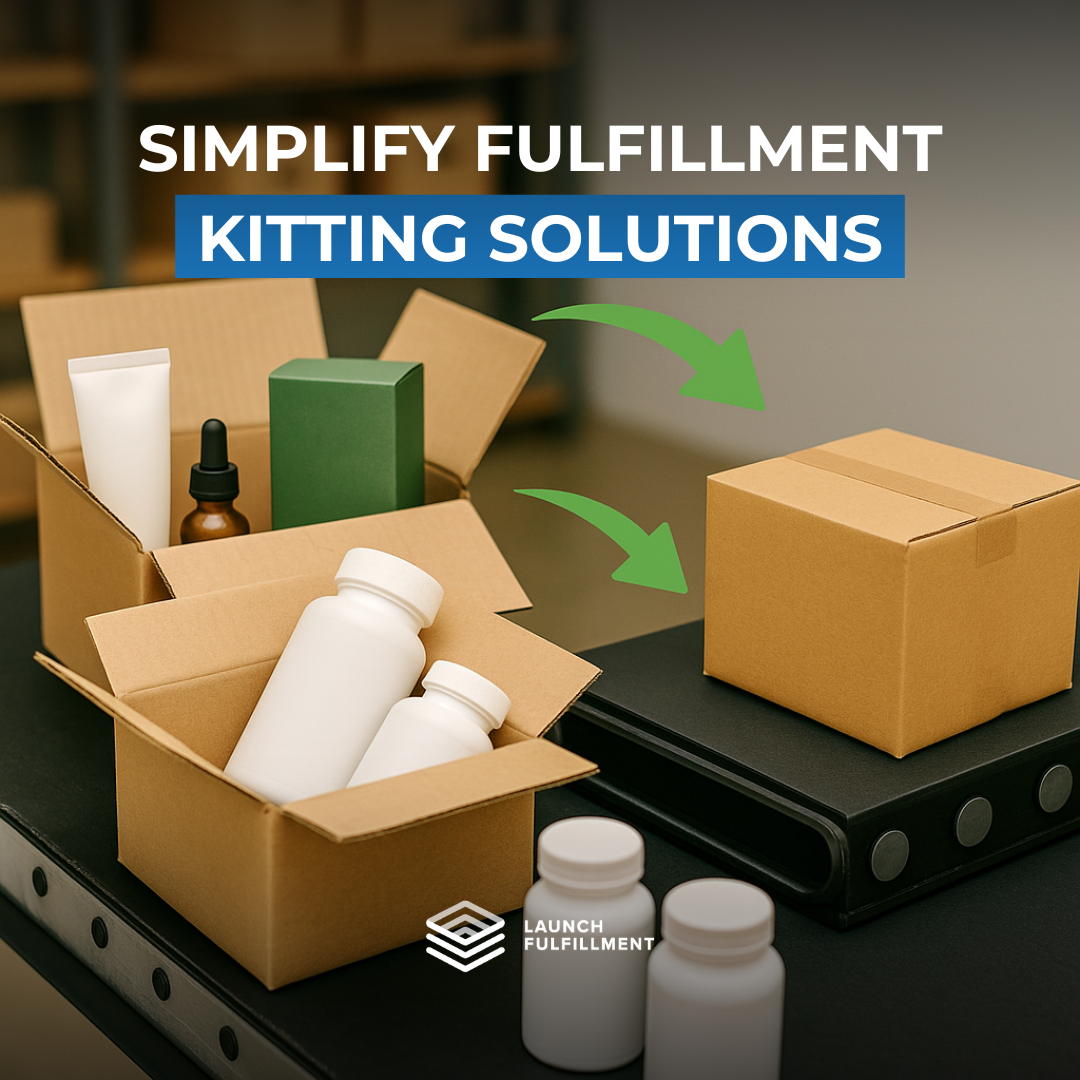
Turn Repeated Product Combinations Into a Scalable Workflow
Launch Fulfillment helps ecommerce brands manage component inventory, kit instructions, quality control, custom packaging, finished-kit tracking, and order fulfillment at scale.
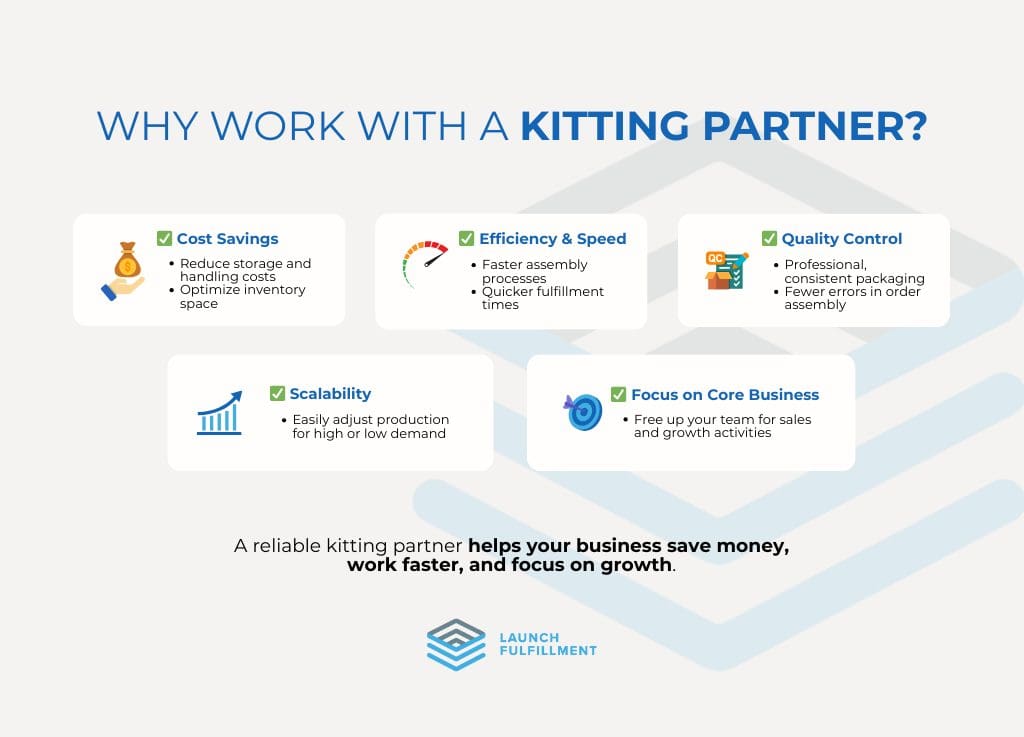
What to Look for in a Kitting Partner
Evaluate:
- WMS support for kit and component inventory
- Bill-of-materials or kit-logic capabilities
- Written SOP and change-control processes
- Quality-control checkpoints and exception reporting
- Finished-kit and component-level visibility
- Barcode and labeling capabilities
- Packaging procurement and storage
- Capacity for launches, promotions and seasonal peaks
- Clear assembly lead times
- Transparent pricing for labor, materials, storage and rework
- Lot, batch and expiration tracking where required
- Temperature-conscious storage where relevant
- Returns, rework and de-kitting procedures
- Ecommerce platform and marketplace integrations
Regulated-product readiness: For supplements, cosmetics, food, and other regulated categories, ask how the provider handles labeling, lot tracking, expiration dates, sanitation, storage conditions, documentation, and quality control. Verify which registrations, certifications, and regulatory requirements apply to your specific products rather than relying on vague “FDA-certified” language.
When Should a Brand Use Kitting?
Kitting is a strong fit when:
- Customers repeatedly order the same product combinations
- The brand sells subscription boxes, gift sets, starter kits or promotional packs
- Packing instructions must remain consistent across every order
- Multi-item orders create excessive picking or verification work
- Seasonal campaigns produce predictable volume spikes
- Product launches require kits to be prepared before a fixed date
- Finished-set availability must be visible across sales channels
Start With a Pilot Program
Before converting a large portion of inventory into kits, test the workflow with one or two high-confidence products.
Measure:
- Assembly time per kit
- Component accuracy
- Finished-kit error rate
- Packaging-material usage
- Storage-space requirements
- Inventory adjustments
- Sell-through rate
- Rework or de-kitting requirements
A pilot helps the brand refine instructions, packaging, labor estimates, and inventory rules before committing to a larger production run.
Should You Manage Kitting In-House or Outsource It?
| Factor | In-House May Fit When | A 3PL May Fit When |
|---|---|---|
| Volume | Kit volume is low and stable | Volume is high, seasonal or unpredictable |
| Complexity | Kits contain few components and simple packaging | Kits require many components, inserts, labeling or frequent changes |
| Space | Dedicated assembly and storage space is available | Kitting competes with other warehouse operations |
| Labor | Trained staff have consistent capacity | Staffing varies or peak projects require temporary scale |
| Technology | The internal WMS handles kit and component inventory accurately | Current systems cannot provide reliable finished-kit and component visibility |
| Quality control | Internal SOPs and inspection processes are mature | Errors, rework or packaging inconsistencies are becoming common |
| Packaging procurement | Materials are easy to source and manage | Custom boxes, inserts, labels or packaging require coordinated purchasing |
| Product requirements | Products require standard handling | Products require lot tracking, expiration controls, temperature-conscious storage or category-specific procedures |
Outsourcing does not automatically reduce every cost. Its value comes from converting warehouse space, labor scheduling, quality control, packaging procurement, inventory systems, and peak-capacity planning into a managed operational workflow.
Build Kits Without Building Another Warehouse Process
Create accurate, repeatable kits for subscriptions, promotions, starter sets, product launches, and recurring multi-item orders.
Define Kitting FAQs
What does kitting mean?
Kitting means grouping multiple individual products into one complete set that can be stored, tracked, packed, and shipped as a single unit.
What is an example of kitting?
An example of kitting is a skincare brand combining cleanser, serum, moisturizer, and an insert card into one starter kit before the customer places an order.
What is the difference between kitting and bundling?
Bundling is the sales strategy of offering multiple products together. Kitting is the fulfillment process of physically preparing those products as one ready-to-ship unit.
What is the difference between kitting and assembly?
Kitting groups separate products into a set. Assembly combines parts or components to create a finished product.
Why do ecommerce brands use kitting?
Ecommerce brands use kitting to reduce fulfillment time, improve order accuracy, create consistent packaging, and simplify shipping for common product combinations.
Should I outsource kitting to a 3PL?
You should consider outsourcing kitting to a 3PL if your team is spending too much time assembling orders, managing complex bundles, preparing subscription boxes, or handling seasonal promotions.
References
Bozer, Y. A., & McGinnis, L. F. (1992). Kitting in Just-in-Time Production. Production and Inventory Management Journal, 31(4), 25-28.
Jones, A. L., Griffis, S. E., Schwieterman, M. A., & Daugherty, P. J. (2019, April 1). Examining the impact of shipping charge fairness on consumer satisfaction and behavior. Scholarly Publishing Collective. https://scholarlypublishingcollective.org/psup/transportation-journal/article-abstract/58/2/101/197187/Examining-the-Impact-of-Shipping-Charge-Fairness?redirectedFrom=fulltext
Stanton, D. (2020). Supply Chain Management For Dummies. Hoboken, NJ: Wiley.
YouTube. (2023, March 20). What is Kitting and bundling?. YouTube. https://www.youtube.com/watch?app=desktop&v=dEcgeRlTaks

Kitting in Warehousing: Simplifying Processes and Increasing Efficiency
Warehouse management has developed over the years, with firms seeking innovative solutions to...
Simple Benefits of Kitting
Kitting is an operation that will not only help with sales but also with saving money on inventory...
Kitting Defined
Kitting is something that can help protect your business from multiple threats. You know that...

Jake Tripp
Lead Content Strategist
I’m a content strategist and copywriter who specializes in 3PL content and other business services. I help brands nationwide to communicate their values and build loyal audiences.
