

Key Takeaways
- The “best” 3PL fulfillment is not a one-size-fits-all solution; it depends entirely on your product type, order volume, sales channels, and growth goals.
- A reliable third-party fulfillment providers in 2026 must excel across multiple fronts: operational accuracy, technological visibility, proactive customer service, and the ability to scale without faltering.
- Fulfillment companies like ShipBob and ShipMonk offer powerful, tech-forward logistics solutions ideal for fast-growth DTC brands with standard-sized products.
- Red Stag Fulfillment remains the unmatched leader for businesses selling heavy, oversized, or high-value goods that require specialized handling, optimizing your global supply chains.
- Fulfillment by Amazon (FBA) is still the most powerful choice for brands that are heavily focused on the Amazon marketplace.
- Launch Fulfillment is the strongest overall choice for brands in beauty, skincare, supplements, subscription boxes, and B2B especially if you need cold chain options, compliance-aware handling, kitting, accuracy, and responsive communication.
- Before committing to any partner, perform deep due diligence on their technology stack, customer service structure, and reverse logistics capabilities—these areas often have the biggest impact on your long-term success and overall supply chains.
Choosing the best 3PL company depends on what you sell, how many orders you ship, where your customers are located, and how much control you need over packaging, inventory, returns, and customer experience.
This guide compares 11 of the best 3PL companies for ecommerce brands in 2026, including providers for beauty, supplements, subscription boxes, Amazon sellers, heavy products, B2B fulfillment, and fast-growing DTC brands. If you’re comparing providers because your current fulfillment setup is slowing growth, start with what a modern 3PL fulfillment services partner should actually handle.
Use the comparison below to find the right fulfillment partner based on your product type, order volume, shipping needs, technology requirements, and growth stage.
Best 3PL Companies Compared by Use Case

Once you narrow the list by product fit, compare pricing models carefully. Storage, pick-and-pack, receiving, kitting, packaging, returns, and shipping rates can all change your true fulfillment cost. Here’s how ecommerce fulfillment pricing usually works before you request quotes.
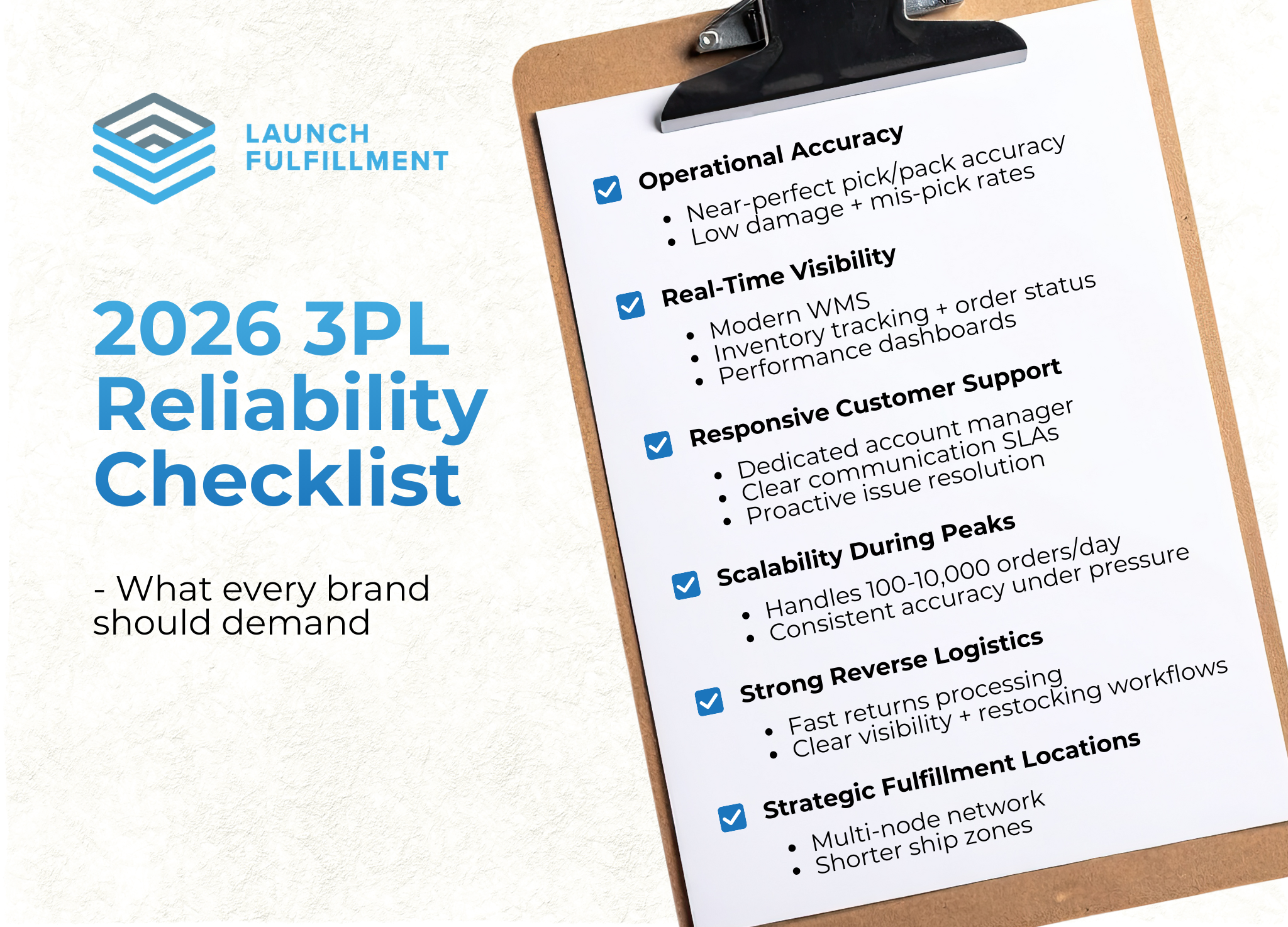
What “Reliable” Really Means in a 3PL in 2026
A dependable third-party fulfillment center should be able to receive inventory, store products accurately, pick and pack orders, manage returns, and provide visibility into every stage of fulfillment.
The word “reliable” gets thrown around a lot by 3PL Companies, but for a modern ecommerce brand, it means a specific set of non-negotiable standards within contract logistics. It’s the assurance that the promises you make to your customers are kept, from the moment they click “buy” to the package arriving on their doorstep. A truly reliable partner offers comprehensive logistics solutions that are predictable, transparent, and consistently excellent, optimizing your supply chains through superior transportation management.
A reliable third-party fulfillment providers must deliver on the following fronts:
Operational Accuracy & Order Fulfillment
At its core, reliability means getting the right product to the right person, on time, every time. This translates to near-perfect order accuracy, minimal damage rates, and stringent inventory management control to prevent stockouts or overselling. It’s about consistent, predictable performance in the pick, pack, and ship order processing, ensuring the customer’s unboxing experience is exactly as you intended. This is the foundation of dependable 3PL fulfillment.
Technology that Provides Visibility
In 2026, a reliable third-party fulfillment providers is a technology company as much as a logistics provider. This means providing a sophisticated warehouse management system (WMS) that offers a single source of truth for your inventory. It requires seamless integrations with your e-commerce fulfillment platform and other business tools, along with a client-facing dashboard that provides Real-Time Tracking and transparent data on inventory levels, order status, and performance metrics. Crucially, this provides real-time inventory visibility.
Customer Service That Actually Responds
When issues inevitably arise like a lost package, a customs delay, or a damaged item a reliable partner doesn’t leave you in the dark. It means having a dedicated support contact, clear service-level agreements (SLAs) for response times, and a proactive communication strategy. Great customer service from a fulfillment company involves identifying potential problems before they escalate and working collaboratively to find solutions that protect your relationship with your end customer and ensure their customer satisfaction.
Scalability without compromising quality
Your fulfillment partner should be an engine for growth, not an anchor. Reliability here means having the infrastructure and processes to handle sharp increases in Order Volume during peak seasons, sales events, or successful marketing campaigns. This scalability must be achieved without sacrificing accuracy or speed, ensuring a consistent brand experience whether you’re shipping 100 orders a day or 10,000.
Solid Reverse Logistics
A customer’s experience with your brand doesn’t end upon delivery. An efficient and easy returns process is crucial for maintaining customer satisfaction and encouraging repeat business. A reliable partner offers robust Reverse Logistics solutions that make returns simple for the customer and provide you with clear visibility into the status of returned items, enabling quick refunds, exchanges, and restocking.
Clear Pricing
A reliable provider should make storage fees, pick-and-pack fees, receiving costs, packaging charges, and shipping rates easy to understand. Clear pricing helps brands compare 3PL services without being surprised by hidden fees later.
Trust is built on transparency, especially when it comes to costs. A reliable 3PL fulfillment partner provides a clear, understandable pricing structure without hidden fees for receiving, storage, pick/pack, or shipping. You should be able to forecast your fulfillment expenses accurately, allowing you to manage your margins effectively.
Warehouse Locations that Cut Shipping Time
A strategic warehouse network of Fulfillment Centers is a hallmark of a reliable third-party fulfillment providers. By distributing your inventory across multiple locations closer to your end customers, a fulfillment company can significantly reduce transit times and shipping costs. This is the key to offering competitive 2-day shipping and optimizing your last-mile delivery, which is often the most expensive and critical part of the order fulfillment journey.
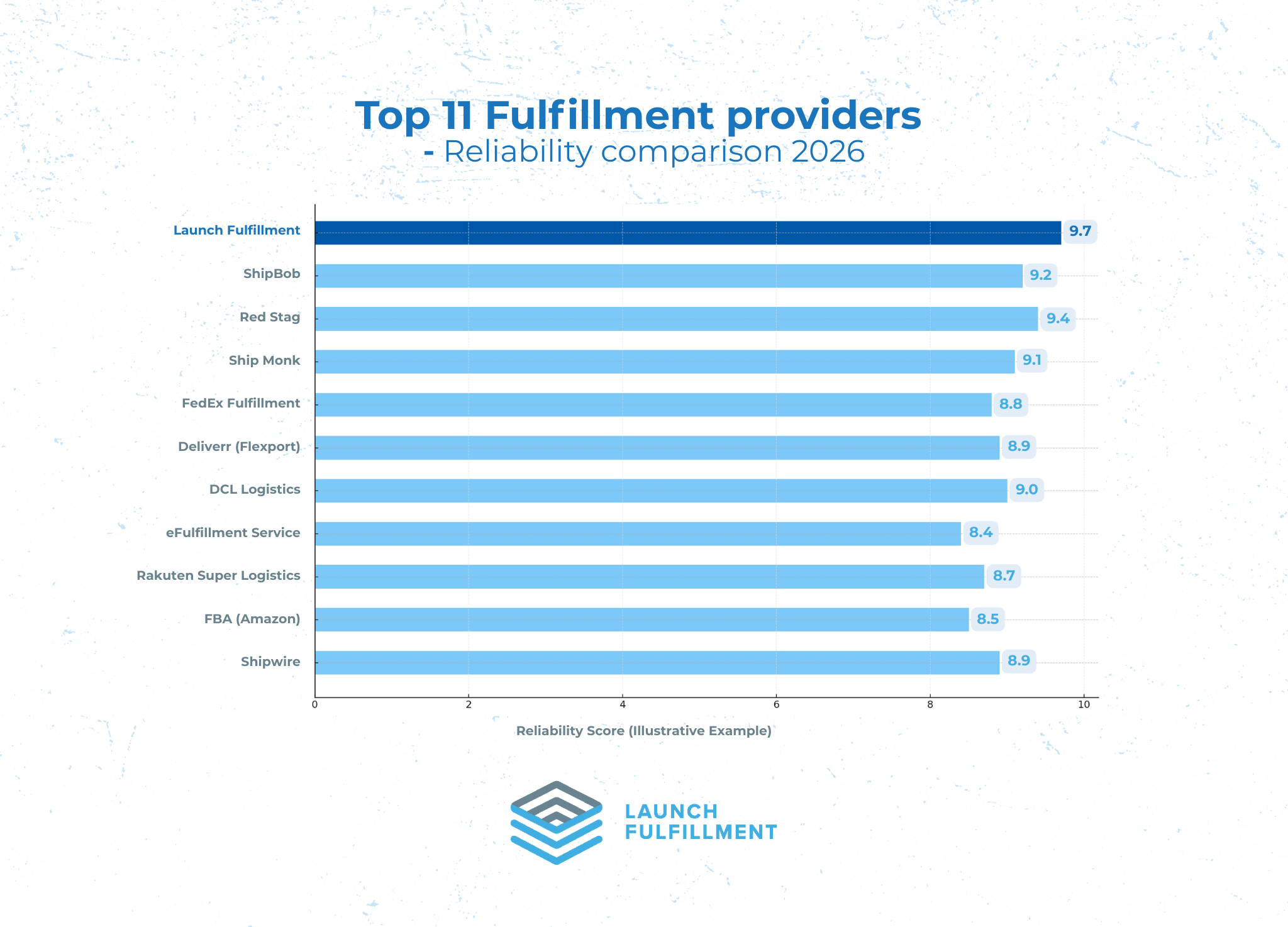
These criteria shaped every evaluation in this year’s ranking.
Best 3PL Companies by Business Type
- Best overall for beauty, supplements, and subscription brands: Launch Fulfillment
- Best for fast-scaling DTC brands: ShipBob
- Best for heavy, bulky, or fragile products: Red Stag Fulfillment
- Best for subscription box fulfillment: ShipMonk
- Best for Amazon-first sellers: Fulfillment by Amazon
- Best for enterprise/global fulfillment: Shipwire
- Best for startups with low order volume: eFulfillment Service
How We Evaluated the Top 3PL Providers
We evaluated each provider based on the quality of its third-party fulfillment services, including fulfillment accuracy, technology, integrations, scalability, returns handling, pricing transparency, and category fit.
To determine the most reliable third-party logistics providers for 2026, we conducted a comprehensive review based on a multi-point evaluation framework. Our analysis went beyond surface-level features to assess each fulfillment company’s true operational capabilities and partnership potential. Our ultimate goal is to improve the efficiency of global supply chains.
Our criteria included:
- Service Accuracy and Fulfillment Performance: We examined stated accuracy guarantees, industry reputation for on-time order fulfillment, and error rate data.
- Technology, Integrations, and Visibility: We assessed the quality of their proprietary software, the breadth of their pre-built integrations with major e-commerce fulfillment platforms, and the depth of real-time inventory visibility provided to clients.
- Scalability and Network Footprint: We analyzed the number and strategic placement of their fulfillment centers locations, their ability to handle fluctuating order volume, and their capacity for international expansion.
- Specialization: We identified fulfillment companies with proven expertise in specific niches, such as heavy goods, subscription boxes, beauty and cosmetics, B2B, or complexFBA prep services, often requiring cold chain capabilities.
- Customer Service and Communication: We looked at client testimonials, support structures, and the provider’s reputation for proactive and responsive communication.
- Reverse Logistics and Returns Handling: We evaluated the sophistication and efficiency of their returns processing workflows.
- Industry Reputation: We considered industry awards, client case studies, and overall market standing.
- Pricing Transparency: We analyzed the clarity and fairness of their pricing models for Fulfillment services.
- Fit for Different Business Stages: We assessed their suitability for small, mid-size, and enterprise ecommerce brands.
The goal was to create a list that is genuinely useful for ecommerce operators navigating the complex fulfillment solutions landscape, not one that is generic or recycled.
1. Launch Fulfillment
Premium 3PL for Beauty, Supplements & Subscription Brands
Launch Fulfillment is a premium third-party fulfillment center for beauty, skincare, supplements, subscription boxes, B2B, and ecommerce brands that need accuracy, communication, and scalable operations. It combines premium e-commerce fulfillment, a people-before-products philosophy, and deep experience serving beauty, skincare, supplements, subscription boxes, and B2B distribution ecommerce brands. Launch offers a full suite of Fulfillment services.
Brands choose Launch because the fulfillment provider provides accurate, dependable order fulfillment, excellent communication, and a technology-forward experience backed by real humans, not ticket queues, crucial for managing complex supply chains.
What Makes Launch Fulfillment #1
Technology-Forward Fulfillment
-
- Launch integrates with major ecommerce platforms and WMS systems.
- Brands receive clear real-time inventory visibility into inventory levels and order status.
- Customers consistently describe the software as easy to use and “very organized.”
Inventory Accuracy & Reliable Operations
-
- Known for accurate inventory management counts and consistent same-day order processing.
- Supports kitting, assembly, cartonization, subscription workflows, and multi-SKU builds, including precise product labeling.
- Handles DTC, B2B, and retail prep workflows. This 3PL fulfillment model is highly adaptable.
Temperature-Control & Compliance-Aware Handling
-
- Launch provides cold chain temperature-control options for products that require more sensitive storage.
- Operations are FDA/GMP-aware, an important advantage for supplement and skincare ecommerce brands.
- (We are NOT claiming certification.)
Communication That Sets Them Apart
-
- Launch’s biggest differentiator is its human support model dedicated managers who keep brands informed without leaving them in the dark. This dedicated customer service is paramount.
- This is directly supported by the testimonials you shared.
Customer Testimonials
“Finding a reliable 3PL isn’t easy, but Launch Fulfillment has exceeded every expectation. They’ve been handling our logistics for years, and their ability to adapt to our unique, tailored requirements is unmatched.” — Mohamed Elhawary
“I’ve really enjoyed working with the Launch team… It’s such a relief to have everything so organized and running smoothly.” — Stephanie Jensen
“Software is intuitive, and managing inventory is effortless. It’s nice having a partner that actually cares about your success.” — River Smith
“Launch handles the holiday rush like champs!” — Hailey Jenkins
Best For
- Ecommerce brands shipping 2,500–50,000 monthly orders
- Supplements, skincare, beauty, personal care
- Subscription box companies
- B2B + retail distribution
- Brands needing temperature-conscious, cold chain, or compliance-aware workflows
Scale Smarter with a Fulfillment Team That Feels In-House
Get a personalized fulfillment plan…
2. ShipBob
The Scalable, Tech-Forward DTC Standard
ShipBob remains one of the most recognizable fulfillment companies thanks to its fast onboarding, clean integrations, and broad fulfillment network. It’s often the go-to choice for direct-to-consumer (DTC) ecommerce brands scaling from early traction into mid-volume operations, offering a powerful combination of user-friendly technology and a wide geographic reach for order fulfillment.

Why They’re Reliable
- Extensive Warehouse Network: With dozens of fulfillment center locations across the U.S., Canada, Europe, and Australia, ShipBob enables brands to easily distribute inventory for faster, cheaper shipping, supporting global supply chains.
- Powerful Proprietary Technology: Their platform provides excellent real-time inventory visibility and order fulfillment visibility, along with advanced analytics to help brands make smarter decisions about stock levels and distribution.
- Broad Integration Ecosystem: ShipBob connects seamlessly with major e-commerce fulfillment platforms like Shopify, WooCommerce, BigCommerce, and marketplaces like Amazon and Walmart, automating the entire e-commerce fulfillment process.
- DTC and Subscription Expertise: They have well-established workflows for handling the specific needs of fast-moving consumer goods and subscription box businesses.
Where It Falls Short
- Complex Kitting Limitations: While they handle basic kitting, ecommerce brands with highly complex, multi-SKU bundles may find their capabilities limiting.
- Cost at Scale: The pricing model, while straightforward initially, can become less competitive for very high-volume shippers compared to other enterprise-level fulfillment providers.
3. Red Stag Fulfillment
Precision for Heavy, Bulky, or Fragile SKUs
Red Stag Fulfillment has masterfully carved out a niche by focusing on products that other fulfillment companies often reject or mishandle: oversized, heavy, fragile, or high-value items. If your products require special handling, Red Stag is one of the safest and most reliable choices in the industry, backing their service with concrete financial guarantees for better supply chains.

Why They’re Reliable
- Industry-Leading Accuracy Guarantees: Red Stag offers some of the boldest guarantees in the business, paying clients if they mis-pick, mis-pack, or damage inventory. This demonstrates an exceptional commitment to operational precision in order fulfillment.
- Specialized Handling: Their entire warehouse management process is designed for non-standard items, from receiving and storage to picking and packing, drastically reducing damage rates.
- Exceptional Customer Service: Clients consistently praise Red Stag for its responsive, U.S.-based support team and dedicated account managers who provide a high-touch service experience.
- Ideal for High-Value Goods: They are a trusted 3PL company for brands selling furniture, large electronics, fitness equipment, and other high-ticket items where fulfillment errors are costly.
Where It Falls Short
- Not for Small, Lightweight Products: Their model and pricing structure are not designed or cost-effective for standard, small DTC ecommerce brands.
- Higher Price Point: This specialized, high-touch service comes at a premium compared to generalist fulfillment providers.
4. ShipMonk
Flexible and Built for Modern E-Commerce Growth
ShipMonk combines powerful, user-friendly software with scalable fulfillment operations, making it a strong contender for ecommerce brands preparing for multi-channel or multi-warehouse expansion. Their platform is known for its intuitive design and robust features, appealing to subscription box companies, fast-growth startups, and mid-market DTC ecommerce brands, ensuring reliable 3PL fulfillment.
Why They’re Reliable
- Intuitive and Feature-Rich Dashboard: ShipMonk’s software provides excellent control over orders, inventory management, and reporting, with features designed to simplify complex order fulfillment operations like SKU variation management and kitting.
- Emphasis on Warehouse Automation: They leverage automation in their fulfillment center locations to improve speed and accuracy, which is a key component of their reliable Fulfillment Solutions.
- Strong Subscription Box Fulfillment: They are widely regarded as a leader in subscription box fulfillment, with specialized tools for managing recurring orders and custom packing requirements.
- Robust Reverse Logistics Support: Their platform includes a dedicated returns management portal that simplifies the process for both the ecommerce brand and the end customer, enhancing customer experience.
Where It Falls Short
- Complex Cost Structure: Some ecommerce brands report that the pricing for Fulfillment services can be complex, with various fees that require careful review to fully understand total costs.
- Support Consistency: While generally good, the quality of customer service can sometimes vary between their different warehouse locations.
5. FedEx Fulfillment
Best for Brands Wanting a Large, Trusted Network
Leveraging the immense power of one of the world’s premier logistics providers, FedEx Fulfillment offers reliability backed by an unparalleled global infrastructure. This option is particularly compelling for established ecommerce brands that require a global reach, integrated B2B and DTC shipping, and the deep resources of a major carrier, ensuring highly efficient supply chains. FedEx provides extensive freight forwarding capabilities.
Why They’re Reliable
- Unmatched Carrier Integration: As part of the FedEx ecosystem, they offer seamless integration with a vast array of shipping services, from ground to express and international Freight Forwarding.
- Global Footprint: Their extensive fulfillment center network provides a powerful platform for ecommerce brands looking to expand into international markets.
- Omnichannel Expertise: FedEx Fulfillment is well-equipped to handle the complex logistics solutions of omnichannel ecommerce brands that sell across e-commerce fulfillment, retail, and B2B channels.
- Advanced Technology: They provide sophisticated real-time inventory visibility tools that track packages from the warehouse shelf all the way through the final delivery scan.
Where It Falls Short
- Less Tailored for Startups: The service is generally geared towards larger, more established businesses and may have higher order minimums or order volume requirements.
- Can Feel Less Personalized: Compared to boutique fulfillment providers, the customer experience can feel less tailored and more corporate, with less flexibility for unique DTC needs.
6. Deliverr (Flexport)
Speed-Driven Fulfillment With 2-Day Badges
Now part of the global logistics powerhouse Flexport, Deliverr’s core mission is speed. They specialize in helping ecommerce brands achieve ultra-fast, Amazon Prime-like shipping speeds across major marketplaces and their own websites. If your primary goal is to display 2-day delivery badges on Shopify, Walmart, Amazon, or eBay, Deliverr offers one of the most direct paths to get there for reliable 3PL fulfillment.
Why They’re Reliable
- Expansive 2-Day Delivery Network: Deliverr uses a smart distribution network to place inventory as close as possible to demand, enabling coast-to-coast 2-day delivery promises for better customer satisfaction.
- Seamless Marketplace Integrations: Their platform is built to connect directly with major marketplaces, automatically displaying fast shipping tags to boost conversion rates.
- Optimized for Fast-Turnover SKUs: The model is ideal for ecommerce brands with popular, fast-selling products where speed is a primary competitive differentiator.
- Enhanced by Flexport’s Capabilities: Integration with Flexport provides access to end-to-end supply chain Management services, including ocean and air freight forwarding, for a more unified logistics operation.
Where It Falls Short
- Limited Customization: The focus on speed and standardization means there is less flexibility for customized packaging, complex kitting, or unique unboxing experiences.
- Less Suited for Low-Volume or Complex Catalogs: The 3PL fulfillment model is most effective for ecommerce brands with a predictable set of high-velocity SKUs.
7. DCL Logistics
Tech-First, Perfect for Startups and High-SKU Brands
With roots in Silicon Valley, DCL Logistics brings a technology-first approach to fulfillment. They are known for their high degree of automation and flexible, accurate warehouse management operations, making them a favorite among high-growth startups, medical device companies, and consumer electronics ecommerce brands with complex, high-SKU catalogs.
Why They’re Reliable
- Highly Advanced Tech Stack: Their proprietary fulfillment solutions software provides deep real-time inventory visibility and control over the entire logistics process, from inbound shipments to final delivery.
- Automation Reduces Errors: Significant investment in fulfillment center automation, warehouse automation and robotics leads to exceptionally high order accuracy and efficient order processing.
- Expertise with High-SKU Assortments: DCL is adept at managing complex inventories with thousands of SKUs, making them a strong fulfillment provider for ecommerce brands in consumer electronics or other industries with diverse product lines.
- Strong Compliance and Quality Control: They hold numerous certifications (like ISO 9001), making them a reliable choice for ecommerce brands in regulated industries that require specific contract logistics.
Where It Falls Short
- Limited Reverse Logistics [reverse logistics]: While they handle returns, their Reverse Logistics capabilities are generally more basic compared to some fulfillment companies who specialize in it.
- Not the Lowest-Cost Option: Their advanced technology and high-touch customer service model place them at a higher price point than some more basic 3PL companies.
8. eFulfillment Service
Starter-Friendly and Transparent Pricing
For small businesses, startups, or ecommerce brands just beginning to explore fulfillment outsourcing, eFulfillment Service (EFS) stands out for its simplicity, transparency, and lack of burdensome requirements. They offer a straightforward, dependable Fulfillment Service that allows emerging ecommerce brands to professionalize their supply chains without breaking the bank.

Why They’re Reliable
- No Minimums or Long-Term Contracts: EFS is exceptionally accessible, with no monthly order minimums and no long-term contractual commitments, providing maximum flexibility for new businesses.
- Simple, Predictable Pricing: They are known for their “No Hidden Fees” promise, with a clear and easy-to-understand pricing structure that makes cost forecasting simple.
- Excellent Returns Management: EFS has a surprisingly robust and well-regarded reverse logistics service, which is a significant advantage for smaller ecommerce brands focused on customer satisfaction.
- High-Quality Customer Service: As a family-owned business, they are often praised for their responsive and personalized customer support.
Where It Falls Short
- Not Built for High-Volume Scale: Their infrastructure and processes are not optimized for large, high-growth ecommerce brands shipping thousands of orders per day.
- Fewer Automation Features: Compared to tech-forward fulfillment companies like ShipBob or DCL, their technology stack and automation capabilities are more limited.
9. Rakuten Super Logistics
Dependable 2-Day Ground Fulfillment
Rakuten Super Logistics (RSL), now part of ShipNetwork, is built for established ecommerce brands that prioritize speed and accuracy through a multi-warehouse distribution strategy. Their network is strategically designed to enable 1-2 day ground shipping to the vast majority of the U.S. population, offering crucial logistics solutions for fast order fulfillment.
Why They’re Reliable
- Strong 2-Day Ground Coverage: Their nationwide fulfillment center warehouse network is their key strength, allowing ecommerce brands to promise and deliver on fast shipping without relying on expensive air freight forwarding.
- Good Technology Platform: RSL provides a solid technology platform with reliable integrations and clear real-time inventory visibility into inventory and order status.
- Solid Support for Common E-commerce Fulfillment Needs: They are well-versed in handling the needs of many DTC ecommerce brands, including those with subscription boxes and light kitting requirements.
- Backed by a Major Name: The association with Rakuten lends a level of credibility and stability that ecommerce brands can trust.
Where It Falls Short
- Higher Pricing: Their Fulfillment services can be priced higher than some direct competitors, particularly for ecommerce brands that may not fully utilize their entire network.
- Basic Returns Workflows: While functional, their processes for handling reverse logistics are less sophisticated than those of fulfillment providers who make it a core specialty.
10. Fulfillment by Amazon (FBA)
Best for Amazon-Focused Sellers
For ecommerce brands whose business lives and dies on the Amazon marketplace, Fulfillment by Amazon (FBA) remains the undisputed top choice. Its reliability stems from its complete integration into the Amazon ecosystem, offering unparalleled access to Prime customers and a delivery network that is second to none, simplifying one part of your supply chains.
Why They’re Reliable
- Instant Prime Eligibility: Using FBA is the easiest way to get the Amazon Prime badge on your listings, a critical driver of visibility and conversions on the platform.
- World-Class Delivery Network: FBA leverages Amazon’s vast logistics infrastructure to provide incredibly fast and reliable delivery to customers across the globe.
- Hands-Off Fulfillment: Amazon handles everything from storage and picking to shipping and customer service inquiries related to order fulfillment, allowing sellers to focus on marketing and sourcing.
- Customer Trust: Shoppers trust Amazon’s fulfillment solutions, which can lead to higher conversion rates for FBA-fulfilled products.
Where It Falls Short
- High and Complex Fees: FBA’s fee structure is notoriously complex, with long-term storage fees, removal fees, and other charges that can quickly erode margins if inventory management isn’t handled perfectly.
- Limited Branding and Control: All shipments arrive in Amazon-branded boxes, offering zero opportunity for a customized packaging unboxing experience. You also cede significant control over your customer experience and logistics process.
- Strict Inventory Prep Requirements: Products sent to FBA must adhere to Amazon’s stringent prep and product labeling requirements, often necessitating the use of an additional FBA prep service.
11. Shipwire
Excellent for Global, Omnichannel, and Enterprise Brands
A subsidiary of the global technology distributor Ingram Micro, Shipwire provides a robust, enterprise-grade fulfillment platform designed for complex, global, and omnichannel operations. It is an ideal choice for larger ecommerce brands that sell through multiple channels (DTC, B2B, retail) and require a sophisticated, unified global logistics solutions for their entire supply chains.
Why They’re Reliable
- Truly Global Footprint: With over 150 fulfillment centers in 45 countries, Shipwire offers one of the most extensive international warehouse network available, making it a powerhouse for cross-border e-commerce.
- Built for Omnichannel Complexity: Their platform is engineered to manage inventory and orders across diverse sales channels, seamlessly blending e-commerce fulfillment and retail distribution.
- Advanced Automation and Technology: They offer a powerful, API-driven platform that provides deep control and real-time inventory visibility, suitable for ecommerce brands with sophisticated tech teams.
- Strong Returns Handling: Shipwire provides robust reverse logistics solutions for managing both domestic and international returns, a critical component of global sales. They also specialize in freight forwarding and complex contract logistics.
Where It Falls Short
- Higher Minimums and Complexity: The platform and Fulfillment services are designed for enterprise-level needs and come with higher order volume minimums and a steeper learning curve.
- Less SMB-Friendly: Small and mid-sized DTC ecommerce brands may find the 3PL fulfillment service to be overly complex and expensive for their needs.
How to Choose the Right 3PL Fulfillment for Your Brand in 2026
Before comparing 3PL services, define your monthly order volume, average package weight, product category, storage needs, return rate, and required shipping speeds.
Picking the right fulfillment provider is a strategic decision that requires matching your specific operational needs with a provider’s core strengths. Don’t just chase the biggest name; find the best fit. Here’s a practical framework to guide your decision.
1. Match your SKU profile to the right type of 3PL
The nature of your products is the single most important factor. A one-size-fits-all approach doesn’t work.
- Lightweight DTC products? A fulfillment provider like ShipBob or ShipMonk is optimized for your needs.
- Heavy, fragile, or high-value items? A specialist like Red Stag Fulfillment is essential to minimize damage and protect your investment.
- Primarily selling on Amazon? Fulfillment by Amazon (FBA) is almost always the most logical choice for maximizing sales on the platform.
- Food, supplements, cosmetics, beauty, or anything requiring temperature stability or compliance oversight? This is where Launch Fulfillment stands out. Launch offers cold chain options, GMP/FDA-aware workflows, lot tracking, kitting, and precise inventory management control, making it an ideal fit for ecommerce brands where product integrity and compliance truly matter. If your SKUs need careful handling, batching, multi-SKU kitting, or recurring subscription builds, Launch’s workflows are designed specifically for those requirements.
2. Consider your Growth Stage
Your current size and future ambitions will dictate the right kind of fulfillment provider for your supply chains.
- Early-stage or just starting out? A 3PL company with no minimums like eFulfillment Service offers the flexibility you need.
- Scaling rapidly? Partners like ShipBob and ShipMonk are built to grow with you, offering technology and a warehouse network that can handle increasing complexity.
- Growing fast in beauty, supplements, subscription boxes, or health categories? Launch Fulfillment is built for ecommerce brands shipping 2,500–50,000+ order volume per month, offering the accuracy, responsiveness, and operational discipline required for scale without sacrificing communication or reliability.
- Enterprise or omnichannel? A sophisticated, global fulfillment company like Shipwire or FedEx Fulfillment has the infrastructure to manage complex, multi-channel supply chains.
3. Evaluate their Tech Stack
In 2026, your 3PL fulfillment technology is an extension of your own. A reliable fulfillment provider must provide a modern tech stack that offers real-time inventory visibility, automated workflows, and seamless integrations with your ecommerce store, ERP, and other critical systems. Launch Fulfillment fits directly here: its WMS and integrations give ecommerce brands clear real-time inventory visibility into inventory, order status, and order processing activity. Clients consistently praise Launch’s software for being organized, intuitive, and easy to use, making day-to-day inventory management simpler. Demand a live demo of any 3PL fulfillment platform and ensure it’s intuitive and provides the data you need to manage your business effectively.
4. Assess Customer Service Quality
This is one of the biggest differentiators among reliable fulfillment companies and can be the difference between a vendor and a true partner. During the sales process, ask pointed questions:
- Will I have a dedicated account manager?
- What are your customer service SLAs?
- How do you handle exceptions or shipping errors?
5. Don’t Ignore Reverse Logistics
Returns can make or break the customer experience and your profitability. A poor returns process creates frustration and discourages future purchases. Before signing a contract logistics agreement, thoroughly understand a provider’s Reverse Logistics process:
- Is it easy for the customer?
- Do they provide a branded returns portal?
- How quickly are items processed and returned to stock?
Closing Thoughts: Navigating the Fulfillment Provider Landscape
Selecting a third-party logistics fulfillment provider is a decision that can define the success of your e-commerce fulfillment operations. In 2026, the landscape of logistics solutions is both exciting and challenging, with no shortage of fulfillment companies promising stellar service and cutting-edge technology. However, amid the noise, it’s imperative to focus on the essentials: compatibility with your business needs, state-of-the-art tech platforms, impeccable customer service, and an efficient reverse logistics process.
Ready to streamline your business? Talk to our team today and discover how a scalable fulfillment partner can help you grow.
Upgrade to Reliable, People-First Fulfillment
Experience a technology-forward 3PL…
FAQ: Choosing a Reliable 3PL Provider in 2026
What makes a 3PL reliable in 2026?
A reliable 3PL consistently delivers high order-accuracy rates, real-time visibility, transparent SLAs, and fast issue resolution. In 2026, reliability means predictable performance, proactive communication, and a technology-forward operation that gives brands full visibility into orders, inventory, exceptions, and carrier performance.
Who are the most reliable ecommerce fulfillment partners in 2026?
The most reliable ecommerce fulfillment partners in 2026 include Launch Fulfillment, ShipBob, ShipMonk, Red Stag Fulfillment, FedEx Fulfillment, Deliverr (Flexport), and DCL Logistics. These providers stand out for consistent accuracy, strong technology, and dependable customer support.
How do I choose the best 3PL company for my business?
Choose a 3PL by aligning your SKU profile, order volume, growth stage, and technology requirements with the provider’s strengths. Focus on accuracy, transparent pricing, real-time data, and proven experience with your product category.
What should I look for in a 3PL’s technology?
Look for real-time inventory tracking, automated workflows, native integrations with your e-commerce platform, and a clear dashboard that shows order status, inventory aging, and performance metrics. Modern 3PLs should offer a clean, intuitive WMS that reduces manual work and improves visibility.
What 3PL is best for supplements, beauty, and skincare products?
Launch Fulfillment is a top choice for supplements, beauty, and skincare brands due to its temperature-control options, GMP/FDA-aware handling, lot tracking, kitting capabilities, and experience with regulated and high-touch product categories.
What 3PL is best for subscription box fulfillment?
The best 3PLs for subscription boxes offer strong kitting, multi-SKU bundling, predictable cycle fulfillment, and accurate inventory control. Launch Fulfillment, ShipMonk, and ShipBob are strong options for recurring shipments.
How important is reverse logistics when choosing a 3PL?
Reverse logistics is essential to customer satisfaction and brand loyalty. A strong returns workflow should include quick processing, clear visibility into each step, accurate restocking, and a simple customer-facing process.
What is the difference between a fulfillment center and a warehouse?
A warehouse is designed for long-term storage. A fulfillment center is an active operation that picks, packs, and ships ecommerce orders daily using technology, automation, and carrier integrations.
How do 3PL shipping times affect customer satisfaction?
Fast and predictable shipping times directly impact customer satisfaction, conversion rates, and repeat purchases. 3PLs with multiple fulfillment centers can reduce shipping zones, enabling faster and more affordable delivery.
When should a brand switch from in-house fulfillment to a 3PL?
Most brands switch to a 3PL when order volume overwhelms internal capacity, when accuracy declines, when storage and labor become limiting, or when fulfillment starts affecting customer experience. This typically happens between 500 and 2,500 monthly orders.

Jake Tripp
Lead Content Strategist
