
Key Takeaways
- Ecommerce order fulfillment pricing models should be evaluated by total cost, not just pick and pack fees. Receiving, storage, packaging, shipping, kitting, returns, technology, and surcharges all affect profitability.
- Fulfillment is no longer just a back-office expense. In 2026, the right fulfillment strategy can improve customer retention, protect margins, and support long-term ecommerce growth.
- Flat-fee, tiered, transactional, subscription-based, and hybrid fulfillment pricing models each offer different tradeoffs in predictability, transparency, scalability, and cost control.
- Hidden fulfillment costs often show up in storage inefficiency, software fees, account management charges, peak season surcharges, slow inventory turns, returns processing, and packaging waste.
- Shipping costs are one of the most volatile parts of ecommerce fulfillment, especially when brands do not manage dimensional weight, carrier surcharges, shipping zones, and package size.
- Data-driven fulfillment strategies, including ABC analysis, warehouse slotting, inventory visibility, and WMS reporting, help brands reduce labor waste and improve cost per order.
- The best ecommerce order fulfillment pricing models help brands balance operational efficiency, customer experience, shipping performance, inventory control, and scalable 3PL support.
In the modern digital economy, many business leaders mistakenly relegate fulfillment to the back office a necessary, albeit mundane, operational expense. However, the most successful brands recognize that fulfillment is actually a potent revenue driver. When logistics are optimized, they act as a silent partner in customer acquisition and retention. If your fulfillment strategy is viewed merely as a cost-saving exercise, you are leaving substantial margin on the table. In 2026, the goal isn’t just to move boxes; it is to leverage your supply chain to build brand loyalty and maximize profitability.
At Launch Fulfillment, we see ecommerce fulfillment pricing as a strategic decision, not just a quote comparison. The right model should help you understand total cost, improve inventory flow, protect margins, and give your customers a delivery experience that feels consistent as you scale.
The Strategic Shift: Why Fulfillment is a Revenue Driver, Not a Cost Center
Moving from Transactional Logistics to Strategic Growth
For years, ecommerce merchants approached logistics as a transactional process. They focused on finding the lowest fulfillment fee, often ignoring the downstream effects of poor accuracy or slow delivery speeds. A strategic approach shifts the focus from the cost per individual unit to the total value of the customer relationship. By treating your warehouse operations as an extension of your marketing strategy, you turn logistics into a competitive advantage that directly influences repeat purchase rates.
That shift is why growing brands often move from manual operations to professional ecommerce fulfillment services. A strong fulfillment partner should help you reduce operational friction, improve speed, maintain order accuracy, and create pricing clarity across receiving, storage, pick and pack, shipping, kitting, and returns.
The Impact of Fulfillment on Customer Lifetime Value (CLV) and Retention
Customer experience begins at the first click and concludes only when the product arrives in pristine condition. A fulfillment error, such as a missing item or damaged packaging, creates a negative touchpoint that can permanently damage a brand’s reputation. Conversely, fast, branded, and error-free delivery enhances CLV. Customers who experience seamless logistics are significantly more likely to return. Remember: a 3% error rate might seem negligible until you calculate the impact on churn, negative reviews, and the ballooning cost of customer acquisition.
Shopify’s 2026 fulfillment guide explains that ecommerce fulfillment includes receiving, processing, packing, and shipping orders, which reinforces why fulfillment pricing should be evaluated as part of the full customer experience, not just as a warehouse line item.
Need Fulfillment Pricing That Supports Profitable Growth?
Launch Fulfillment helps ecommerce brands understand the real cost of fulfillment, including storage, pick and pack, packaging, shipping, kitting, returns, and inventory visibility so pricing decisions support both margin and customer experience.
Understanding the Total Cost of Ownership in Fulfillment
 Total cost of ownership shows why ecommerce brands should evaluate fulfillment pricing beyond pick and pack fees alone.
Evaluating a 3PL provider based solely on a “pick and pack” fee is a recipe for financial leakage. The TCO approach requires you to look at the holistic impact of your logistics spend on your P&L. This includes the unseen costs of integration, system maintenance, storage inefficiency, returns, and the impact of slow inventory turns.
Launch Fulfillment’s guide to ecommerce fulfillment pricing explains how receiving, storage, pick and pack, packaging, shipping, returns, and value-added services all shape the total cost of working with a 3PL.
Beyond the Invoice: Identifying Hidden Fulfillment Costs
Transparency is the hallmark of a healthy partnership with a fulfillment center. Hidden fees often reside in the fine print: account management retainers, software integration costs, disposal fees, and surprise peak season surcharges. Conduct a quarterly audit of your invoices to ensure that your landed cost per unit aligns with your original projections. If your service provider cannot explain the variance between your quoted price and your actual billing, your TCO is likely inflated.
Brands should also compare invoice-level costs against operational outcomes. If a lower-cost provider creates delayed receiving, poor inventory accuracy, packaging waste, or preventable reships, the cheaper pricing model may be more expensive in practice.
How Fulfillment Strategy Affects Your Cash Conversion Cycle and Working Capital
Inventory is essentially tied-up capital. If your logistics strategy leads to bloated storage levels of slow-moving goods, you are strangling your liquidity. A strategic fulfillment model minimizes storage fees by improving inventory velocity. By optimizing your replenishment cycles and reducing the time products spend sitting in a warehouse, you free up working capital that can be reinvested into inventory for high-velocity SKUs or customer acquisition efforts.
This is where inventory management becomes a financial lever. Better inventory visibility helps brands reduce stockouts, avoid excess storage, identify slow movers, and make replenishment decisions before fulfillment costs start compounding.
The Anatomy of Fulfillment Fees: Standard Pricing Components
Understanding the line items on your invoice is critical for benchmarking your performance against 2026 industry standards.
Warehouse Receiving and Onboarding Fees
Receiving is the foundation of inventory accuracy. This involves logging, counting, and stowing products upon arrival at the fulfillment center. While these fees are often one-time or per-pallet, they set the tone for your inventory integrity. High onboarding fees may be worth the investment if they ensure rigorous quality control protocols are in place.
Clean receiving depends on supplier coordination, carton labeling, SKU counts, shipment appointments, and warehouse processes. Launch Fulfillment’s fulfillment warehousing facilities support the receiving, storage, and order processing foundation that ecommerce brands need as volume increases.
Inventory Storage: Standard vs. Long-Term Storage Fees
Storage fees are typically calculated based on cubic footage, pallet space, bin space, or shelf space occupied. In 2026, warehouse space remains too valuable to treat as passive storage. Long-term storage fees are punitive by design, intended to discourage merchants from using fulfillment centers as cheap, static warehouses. Regularly pruning your catalog to remove obsolete items is the best way to keep these costs under control.
Brands with seasonal inventory, large catalogs, or slow-moving SKUs should pay close attention to storage terms. Poor storage discipline can quietly turn a profitable SKU into a margin drag before the item ever ships.
Pick and Pack Fees: The Cost Per Order Baseline
The cost per order is the most visible metric in ecommerce fulfillment. In 2026, brands should avoid relying on static industry averages because pick and pack pricing can vary based on order volume, SKU complexity, packaging requirements, automation, labor market conditions, and the level of service included. When comparing quotes, ensure the rate accounts for standardized packaging, item count, inserts, special handling, and the labor required to prepare the parcel for transit.
For brands that need a clearer view of this workflow, Launch Fulfillment’s pick, pack, and ship services explain how picking accuracy, packaging logic, label generation, and carrier handoff work together inside a scalable fulfillment process.
Kitting and Value-Added Services
If your brand offers subscription boxes or complex product bundles, kitting services are vital. These involve assembling multiple items into a single, cohesive unit before shipping. While these services add to your fulfillment costs, they often increase Average Order Value (AOV), making them a worthwhile trade-off for many brands.
Launch Fulfillment’s kitting and assembly services support bundles, subscription boxes, promotional kits, retail prep, influencer kits, and other value-added workflows that require accuracy beyond standard pick and pack.
Return Processing and Reverse Logistics Costs
Returns are a reality of modern ecommerce, but they are also a chance to recover value. Efficient reverse logistics ensures that returned items are inspected, graded, and restocked quickly. A slow returns process is a double loss: you lose the initial sale, and you tie up inventory that could be generating revenue.
Launch Fulfillment’s guide to reverse logistics explains why returns should be treated as part of the fulfillment system. Processing returns quickly helps protect inventory value, improve customer trust, and reduce the operational drag of unsellable or unprocessed stock.
Get Clear on What Your Fulfillment Fees Really Cover
From receiving and storage to pick and pack, kitting, shipping, and returns, Launch Fulfillment helps brands understand where fulfillment costs come from and how to build a more scalable model.
Primary Fulfillment Pricing Models for 2026

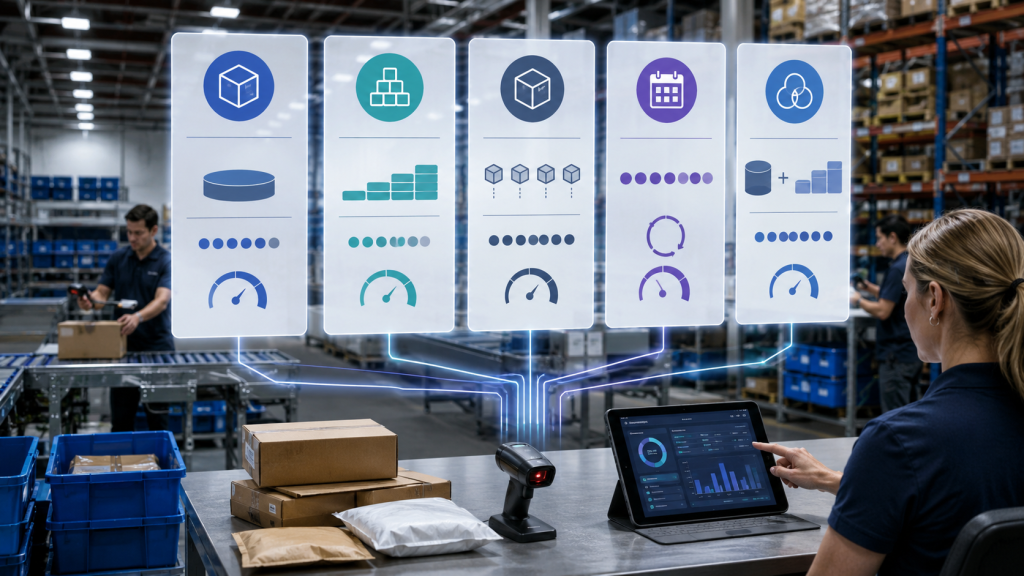 Ecommerce order fulfillment pricing models vary by predictability, transparency, scalability, and the services included in each fulfillment fee.
Ecommerce order fulfillment pricing models vary by predictability, transparency, scalability, and the services included in each fulfillment fee.
The All-In Flat Fee Model: Predictability vs. Transparency
Flat-fee models offer simple budgeting, as all costs are bundled into one rate. However, this simplicity often masks hidden premiums. While easy to forecast, these models can become prohibitively expensive as your order volume scales.
The risk with flat-fee pricing is that brands may lose visibility into what they are actually paying for. If storage, packaging, shipping, account management, or labor assumptions are bundled too broadly, it becomes harder to identify what is driving cost changes.
Tiered Pricing: Scalability for Growing Brands
Tiered pricing rewards volume. As your business grows, your per-order costs decrease. This is an excellent model for brands experiencing consistent growth, as it aligns your fulfillment provider’s incentives with your own success.
Tiered pricing can be especially useful for brands with predictable order growth, clear SKU behavior, and stable fulfillment requirements. It also gives teams a better way to forecast costs as monthly order volume increases.
Per-Unit or Transactional Pricing: The Industry Standard for 3PLs
This is the most common model, where you pay for exactly what you use. It is highly transparent but requires meticulous tracking of your order volume to ensure you aren’t overspending on fluctuating seasonal demand.
Launch Fulfillment’s 3PL pricing models guide explains how different fee structures can affect predictability, transparency, and total fulfillment cost for ecommerce brands.
Subscription-Based Fulfillment: Pros and Cons for Consistent Volume
For brands with highly predictable, subscription-based business models, this pricing structure can provide excellent value. It offers budget certainty and prioritizes your place in the fulfillment queue, though it lacks flexibility if your volume dips unexpectedly.
Subscription brands should also factor in kitting, inserts, replenishment schedules, subscription box assembly, packaging standards, and recurring delivery expectations. Launch Fulfillment’s subscription box fulfillment resources can help brands think through those recurring operational requirements.
Evaluating Fulfillment Models: In-House, Outsourced, and Hybrid
In-House Fulfillment: When Control Outweighs Overhead
In-house fulfillment gives you total control over the packaging and the customer experience. However, it requires significant investment in warehouse space, labor, and technology. It is typically ideal for startups or high-touch luxury brands that require bespoke unboxing experiences.
The tradeoff is fixed overhead. Warehouse leases, equipment, software, utilities, labor, hiring, training, and management time all need to be included when comparing in-house costs against outsourced fulfillment.
Third-Party Logistics: Leveraging Scale and Expertise
Partnering with a 3PL allows you to offload the complexities of logistics to professionals. This is the optimal route for scaling brands that need to focus on marketing and product development rather than managing warehouse staff and logistics software.
Launch Fulfillment’s 3PL fulfillment services help ecommerce brands scale order volume, improve fulfillment consistency, access operational expertise, and reduce the internal burden of managing every warehouse process themselves.
Fulfillment by Amazon and Multi-Channel Fulfillment
FBA provides access to Amazon’s customer base. However, the ecosystem is restrictive and can come with high fees. Many brands use marketplace fulfillment for marketplace sales while leveraging a secondary 3PL for their direct-to-consumer websites to maintain brand independence.
For DTC brands, channel strategy matters. Your fulfillment model should support brand control, customer data, packaging standards, inventory visibility, and the ability to serve customers beyond one marketplace ecosystem.
The Rise of the Hybrid Fulfillment Model: Balancing Reach and Margin
The smartest brands are now adopting a hybrid model. This involves keeping certain high-velocity items in a centralized 3PL facility while utilizing a secondary warehouse or local distribution partners to reduce shipping times and costs in key geographic zones.
Hybrid fulfillment can be useful for brands with regional demand, international expansion plans, or multiple selling channels. Launch Fulfillment’s guide to 3PL vs. in-house fulfillment can help teams compare the cost, control, and scalability tradeoffs between different fulfillment models.
Navigating Shipping Costs and Carrier Dynamics

Shipping costs can change quickly, but dimensional weight control, right-sized packaging, and smart zone strategy help protect ecommerce margins.
Shipping costs are the most volatile component of your logistics spend. Negotiating carrier rates and optimizing parcel transit is essential to protecting your margins.
The Impact of Dimensional Weight on Your Bottom Line
Carriers charge based on the larger of actual weight or dimensional weight. If your packaging is too large for the product inside, you are effectively paying to ship air. Using custom packaging tailored to your product dimensions can drastically reduce your monthly shipping costs.
UPS advises shippers to use accurate package dimensions to avoid additional shipping fees, and USPS 2026 updates note dimensional weight pricing for low-density parcels above one cubic foot. Brands can also use Launch Fulfillment’s dimensional weight calculator FAQ to understand how package size can influence billable weight.
Zone Skipping and Regional Distribution Strategies
Shipping a package across the country is expensive. Zone skipping allows you to aggregate shipments and inject them directly into regional hubs closer to the destination. If your shipping costs consistently exceed 15% of your AOV, implementing a regional distribution strategy is likely your most effective lever for cost optimization.
Launch Fulfillment’s guide to shipping zones explained breaks down why distance affects parcel costs and transit times. For brands with national order volume, inventory placement can become a direct margin lever.
Managing Peak Season Surcharges and Carrier Fee Fluctuations
Peak season brings unavoidable surcharges. The key is to manage these by diversifying your carrier mix, mixing major carriers with regional providers to spread risk and avoid the steep price hikes associated with peak capacity constraints.
FedEx maintains a current rate-change resource for shipping rates and fees, and USPS announced competitive pricing changes for July 2026. In practice, ecommerce brands should review carrier changes alongside their own invoice data because surcharges, package dimensions, service selection, and address accuracy often determine the true cost per shipment.
Last-Mile Delivery: The Balance of Speed vs. Cost
The last mile is the most expensive part of the supply chain. While consumers demand speed, you must balance this against your margins. Offer expedited shipping as a premium, paid option, and reserve standard delivery for the bulk of your orders to preserve your bottom line.
Brands can also improve last-mile performance by making shipping promises clearer at checkout, using the right service level, reducing preventable address issues, and aligning fulfillment cutoffs with real carrier handoff times. Launch Fulfillment’s guide to shipping and handling costs can help brands evaluate the full shipping cost beyond the label rate.
Control Shipping Costs Before They Control Your Margins
Launch Fulfillment helps brands think through dimensional weight, shipping zones, packaging efficiency, carrier strategy, and fulfillment workflows so shipping costs do not quietly erode profitability.
Data-Driven Cost Optimization: Advanced Logistics Metrics
ABC Analysis: Optimizing SKU Velocity and Inventory Turns
Implement an ABC analysis to categorize your products based on velocity. “A” items, or high-velocity SKUs, should be stored in the most accessible, low-cost locations within your fulfillment center. “C” items, or slow movers, should be relegated to the back or consolidated to reduce storage fees. This simple data exercise can lead to significant reductions in labor costs and storage overhead.
Launch Fulfillment’s guide to ABC analysis explains how SKU classification can support smarter inventory decisions. When paired with strong warehouse slotting, ABC analysis can help reduce pick time, storage waste, and operational drag.
For physical warehouse optimization, warehouse slotting optimization can help align product placement with order velocity, picker efficiency, replenishment needs, and shipping workflows.
Warehouse Management Systems and Real-Time Visibility
A fulfillment pricing model is only useful if the data behind it is accurate. A strong WMS should provide real-time visibility into inventory levels, order status, receiving activity, shipment exceptions, storage utilization, and returns. Without that visibility, brands are forced to react to problems after they show up as customer complaints or unexpected fees.
Launch Fulfillment’s warehouse management system resources explain why WMS visibility matters for fulfillment accuracy, inventory control, and operational decision-making.
Packaging, Sustainability, and Cost Control
Packaging is more than a material expense. It affects DIM weight, damage rates, unboxing experience, storage requirements, and shipping cost. Right-sized packaging can reduce void fill, improve product protection, and help lower transportation waste.
The EPA’s sustainable packaging guidance notes that efficient packaging can reduce waste and help companies save money. For ecommerce brands, the best packaging strategy balances product safety, brand presentation, shipping cost, material waste, and customer expectations.
Final Thoughts
Mastering e-commerce fulfillment in 2026 requires a shift from viewing logistics as a cost center to treating it as a strategic engine for growth. By focusing on the total cost of ownership, auditing your fee structure for hidden costs, and utilizing a data-driven approach to inventory velocity, you can protect your margins while simultaneously improving the customer experience.
If your current logistics model relies on gut instinct rather than granular, SKU-level data, start your transition today. Begin by auditing your storage fees against your turnover rate, and benchmark your pick-and-pack performance against your actual cost per order. Your supply chain should be a catalyst for your brand’s future success, not a bottleneck to your profitability. The brands that win in 2026 will be those that view every package leaving the warehouse as a critical investment in their long-term customer relationships.
Launch Fulfillment helps ecommerce brands evaluate fulfillment pricing with the full operation in mind: receiving, storage, pick and pack, shipping, kitting, returns, inventory visibility, and customer experience. You can learn more about the company’s approach on the About Launch Fulfillment page.
Build a Fulfillment Pricing Model That Scales
If your fulfillment costs are hard to forecast, your invoices keep changing, or your current provider cannot explain what is driving your total cost, Launch Fulfillment can help you build a clearer path forward.
FAQ: Order Fulfillment Pricing Models
What are ecommerce order fulfillment pricing models?
Ecommerce order fulfillment pricing models are the ways a 3PL or fulfillment provider charges for services like receiving, storage, pick and pack, packaging, shipping, kitting, returns, and technology access. Common models include flat-fee pricing, tiered pricing, per-unit or transactional pricing, subscription-based fulfillment, and hybrid fulfillment.
What is the best fulfillment pricing model for ecommerce brands?
The best fulfillment pricing model depends on your order volume, SKU complexity, storage needs, packaging requirements, shipping profile, and growth stage. Flat-fee pricing can be easier to forecast, while transactional pricing is usually more transparent. Tiered pricing often works well for growing brands because per-order costs can decrease as volume increases.
What is included in ecommerce fulfillment pricing?
Ecommerce fulfillment pricing typically includes warehouse receiving, inventory storage, pick and pack fees, packaging materials, shipping, kitting or assembly, return processing, and technology or WMS access. Some providers may also charge for account management, long-term storage, peak season labor, special projects, disposal, or custom packaging.
Why should brands look beyond pick and pack fees?
Brands should look beyond pick and pack fees because they are only one part of the total fulfillment cost. Storage inefficiency, slow inventory turns, shipping zones, dimensional weight, returns processing, software fees, packaging waste, and surcharges can all affect profitability. A low pick and pack fee may not mean the provider is the lowest-cost option overall.
What is total cost of ownership in fulfillment?
Total cost of ownership in fulfillment is the full financial impact of your fulfillment operation, not just the invoice line items. It includes direct fees like receiving, storage, pick and pack, and shipping, plus hidden costs like system maintenance, slow inventory movement, customer churn from poor delivery experiences, returns delays, and margin loss from inefficient operations.
How do shipping costs affect fulfillment pricing?
Shipping costs are often the most volatile part of ecommerce fulfillment pricing. Package dimensions, dimensional weight, shipping zones, carrier surcharges, residential delivery fees, peak season costs, and service-level choices can all change the final cost per order. Right-sized packaging, better inventory placement, and carrier strategy can help protect margins.
How can ecommerce brands reduce fulfillment costs?
Ecommerce brands can reduce fulfillment costs by improving inventory accuracy, using right-sized packaging, monitoring dimensional weight, reducing long-term storage, optimizing SKU placement, using ABC analysis, reviewing carrier surcharges, and choosing a fulfillment pricing model that fits their order volume and growth stage. A strong 3PL should help identify where costs are coming from and how to reduce waste.
