
Key Takeaways
- Learning how to calculate shipping and handling costs accurately is essential for protecting e-commerce profit margins. Many brands underestimate fulfillment expenses by only accounting for carrier shipping rates while ignoring packaging, labor, storage, and operational costs.
- Shipping and handling costs include much more than the shipping label itself. Packaging materials, warehouse labor, dimensional weight charges, storage overhead, returns management, and carrier surcharges all contribute to the true cost per order.
- Dimensional weight (DIM weight) can dramatically increase e-commerce shipping costs. Carriers often charge based on package size rather than actual weight, making packaging optimization one of the fastest ways to reduce fulfillment expenses.
- Shipping zones directly impact delivery costs and profitability. The farther a package travels, the higher the shipping expense, which is why strategic inventory placement and distributed fulfillment can significantly reduce transportation costs.
- Handling costs should be calculated into every e-commerce order. Picking, packing, labeling, packaging supplies, and warehouse workflows all require labor and operational resources that affect total fulfillment profitability.
- Free shipping is a pricing strategy, not a free operational expense. E-commerce brands should carefully calculate shipping thresholds, product margins, and fulfillment costs before offering free or discounted shipping promotions.
- The best shipping and handling cost strategies combine accurate data, operational efficiency, packaging optimization, and smart carrier selection. Brands that understand their true fulfillment economics are better positioned to scale sustainably while maintaining customer satisfaction.
Many e-commerce business owners operate under a dangerous illusion: they believe that as long as their revenue is climbing, their profit margins will naturally follow. Yet, there is a “Shipping Paradox” that plagues growing brands. You might be moving thousands of units, but if you have not accurately calculated your shipping and handling costs, you are likely hemorrhaging capital on every transaction. Shipping is rarely just the price on the carrier’s rate card; it is a complex ecosystem of weight, distance, labor, and hidden surcharges that can erode your bottom line in silence. This guide will teach you how to move beyond basic arithmetic to build a robust, margin-protected shipping strategy.
At Launch Fulfillment, we see shipping and handling costs as one of the biggest blind spots in e-commerce profitability. A strong e-commerce shipping strategy should account for carrier rates, packaging, warehouse labor, delivery zones, dimensional weight, and the real handling cost behind every order.
Why Accurate Shipping and Handling Calculations Matter for Your Bottom Line
The Impact of Shipping Costs on Profit Margins
When you undervalue the cost of sending a product to a customer, you are effectively subsidizing your sales with your own profit. Many businesses treat shipping as a flat expense, but it is actually a highly variable line item. If your product margins are thin, a 15% increase in carrier shipping rates can turn a profitable item into a loss-maker overnight. You must account for the full spectrum of costs, including the price of packaging materials, labor time, and the inevitable return logistics that characterize modern retail.
This is why shipping math should be connected to broader ecommerce fulfillment pricing. If you only account for the shipping label and ignore pick fees, packaging materials, storage, returns, and labor, your true margin picture will be incomplete.
Understanding the Link Between Shipping Rates and Cart Abandonment
Pricing strategy is a delicate balance. High shipping charges are the leading cause of online cart abandonment. Customers today expect transparent, reasonable, and often free shipping. If your calculations are imprecise, you either overcharge your customers, which kills your conversion rates, or you undercharge them, which kills your profitability. Mastering the math allows you to offer competitive shipping options that satisfy the customer while protecting your operational health.
Shopify’s shipping strategy guidance explains that shipping costs influence both profitability and a customer’s likelihood to place an order, which reinforces why rates need to balance margin and conversion. Shopify shipping strategy guidance
Defining the Difference: Shipping vs. Handling Costs
It is crucial to distinguish between these two. Shipping costs represent the fees charged by the shipping company (like UPS or FedEx) to move your package from origin to destination. Handling costs, however, are internal. They cover the labor involved in picking, packing, and labeling the shipment, as well as the overhead of your warehouse space. Ignoring handling is the most common mistake made by new e-commerce sellers.
Launch Fulfillment’s pick, pack, and ship services are designed around this reality: fulfillment cost is not just what the carrier charges. It also includes the operational effort required to get the order accurately prepared and out the door.
Need a Clearer View of Shipping and Handling Costs?
Launch Fulfillment helps ecommerce brands understand the full cost of shipping, handling, packaging, fulfillment labor, and carrier strategy so every order protects your margins.
Step 1: Calculate the “Billable Weight” of Your Package
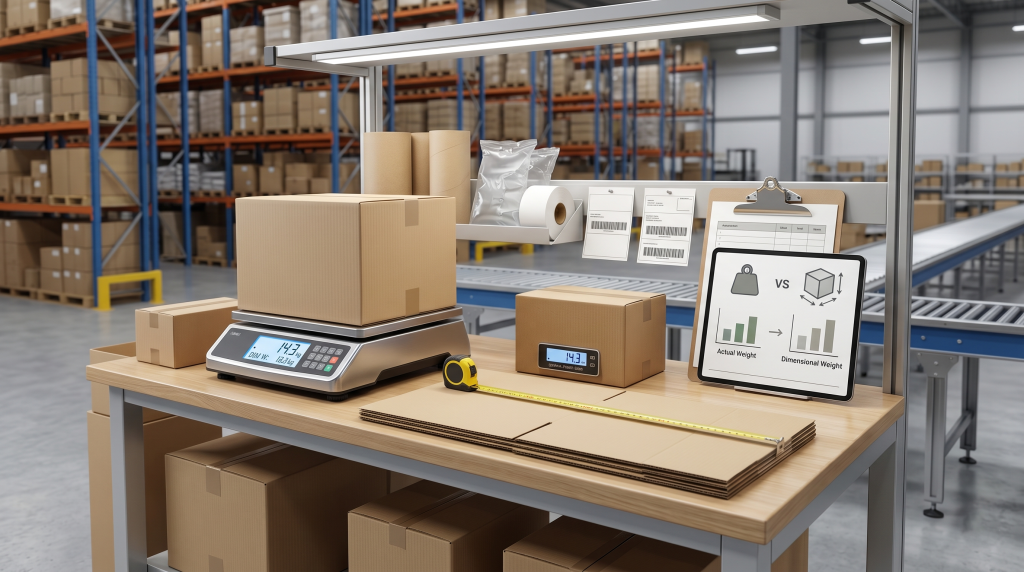
Shipping carriers often calculate costs using whichever is greater: actual package weight or dimensional weight.
Understanding Actual Weight vs. Dimensional (DIM) Weight
Carriers have evolved from charging strictly by the weight of a package to charging by the space it occupies. This is called “DIM weight.” If you are shipping a light but bulky item, the shipping company will charge you based on the volume of the box rather than its scale weight. You must identify which is higher, the actual weight or the DIM weight, as that is the value they will bill you for.
UPS explains that dimensional weight compares how much space a package occupies with its actual weight and may apply when a package is large relative to its weight. UPS dimensional weight guidance, Launch Fulfillment’s dimensional weight calculator FAQ can help brands understand how box dimensions influence billable weight.
How to Calculate Cubic Inches and DIM Weight for Different Carriers
To calculate DIM weight, multiply the length, width, and height of your package in inches. Then, divide that number by the carrier’s specific divisor (commonly 139 for many major carriers). Always check with your specific provider, as these divisors change. If the resulting number is higher than the physical weight of your box, you are being billed for space, not mass.
If you want a faster way to estimate the math, use Launch Fulfillment’s dimensional weight calculator to compare actual weight, dimensional weight, and billable weight before you choose packaging or shipping rates.
Choosing the Right Scale Types and Measuring Tools for Accuracy
Guessing weights is a fast track to surcharges. Invest in a high-quality industrial shipping scale that connects to your computer. Precision is non-negotiable here. Even a half-pound discrepancy across thousands of shipments amounts to a massive loss. Always measure your boxes before sealing them to ensure you are inputting exact dimensions into your shipping software.
USPS notes that package shape, weight, and size affect pricing, including dimensional weight or oversized pricing depending on mail class and other factors. USPS parcel size and weight standards
Pro-Tip for Profitability: Minimizing the “Outer Shipping Container” to Reduce Billable Weight
The most effective way to lower shipping costs is to right-size your packaging. Use custom-fit boxes or poly mailers to minimize empty space. Every cubic inch of air you ship costs you money. Reducing the size of your outer shipping container reduces your DIM weight, which is the most immediate way to drop your shipping charges.
This is especially important for beauty, supplements, apparel, home goods, and subscription brands, where packaging can quietly push orders into higher billed-weight brackets. Launch Fulfillment’s 3PL pricing models explained guide can help you understand how packaging, shipping, handling, storage, and returns all affect total fulfillment cost.
Step 2: Determine the Geography of the Shipment (Shipping Zones)
How Shipping Zones Work: From Zone 1 to Zone 8
Carriers divide the world into zones based on the distance between the origin and the destination. Zone 1 is essentially your local area, while Zone 8 is the furthest distance possible. Shipping costs increase exponentially as the zone number increases. Understanding where your customers are located relative to your warehouse is vital for predicting your average cost per shipment.
Launch Fulfillment’s guide to shipping zones explains how distance from your fulfillment origin affects shipping rates, delivery speed, and margin protection.
Evaluating Domestic Shipping vs. International Shipping Services
Domestic shipping is relatively predictable, but international shipping introduces complexities like customs, duties, and disbursement fees. Always be transparent with customers about who is responsible for these international costs, as unexpected fees upon delivery are a primary source of customer dissatisfaction and return requests.
USPS explains that international shipping may require customs forms and offers services for overseas destinations, while CBP notes that mail entering the United States from abroad is sent to U.S. Customs and Border Protection for examination and duty or tax assessment when owed. USPS international shipping guidance, CBP international mail processing guidance
The Role of Item Location and Fulfillment Centers in Reducing Distance
If you have a high volume of orders in a specific region, it may be time to consider distributed inventory. By placing products in a warehouse closer to high-density customer clusters, you effectively lower the average zone of your shipments, significantly decreasing your total shipping spend.
Strategic warehousing and fulfillment services can help brands reduce distance, improve delivery performance, and avoid treating expensive long-zone shipping as the default.
Pro-Tip for Profitability: Using 3PL Providers and Hybrid Shipping Solutions (UPS SurePost, FedEx SmartPost)
If your order volume exceeds your capacity, a 3PL (Third-Party Logistics) provider can offer volume-based discounts that you cannot achieve alone. Additionally, investigate hybrid shipping methods where the primary carrier handles the long-haul transit and the local post office handles the “last mile” delivery. This is often the most cost-effective method for lightweight, non-urgent packages.
A strong 3PL fulfillment services partner can also help you evaluate carrier mix, shipping zones, DIM weight, warehouse placement, and rate strategy together rather than treating each cost driver separately.
Whether you use a third party fulfillment company, or you take care of shipping yourself – you need to know everything that goes into the shipping and handling process. What better way than to add some costs to that equation!
Lower Shipping Costs With Smarter Fulfillment
Launch Fulfillment helps ecommerce brands reduce shipping and handling costs through better packaging, warehouse workflows, carrier strategy, and inventory placement.
Step 3: Audit Your Total Handling and Fulfillment Costs

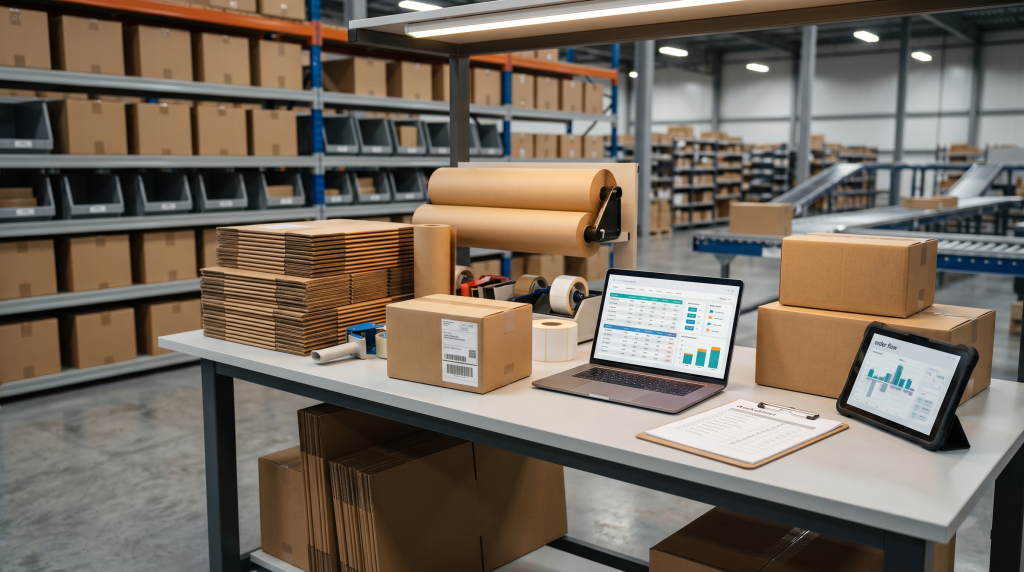 True shipping and handling costs include labor, packaging materials, warehouse operations, and fulfillment efficiency.
Calculating Warehouse Labor and Handling Time per Order
True shipping and handling costs include labor, packaging materials, warehouse operations, and fulfillment efficiency.
Your warehouse staff is not free. You must track how long it takes to pick an item, pack it, seal it, and print the labels. Calculate the hourly rate of your labor and divide it by the number of orders processed per hour to find your “labor cost per order.”
Launch Fulfillment’s order fulfillment resources can help brands understand how receiving, picking, packing, shipping, and returns flow together inside a cost-aware fulfillment process.
The “Hidden Tax”: Factoring in Packaging Materials, Poly Mailers, and Office Supplies
Do not overlook the “hidden tax” of small items. Tape, bubble wrap, poly mailers, labels, and printer ink are legitimate expenses. If you use expensive, branded packaging, ensure that the cost is integrated into your shipping and handling baseline. These costs add up quickly when scaled.
If your brand relies on samples, bundles, inserts, or premium packaging, those should be priced into your fulfillment model. For high-touch workflows, kitting and assembly services can help standardize packaging labor and improve consistency.
Including Operating Expenses: Rent, Storage Costs, and Utilities
Your fulfillment space has a price. Calculate the monthly rent, electricity, and insurance for your storage area. Distribute this cost across your average monthly shipment volume to determine how much of your overhead is attributed to each package sent to a customer.
Storage costs also depend on inventory velocity. A product that sells quickly may carry a low storage burden, while slow-moving inventory can quietly raise your cost per order. Launch Fulfillment’s inventory management support helps brands connect stock visibility with fulfillment cost control.
Pro-Tip for Profitability: Streamlining Fulfillment Operations to Lower Cost-per-Order
Standardize your packing station. If your staff has to walk across the room to find tape or labels, you are losing money on labor. Organize your warehouse so that the most popular items are in the easiest-to-reach locations. A well-designed workflow significantly lowers the time spent on every single order.
Efficient pick, pack, and ship workflows reduce touches, lower labor costs, improve accuracy, and help orders reach carriers faster.
Step 4: Finalize Your Pricing Strategy and Shipping Policy
Aggregating the Data: Creating a Total Cost-per-Item Template
Consolidate all the data you have gathered into a single spreadsheet. Include your carrier rates, packaging material costs, labor costs, and estimated overhead. This “Total Cost-per-Item” template will allow you to see the exact break-even point for every product in your catalog.
Your cost-per-item model should include actual weight, DIM weight, shipping zones, packaging materials, handling labor, storage allocation, returns burden, and carrier surcharge exposure. It is not glamorous, but neither is discovering your bestseller is secretly a tiny profit vampire.
Choosing Your Model: Flat Rate Shipping vs. Real-Time Carrier Rates
You have two main paths. Flat rate shipping is easy for the customer to understand and often increases conversion. Real-time carrier rates are more accurate but can sometimes “sticker shock” a customer at checkout. Many successful brands use a hybrid approach: they calculate the average cost of shipping and build a portion of it into the product price, allowing them to offer a “flat” or “discounted” shipping rate.
Shopify explains that shipping zones and rates define where you ship products and how much customers pay for shipping at checkout. Shopify shipping zones and rates guidance. This makes checkout pricing strategy directly dependent on fulfillment data quality.
Implementing Shipping Thresholds to Increase Average Order Value (AOV)
A common strategy is to offer free shipping over a certain dollar amount. This encourages customers to add more items to their cart to reach the threshold, which helps you cover the shipping costs through increased product margin. Ensure your threshold is set high enough that your margins remain protected after the cost of the shipment.
For brands comparing standard and premium delivery options, Launch Fulfillment’s guide to standard vs. expedited shipping can help align shipping speed, margin protection, and customer expectations.
Pro-Tip for Profitability: Balancing Free Shipping with Customer Satisfaction and Margins
Total “Free Shipping” is a marketing tactic, not a logistics reality. Even when you offer it, you are paying for it. Make sure your base product prices have enough margin to absorb the shipping cost, or use your shipping policy to influence buying behavior, such as incentivizing larger, more efficient orders.
Free shipping should be tied to actual margin math, not vibes. If the threshold does not cover shipping and handling costs, the promotion may grow revenue while shrinking profit.
Accounting for Surcharges and Accessorial Fees
Common “Hidden” Costs: Residential Delivery and Address Correction Fees
Carriers charge extra for residential deliveries versus commercial ones. Furthermore, address correction fees are frequent when customers enter incomplete information. Always use address verification software during the checkout process to prevent these unnecessary expenses.
Hidden fees are one reason brands should review Launch Fulfillment’s guide on questions to ask a 3PL before signing a fulfillment contract. Pricing transparency matters long before the invoice arrives.
Managing High-Cost Shipments: Large Package Surcharges and Oversize Fees
Packages that exceed specific dimensions or weight thresholds trigger massive surcharges. If your product is large, be aware of the “oversize” bracket. Often, shipping two smaller boxes is cheaper than shipping one large one due to these surcharges.
This is where packaging strategy and carrier logic need to work together. Launch Fulfillment’s article on shipping zones explained provides a deeper look at how distance, zones, and package profile can affect shipping profitability.
The Cost of Protection: Insurance and Signature Requirements
For high-value items, shipping insurance is a necessity. While it adds to your costs, the expense of a lost or stolen package is far greater. Signature requirements can also protect you from fraud, though they create an inconvenience for the customer that must be balanced against the value of the goods.
High-value orders should be evaluated on total risk, not just delivery price. Insurance, signature confirmation, carrier reliability, and customer communication all influence the true cost of a shipment.
International Fees: Understanding U.S. Customs, Duties, and Disbursement Fees
International shipping is prone to surprise fees. Carriers often charge “disbursement fees” for fronting the costs of customs and duties on the customer’s behalf. Ensure your international shipping policies clearly state who pays these, or build them into the landing price for the customer to maintain a seamless experience.
If you ship internationally, your policy should clarify duties, taxes, delivery timelines, returns, and refused-package handling. Surprise fees are the fastest way to turn an exciting international order into a customer support fire drill.
Turn Shipping Math Into Margin Protection
Launch Fulfillment helps ecommerce brands calculate real fulfillment costs, reduce hidden shipping waste, and build shipping policies that support both customer experience and profitability.
Final Thoughts
Calculating shipping and handling is not a one-time project; it is an ongoing process of operational audit and strategic adjustment. By mastering the distinction between DIM weight and actual weight, accounting for the hidden costs of warehouse labor, and setting smart shipping thresholds, you transform shipping from a source of financial drain into a competitive advantage.
Your next steps are clear: begin by auditing your current shipping spend against your actual margins. Over the next 48 hours, document every minute spent on fulfillment and every dollar spent on packaging materials. Use these figures to populate a total cost-per-item template. Once you have this visibility, you can stop guessing and start scaling with confidence, knowing that every package leaving your warehouse is protecting your bottom line rather than depleting it. Accurate shipping math is the foundation of a sustainable e-commerce business.
If your team is ready to move from rough shipping estimates to accurate fulfillment economics, contact Launch Fulfillment to talk through your shipping, handling, packaging, and fulfillment cost structure.
Related Posts
FAQ: Shipping And Handling Costs
What are shipping and handling costs?
Shipping and handling costs are the combined expenses associated with preparing and delivering an order to a customer. Shipping costs typically include carrier transportation fees, while handling costs cover labor, packaging materials, warehouse operations, labeling, and order preparation.
Why are shipping and handling costs so expensive?
Shipping and handling costs can increase due to dimensional weight pricing, carrier surcharges, fuel costs, packaging materials, labor expenses, shipping zones, and warehouse overhead. Larger packages, long-distance shipments, and expedited delivery options often result in significantly higher fulfillment costs.
How do businesses calculate shipping and handling costs?
Businesses calculate shipping and handling costs by combining carrier shipping rates with packaging expenses, warehouse labor, fulfillment fees, storage costs, and operational overhead. Many ecommerce brands also account for dimensional weight, shipping zones, and return logistics when determining total fulfillment costs.
What is the difference between shipping costs and handling fees?
Shipping costs are the charges imposed by carriers like UPS, FedEx, or USPS to transport a package. Handling fees refer to the internal operational costs required to process the order, including picking, packing, labeling, packaging supplies, and warehouse labor.
Can reducing package size lower shipping and handling costs?
Yes. Reducing package dimensions is one of the most effective ways to lower shipping and handling costs because many carriers use dimensional weight pricing. Using right-sized packaging, poly mailers, and efficient packing methods can help ecommerce brands reduce billable weight and improve profitability.
