
Key Takeaways
- Warehouse slotting optimization is the process of placing inventory in the most efficient warehouse locations to reduce picker travel time, improve throughput, and speed up order fulfillment.
- A strong slotting strategy starts with ABC analysis. High-velocity “A” SKUs should be placed closest to packing and shipping areas, while slower-moving “B” and “C” items can be stored farther away.
- The Golden Zone improves both speed and safety. Placing frequently picked products between waist and shoulder height helps reduce bending, reaching, fatigue, and picking errors.
- Product affinity matters. SKUs that are often ordered together should be stored near each other to reduce backtracking, simplify batch picking, and improve multi-item order fulfillment.
- Warehouse slotting should be based on clean inventory data. Accurate SKU dimensions, weights, order history, sales velocity, and replenishment patterns are essential for building an effective slotting plan.
- Poor slotting increases labor costs and creates bottlenecks. When pickers spend too much time walking, searching, or navigating congested aisles, fulfillment speed and margins both suffer.
- Warehouse slotting optimization is not a one-time project. Brands and 3PLs should regularly audit SKU placement, adjust for changing demand, and use WMS data or automation to keep pick paths efficient.
In the modern fulfillment landscape, the efficiency of your warehouse is dictated not by the size of your footprint, but by the intelligence of your layout. Every minute a picker spends walking, searching, or repositioning items is a minute stripped from your bottom line. Warehouse slotting optimization is the strategic science of placing inventory in the most logical locations to maximize throughput. When executed correctly, it transforms your facility from a static repository into a high-velocity engine for order fulfillment, directly impacting customer satisfaction and operational margins.
At Launch Fulfillment, we see warehouse slotting as one of the quiet levers behind faster fulfillment, cleaner inventory control, and better ecommerce customer experiences. Strong ecommerce fulfillment services do not just store products; they organize inventory so orders move through the warehouse with less friction, fewer errors, and shorter pick paths.
Beyond Storage: Why Slotting is the Engine of Order Fulfillment
Moving from Passive Storage to Active Throughput
Many operators view their warehouse as a place to house goods until needed. This passive mentality often leads to “honeycombing”, where empty, unused space becomes trapped behind stagnant inventory. Active slotting shifts this focus toward throughput. By treating your warehouse as a dynamic flow system, you ensure that high-demand products are positioned to minimize transit times. This transition from passive storage to an active, optimized flow is the first step toward achieving peak operational maturity.
This is where warehousing and fulfillment services become strategic. If your layout slows down pickers, creates congestion, or buries high-volume SKUs in the wrong zone, your warehouse is not just storing products; it is quietly taxing every order.
The Direct Correlation Between Slotting and Labor Costs
Labor typically accounts for over 50% of operating expenses in a typical facility. Within that, travel time often consumes 60% to 70% of a picker’s day. If your pickers are traversing the entire facility for single-line orders, you are paying for non-value-added travel rather than picking productivity. Warehouse slotting optimization serves as a tactical lever to collapse these distances. By moving high-velocity items closer to dispatch areas, you fundamentally alter the cost structure of your picking process, yielding immediate savings in labor utilization.
Launch Fulfillment’s pick, pack, and ship services are built around this same principle: accurate fulfillment depends on well-designed workflows, smart item handling, and fast movement from order receipt to carrier handoff.
Need Faster Pick Paths Without More Warehouse Chaos?
Launch Fulfillment helps ecommerce brands improve fulfillment speed, inventory organization, order accuracy, and shipping performance through smarter warehouse workflows.
The Core Framework: Velocity-Based Slotting and ABC Analysis
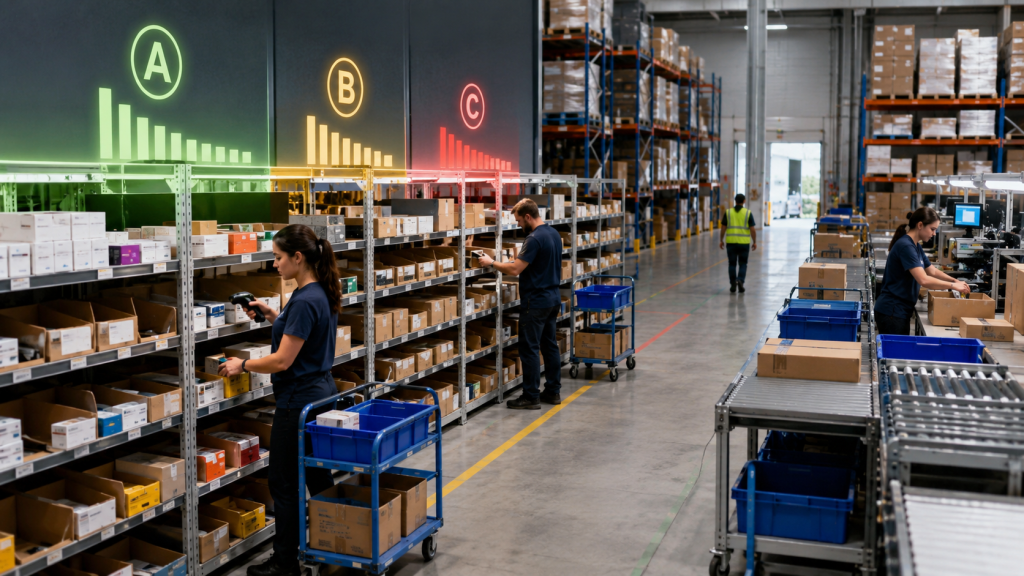
ABC slotting places high-demand SKUs in the most accessible warehouse zones to reduce travel time and improve picking efficiency.
A spatial representation of ABC slotting: High-velocity ‘A’ items are positioned immediately adjacent to the shipping dock to drastically reduce picker travel time and increase throughput.
Segmenting SKUs by Sales Velocity and Order Volume
The foundation of effective slotting is a rigorous ABC analysis. Category “A” items represent the top 20% of your SKUs that generate 80% of your order volume. Category “B” represents the next tier, and “C” comprises the long-tail, slow-moving items. By segmenting your inventory based on historical order patterns, you gain the clarity needed to make data-driven placement decisions that prevent bottlenecks and ensure your most popular products remain accessible.
Launch Fulfillment’s ABC Analysis glossary explains how inventory can be categorized by importance and value, making it a useful foundation for slotting decisions, replenishment priorities, and SKU-level control.
Identifying the “A” Category: High-Velocity SKUs and Proximity to Shipping
The “A” items demand the most accessible spots in the facility. Proximity to the shipping dock is non-negotiable for these products. Placing high-velocity SKUs at the end of an aisle or on high racks forces pickers into unnecessary detours. Instead, create a dedicated “A-Zone” near the outbound loading area to drastically reduce the round-trip distance, effectively increasing your picks-per-hour and reducing congestion in the primary aisles.
For e-commerce brands, this directly affects order fulfillment. If bestsellers are close to packing stations and shipping docks, teams can process more orders with fewer touches, less walking, and fewer bottlenecks.
Strategic Placement for “B” and “C” Class Inventory
“B” and “C” items should be relegated to the deeper, less accessible zones of the facility. Since these products are picked less frequently, the added travel time is amortized over a lower volume, making the overall impact on labor efficiency minimal. Utilizing higher rack levels or remote zones for “C” items keeps your primary, easy-to-reach floor space open for the items that actually drive your business throughput.
This also helps protect your primary pick face from clutter. Slow-moving SKUs still need to be accurate and accessible, but they should not occupy the same prime real estate as high-volume products that drive daily throughput.
Mastering the “Golden Zone”: Ergonomic Slotting for Peak Efficiency

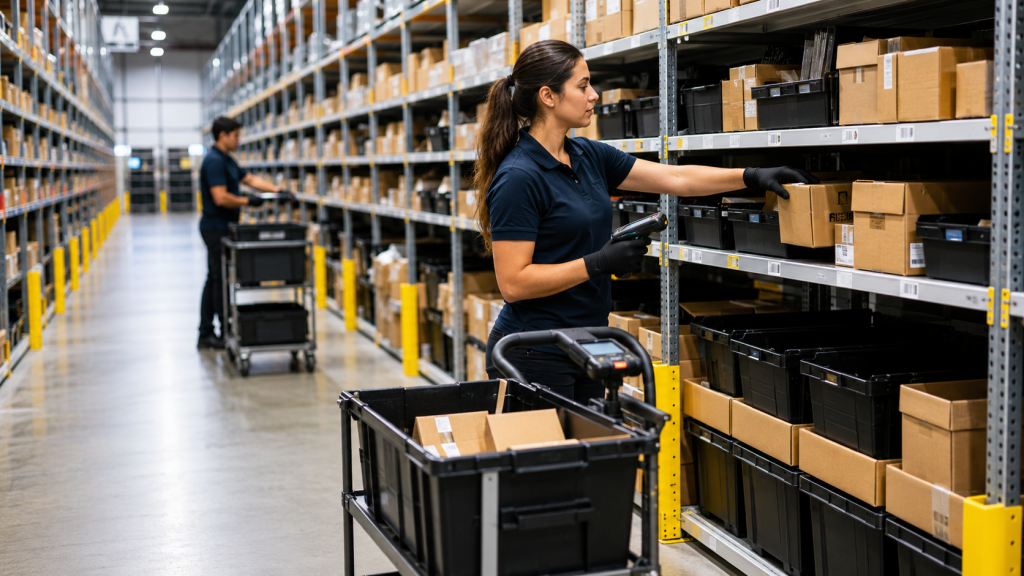 Golden Zone slotting places high-velocity products at comfortable pick heights to improve speed, safety, and accuracy.
Golden Zone slotting places high-velocity products at comfortable pick heights to improve speed, safety, and accuracy.
The Golden Zone Concept: Optimizing the Pick Face at Waist Height
The “Golden Zone” refers to the space between waist and shoulder height. This is the area where pickers can retrieve items with the least amount of exertion. By dedicating this prime shelf space exclusively to your highest-velocity items, you minimize the need for bending or reaching. This strategy is not just about speed; it is about sustaining performance by reducing the physical toll on your workforce throughout a shift.
OSHA notes that workers can be exposed to ergonomic risk factors such as lifting heavy items, bending, reaching overhead, pushing, pulling, awkward postures, and repetitive tasks. OSHA ergonomics guidance: Slotting high-velocity SKUs in the Golden Zone helps reduce those repetitive strain points while supporting faster picking.
Reducing Worker Fatigue and Enhancing Safety Through Proper Bin Placement
Proper bin placement is a safety imperative. When workers are forced to pick from the floor or reach above their heads repeatedly, fatigue sets in, leading to slower performance and increased injury risk. Ergonomic slotting stabilizes your workforce’s output. By ensuring that the pick face is always within the optimal comfort range, you maintain a consistent pace that protects your team and preserves their accuracy over the course of an eight-hour shift.
NIOSH describes the Revised Lifting Equation as a tool used to calculate risk for work-related musculoskeletal disorders in manual lifting tasks. NIOSH lifting equation overview. While e-commerce pick paths are not always heavy-lift environments, the same principle applies: reduce unnecessary strain, and the work becomes safer, faster, and more consistent.
Heavy vs. Light: Weight Distribution and Safe Picking Environments
Weight distribution is the final component of ergonomic safety. Heavy, dense products must be prioritized for lower-level, waist-high positions to prevent back strain and damage to bins or shelving. Conversely, lightweight, low-risk items can occupy higher, less accessible spots. A balanced slotting plan considers both velocity and weight, creating a safe, intuitive environment that minimizes workplace incidents.
For supplement, beauty, wellness, and subscription brands, this can mean placing high-volume bottles, jars, kits, or bundled products in easy-access locations while moving lightweight packaging supplies or slower-moving SKUs to less central storage zones.
Data-Driven Strategies: Product Affinity and Grouping Patterns
Leveraging Product Affinity Analysis to Minimize Picker Travel
Beyond simple velocity, savvy operators use product affinity analysis to identify items that are frequently ordered together. If items “X” and “Y” appear in the same order 40% of the time, they should be stored in adjacent bins. This eliminates the need for the picker to backtrack, consolidating multiple picks into a single, compact travel path.
This is especially valuable for brands using kitting and assembly services, where bundles, subscription boxes, samples, inserts, and multi-item orders need consistent, efficient pick paths.
Using Batch Picking Data to Influence Bin Location Placement
Batch picking involves collecting items for multiple orders in one trip. Analyzing your batch picking data allows you to group related SKUs into specific zones. This methodology ensures that when a picker enters a zone, they collect the maximum number of items per foot traveled, significantly reducing the “pick path” complexity.
Launch Fulfillment’s guide to order fulfillment operations covers how warehouse optimization strategies like ABC analysis, batch picking, barcode scanning, and slotting can help fulfillment teams process higher order volumes more efficiently.
Managing SKU Complexity: Kits, Bundles, and Multi-Item Orders
When dealing with complex orders, such as kits or bundles, the placement strategy must evolve. These items should be slotted together to avoid disparate “pick-to-pick” journeys. By keeping the components of a kit within a single, manageable pick face, you streamline the assembly process and ensure the customer receives their complete order without internal warehouse delays.
For brands with complex catalogs, SKU complexity should also connect to inventory management. If inventory data is inaccurate, even the smartest slotting map will eventually lead pickers to the wrong place with heroic confidence and terrible results.
Optimize Fulfillment Around How Customers Actually Order
Launch Fulfillment helps ecommerce brands connect inventory management, SKU organization, kitting, picking, packing, and shipping so warehouse workflows support real customer demand.
Optimizing Pick Paths: Layout Strategies to Eliminate Bottlenecks
Mitigating Congestion in High-Velocity Zones
High-velocity zones are prone to traffic jams. If too many pickers are concentrated in one aisle, the resulting congestion will negate any speed gains. Spread your “A” class items across multiple aisles or parallel zones to distribute traffic. By creating alternative pathways, you ensure that the picking process remains fluid even during peak seasonal volumes.
For fast-growing brands, this matters most during promotional periods, product launches, and peak season. A layout that works at 500 orders per day may break quickly when volume doubles and every picker suddenly needs the same aisle.
Selecting the Right Methodology: Zone Picking vs. Wave Picking
Your slotting strategy must align with your chosen picking methodology. Zone picking involves assigners to specific areas, which is highly efficient for large, high-volume operations. Wave picking coordinates orders to balance the workload across the warehouse. By mapping your slotting to these methodologies, you ensure that the physical layout supports the operational flow rather than hindering it.
Brands evaluating outsourced fulfillment should ask how their provider manages zones, waves, batch picking, SKU placement, and inventory movement. Launch Fulfillment’s questions to ask a 3PL guide can help teams evaluate these operational details before committing.
Designing One-Way Flow and Cross-Aisle Efficiency
A clean, one-way traffic flow prevents collisions and confusion. Designing your aisles with a clear start and end point encourages a logical, forward-moving pick path. When combined with strategic cross-aisle access, this layout allows pickers to traverse the warehouse in the shortest possible distance, reinforcing the efficiency of the entire operation.
Smart layout design also affects receiving, replenishment, packing, carrier handoff, and returns. Strong slotting should support the full warehouse lifecycle, not just the pick route.
The Slotting Audit: A Step-by-Step Implementation Guide
Conducting a Physical Audit: Identifying Warehouse “Drift”
Warehouses suffer from “drift”, a phenomenon where items gradually migrate from their optimal locations due to replenishment convenience or human error. Regular, scheduled audits are essential to identify this creep. Walk your facility, observe the pickers, and measure the travel times. If an item is consistently being picked from a non-optimal location, it is time for a re-slot.
Slotting audits should work alongside cycle count vs. physical inventory programs. If counts reveal repeated errors in the same zones, the problem may not be only inventory accuracy; it may be location logic.
Cleaning Your Data: Inventory Accuracy and Dimensional Data (Cube)
Bad data leads to bad slotting. Before optimizing, verify your SKU dimensions and weight (the “cube”). If your WMS lacks accurate volumetric data, your slotting algorithm will fail to assign the correct bin size. Ensure every SKU in your database is measured, weighed, and categorized, providing the reliable information foundation needed for successful slotting optimization.
Accurate dimensional data also affects packaging and shipping costs. Launch Fulfillment’s dimensional weight calculator FAQ explains how package dimensions can influence billable weight and carrier charges.
Creating a Slotting Decision Matrix Based on Order Patterns
Develop a matrix that maps every SKU to a specific location based on velocity and size. For example: “High Velocity + High Weight = Low Shelf near Packing.” This matrix serves as the standard operating procedure for your team, removing ambiguity from the replenishment and put-away process.
A decision matrix is also easier to maintain when tied to replenishment planning. Launch Fulfillment’s reorder point formula guide explains how usage, lead time, and safety stock can support better inventory planning before products run low in the pick face.
Moving from Static to Dynamic: The Role of AI and Automation
The Limitations of Manual Spreadsheets and Legacy Technology
Manual spreadsheets are incapable of handling the SKU volatility of today’s market. By the time you finish a manual slotting analysis, it is likely already outdated. To maintain high throughput, you must look toward modern solutions that can process real-time order data and suggest dynamic moves based on shifting consumer trends.
Launch Fulfillment’s warehouse management system resources explain how WMS technology can improve warehouse efficiency, real-time visibility, and fulfillment processes.
AI-Driven Slotting Optimization: Leveraging Real-Time Data
AI-driven tools can analyze order patterns in real-time, identifying which products are trending and which have become “dead” stock. These systems provide actionable intelligence, allowing for constant, incremental adjustments to the facility layout, ensuring your warehouse is always operating at peak efficiency.
MHI Solutions notes that AI is moving from descriptive reporting toward predictive insights that can guide inventory, labor, and equipment decisions in real time. MHI Solutions smart warehouse overview
Integrating Slotting with Warehouse Management Systems (WMS)
Slotting optimization is most effective when integrated directly into your WMS. A seamless connection allows for automated replenishment triggers and real-time path updates. When the WMS is aware of the current slotting logic, it can direct your pickers toward the most efficient route automatically, removing the cognitive burden from the floor staff.
For e-commerce brands, this reinforces why fulfillment software and warehouse execution should not live in separate worlds. Launch Fulfillment’s fulfillment warehousing facilities page explains how inventory is digitized, tracked, and connected to e-commerce logistics workflows.
Digital Twin Technology: Simulating Slotting Changes Before Implementation
A digital twin allows you to model your warehouse and simulate the impact of slotting changes before you move a single box. This technology mitigates the risk of downtime or productivity dips during a reorganization. By testing scenarios virtually, you can guarantee that the new layout will result in faster pick paths and higher throughput.
Digital twin modeling can be especially useful when evaluating new automation, robotics, seasonal layouts, or major SKU-mix changes. It gives warehouse teams a way to test before turning the building into a live-action puzzle.
Scaling for Complexity: Automation and Robotics Integration
As your facility grows, you may integrate robotics such as autonomous mobile robots (AMRs) to handle long-distance transport. Robotics performs best in highly structured environments where slotting is optimized for machine accessibility. By combining traditional human-centric slotting with robotic automation, you create a hybrid model that maximizes the unique benefits of both: human dexterity for picking and robotic speed for travel.
A 2024 review of autonomous mobile robots in warehouse environments notes that AMRs can help cut down repetitive walking distance and effort while improving performance and reducing fatigue for human collaborators. Autonomous mobile robot warehouse review
Build a Fulfillment Operation That Can Scale
Launch Fulfillment helps ecommerce brands improve inventory visibility, warehouse workflows, pick-pack-ship accuracy, and fulfillment speed without forcing internal teams to manage every operational detail alone.
Final Thoughts
Warehouse slotting optimization is not a one-time project; it is a fundamental, ongoing commitment to operational excellence. By focusing on velocity-based segmentation, the “Golden Zone,” and data-driven product grouping, you can fundamentally reduce picker travel and increase throughput. Start by auditing your current data, cleaning your inventory dimensions, and applying a logic-driven decision matrix to your placement. As you embrace automation and real-time AI, your warehouse will evolve into a resilient, highly responsive hub capable of meeting any customer demand. Commit to the process of continuous refinement, and watch as your labor costs drop and your picking efficiency soars.
If your current fulfillment setup is slowing down pick paths, creating inventory confusion, or making growth harder than it should be, contact Launch Fulfillment to talk through your warehousing, inventory, and order fulfillment needs.
