
Key Takeaways
- Assembly services vs kitting comes down to purpose: kitting groups finished products into one customer-ready bundle, while assembly combines components to create or complete a functional product.
- Kitting is usually driven by marketing and fulfillment strategy. It helps ecommerce brands create product bundles, subscription boxes, promotional kits, influencer packages, and custom unboxing experiences without changing the core product.
- Assembly services are more technical than kitting. They often involve component integration, product prep, tools, work instructions, inspection steps, and quality control before an item is ready to ship.
- Choosing between kitting and assembly depends on product complexity. If you are combining finished goods, you likely need kitting. If parts must be joined, configured, tested, or completed, assembly services are the better fit.
- Both workflows require strong inventory management. Missing components, inaccurate SKU counts, or poor WMS visibility can delay kits, disrupt assembly workflows, and create fulfillment errors.
- Quality control is critical for value-added fulfillment. Barcode scanning, photo verification, component checks, and documented work instructions help reduce mistakes, returns, and customer complaints.
- The right 3PL partner can turn kitting and assembly into a growth advantage. With scalable labor, organized workflows, custom packaging support, and real-time visibility, brands can launch bundles, subscription boxes, and prepared products without overwhelming internal teams.
Modern supply chain success hinges on the agility of your fulfillment strategy. As brands scale, the demand for value-added services, specifically kitting and assembly, becomes a critical lever for growth. While often grouped together, these two processes serve distinct functions. Understanding the difference between them is the difference between a streamlined, profitable operation and one plagued by hidden costs and bottlenecks.
At Launch Fulfillment, we see kitting and assembly as more than warehouse tasks. They are fulfillment strategy decisions that affect inventory accuracy, labor costs, customer experience, packaging consistency, and speed to market. For ecommerce brands using ecommerce fulfillment services, choosing the right workflow can make the difference between scalable growth and operational drag.
Understanding the Fundamentals: Is It Kitting or Assembly?
To optimize your logistics, you must first categorize your needs. Kitting and assembly represent two different paths toward readying a product for the end user. Misidentifying your requirements often leads to improper resource allocation, resulting in higher shipping costs and sluggish order turnaround times.
The simplest way to think about it is this: kitting usually groups finished goods into a sellable bundle, while assembly creates or completes a product from components. Launch Fulfillment’s kitting and assembly services help brands manage both workflows with repeatable processes, inventory visibility, and fulfillment support built for scale.
Defining Kitting: The Art of Bundling for Fulfillment
Kitting is a commercial strategy focused on grouping multiple individual items into a single, cohesive unit. It is essentially an inventory management technique used to create a new, marketable SKU from existing stock. In a kitting workflow, workers pick various items and combine them into a single package, often for promotional events, subscription boxes, or retail bundles. The primary objective is to increase sales velocity and improve the customer experience by delivering complete sets rather than disparate items.
For ecommerce brands, kitting often supports starter packs, beauty routines, supplement stacks, limited-edition bundles, influencer kits, subscription boxes, and promotional offers. Launch Fulfillment’s guide on what kitting means in ecommerce fulfillment explains how kits can simplify multi-item fulfillment and create a better buying experience for customers.
Defining Assembly Services: The Science of Component Integration
Assembly services are inherently technical. Unlike kitting, which involves gathering finished goods, assembly involves taking raw components or sub-assemblies and transforming them into a single, functional product. This is a production-led process that often requires specific tools, specialized training, and rigorous quality control protocols. Assembly is a manufacturing necessity, whereas kitting is a fulfillment convenience.
Assembly may involve attaching parts, inserting components, applying labels, configuring packaging, preparing retail-ready displays, or completing a product before shipment. For brands comparing providers, custom kitting and assembly services should be evaluated based on process control, labor planning, quality checks, WMS visibility, and scalability.
The Core Distinction: Marketing Intent vs. Engineering Necessity
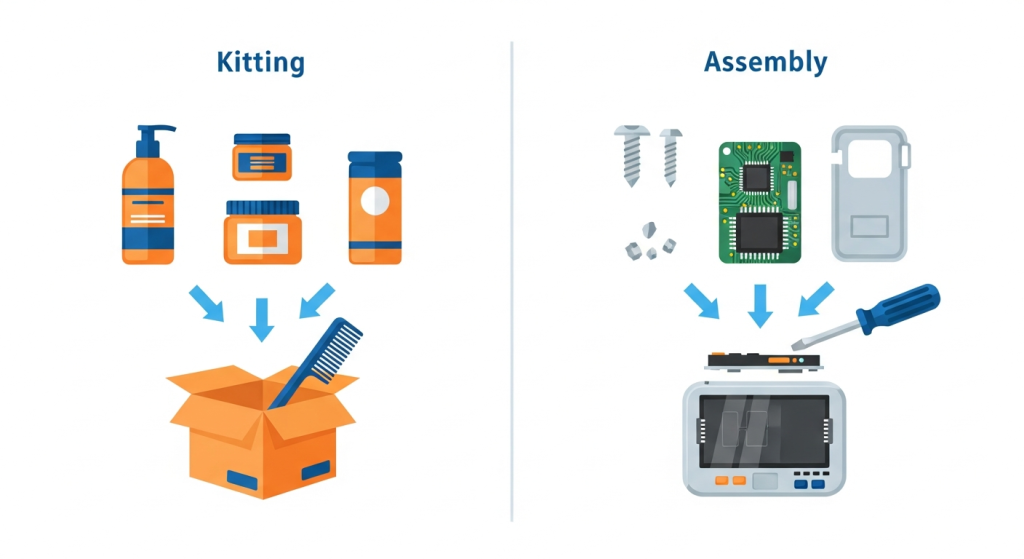
Kitting groups finished goods for retail convenience, while assembly combines raw components to build a functional product.
The divide between these services lies in their intent. Kitting is driven by marketing and sales objectives; it adds value by simplifying the buying process. Assembly is driven by engineering and production requirements; it adds value by creating the product itself. When you view kitting through a retail lens and assembly through a technical lens, you can better align your supply chain with your broader business goals.
In practical terms, a kit is often a merchandising tool, while assembly is usually a production or preparation step. If the goal is to increase average order value, improve unboxing, or sell a curated set, kitting may be the right fit. If the product cannot function until components are joined, finished, tested, or configured, you likely need assembly.
Need Help Choosing Between Kitting and Assembly?
Launch Fulfillment helps ecommerce brands build scalable fulfillment workflows for bundles, subscription boxes, product prep, custom packaging, retail compliance, and value-added services.
The Strategic Role of Kitting in Modern eCommerce
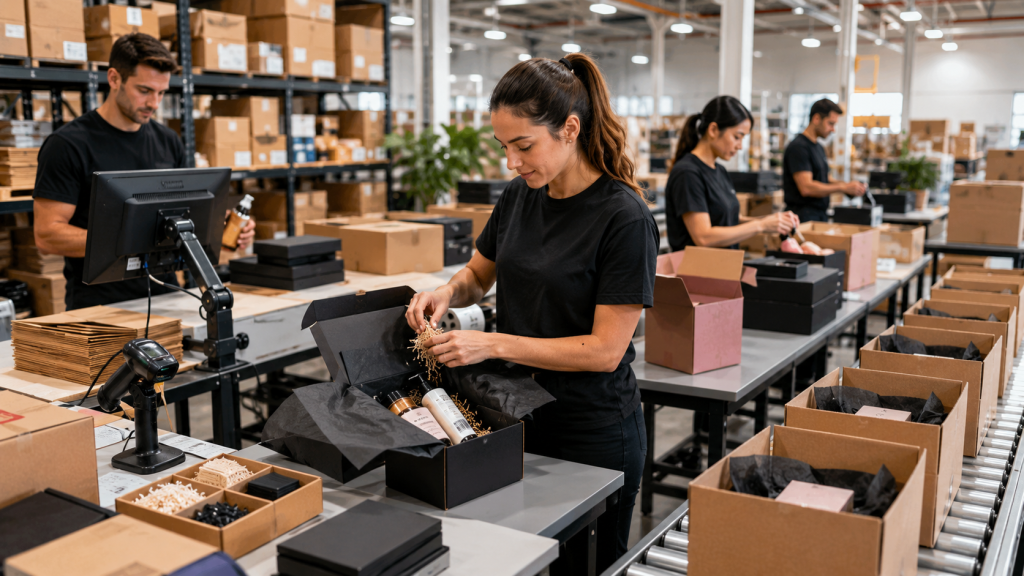
Kitting helps ecommerce brands turn finished goods into bundles, subscription boxes, and customer-ready product sets.
In the current market, speed is currency. Kitting allows brands to respond to shifting consumer demands without redesigning their entire manufacturing pipeline.
For fast-growing brands, kitting is especially useful because it can turn existing inventory into new offers without changing the core product. A wellness brand can create a monthly supplement stack. A beauty brand can create a skincare routine. An apparel brand can create a seasonal accessories set. This is why kitting connects directly to order fulfillment, inventory planning, packaging, and customer experience.
Boosting Brand Awareness through Custom Packaging and Subscription Boxes
Custom packaging is more than protection; it is a marketing tool. By utilizing kitting services, brands can create personalized “unboxing” experiences. Subscription boxes, for instance, rely entirely on efficient kitting to ensure that every subscriber receives the correct assortment of goods, reinforcing brand loyalty through presentation.
Launch Fulfillment’s subscription box fulfillment services support recurring shipments, custom packaging, inserts, inventory tracking, and kitting workflows for brands that need consistency across every box.
Enhancing Customer Experience with Pre-Assembled Kits
Customers prefer solutions over parts. By kitting related items together, such as a camera, memory card, and lens, you remove the friction of separate purchases. This improves customer satisfaction and increases the average order value, turning single-item shipments into high-value bundles.
This is also where kitting overlaps with merchandising strategy. Launch Fulfillment’s article on kitting vs. bundling explains how kitting supports operational execution while bundling supports sales strategy. Together, they can help brands increase order value without making fulfillment chaotic.
Seasonal Scaling: Using Kitting Lines to Handle Order Surges
Seasonal peaks often overwhelm internal teams. Outsourcing kitting to a 3PL allows manufacturers to scale labor during holiday rushes or product launches. Because kitting is generally a manual process that doesn’t require complex engineering tools, it is the ideal service to scale up or down based on inventory levels and market demand.
For brands planning holiday drops, influencer campaigns, or limited-time bundles, the right 3PL fulfillment services partner can help stage components, build kits, track inventory, and keep orders moving during volume spikes.
Kitting for Retail Fulfillment: From UPC Stickers to Hang-tags
Retail compliance is notoriously difficult. Kitting services often include essential value-added tasks like applying custom labeling, UPC stickers, and hang-tags. By preparing products to meet specific retailer requirements before they hit the warehouse floor, you avoid costly chargebacks and delays.
For retail and wholesale channels, labeling accuracy matters. GS1 explains that logistic labels help physically identify logistic units across complex logistics flows, while GS1-128 barcodes are commonly used in logistic labels accepted by major retailers and marketplaces. GS1 Logistic Label Guideline GS1-128 barcode overview
Deep Dive into Assembly Services: When Manufacturing Meets Logistics
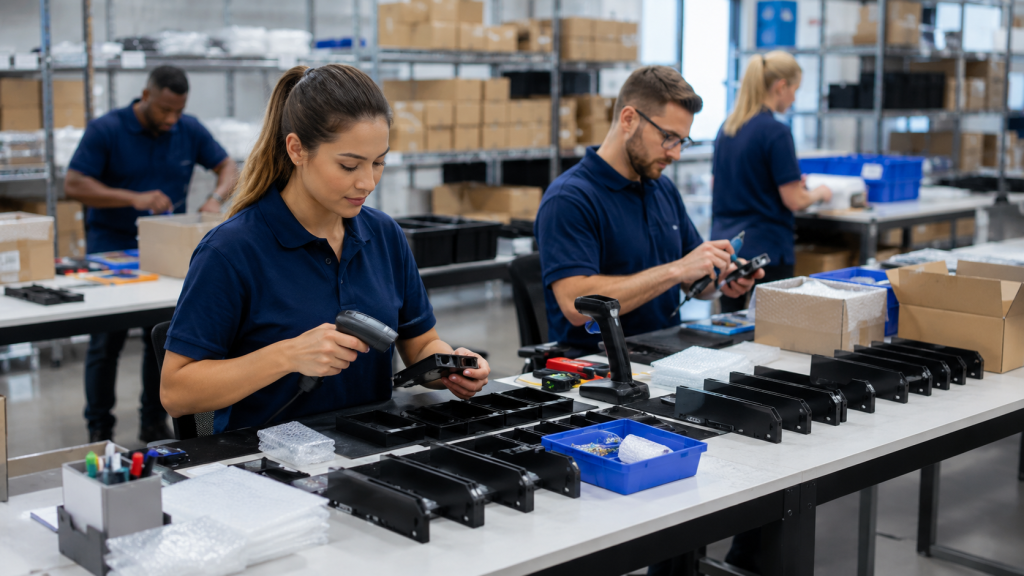
Assembly services help brands prepare, inspect, and complete products before they move into packing and shipping.
Assembly services may be a better fit when a product needs technical handling, component integration, tool-assisted work, or specialized quality checks before it can be shipped. For ecommerce brands, this may include light assembly, product prep, display building, accessory pairing, or retail-ready configuration.
Mechanical and Electrical Assembly: Building Functional Units
This involves precise tasks like integrating circuitry into housings or attaching mechanical components. Unlike simple bundling, these tasks require an environment that mimics a factory floor. Precision is paramount here, as a mistake during the assembly phase can render the entire unit defective.
Brands with more technical products should evaluate whether their fulfillment partner has the labor training, documented work instructions, quality control checkpoints, and space required to perform assembly consistently. A standard pick-pack-ship operation may not be enough for products that need true component integration.
The Importance of Sub-assemblies in Complex Product Distribution
Shipping complex products as a single finished good is often expensive due to size constraints. By shipping sub-assemblies and performing final integration closer to the customer, companies can optimize freight costs and reduce the risk of damage during transit.
This strategy can also support better shipping and handling cost control. Smaller component shipments may reduce dimensional weight or damage risk, but they only make sense if the final assembly process is reliable, documented, and cost-effective.
Industrial Applications: Panels, Motors, and Pump Assemblies
In industrial sectors, assembly services often handle heavy, specialized equipment. These units require structural integrity checks and performance testing that go far beyond standard warehouse tasks. This level of technical oversight is why assembly is frequently performed by specialists integrated into the logistics chain.
Although many ecommerce brands do not require industrial-grade assembly, the principle still applies: the more complex the product, the more important it is to define quality standards, labor steps, packaging requirements, and inspection points before orders go live.
Managing Regulatory Compliance and ISO 9001 Standards in Production
Assembly providers often adhere to strict quality management systems, such as ISO 9001. When your assembly partner maintains these certifications, they provide documented proof of process control, ensuring that every unit meets industry-specific standards for safety and reliability.
ISO describes ISO 9001 as a globally recognized quality management standard that helps organizations improve performance, meet customer expectations, and demonstrate commitment to quality. ISO 9001:2015 overview. For medical device-related workflows, the FDA’s Quality Management System Regulation addresses current good manufacturing practice requirements for medical devices. FDA QMSR overview
The Decision Matrix: Which Strategy Fits Your Business Model?
Choosing between these services requires a cold, hard look at your operational data.
Launch Fulfillment recommends evaluating the product’s complexity, SKU structure, labor requirements, launch timeline, packaging needs, compliance requirements, and customer expectations before choosing between kitting and assembly. The best choice is the one that reduces friction without adding unnecessary operational cost.
Assessing Product Complexity: Single SKU vs. Multi-Component Bundles
If your “product” is a group of existing finished goods, you need kitting. If your “product” requires parts to be joined to function, you need assembly. Distinguishing between a “set” and a “system” simplifies your choice.
For example, a skincare routine made of separate finished products is usually a kit. A product that requires a pump, cap, label, insert, and functional component to be combined before sale may require assembly or product prep.
Analyzing Inventory Levels: Stocking Parts vs. Finished Goods
Inventory management is significantly more complex with assembly. When you stock raw parts for assembly, you must track BOMs (Bills of Materials) carefully. Kitting, by contrast, tracks Finished Goods (FG), keeping your inventory records cleaner and easier to manage at the SKU level.
This is why both workflows need strong inventory management. A missing component can stop a kit from being completed, delay an assembly workflow, or create inaccurate available-to-sell inventory across ecommerce channels.
Speed to Market: How Fulfillment Strategy Impacts Your Launch Timeline
Kitting can be implemented in days, as it often involves pre-existing stock. Assembly, however, requires process design, tool calibration, and operator training. If your launch timeline is aggressive, lean heavily into kitting.
For product launches, your fulfillment partner should help you map receiving deadlines, component staging, labor needs, packaging prep, inventory sync, and shipping timelines. Launch Fulfillment’s fulfillment warehousing facilities are designed to connect receiving, storage, fulfillment, and shipping into one operational flow.
Customization Requirements: Tailoring the Final Product to the End User
If your business model relies on high levels of mass customization, kitting is your best ally. It allows for modularity adding a manual or a specialized accessory just before shipping without altering the primary production run.
This can be especially helpful for beauty, wellness, apparel, supplement, and subscription brands that want to personalize orders with samples, inserts, retail prep, limited-edition bundles, or customer-specific accessories.
Build a Kitting or Assembly Workflow That Scales
Launch Fulfillment helps ecommerce brands turn multi-item orders, bundles, subscription boxes, custom packaging, and product prep into repeatable fulfillment workflows.
Operationalizing the Workflow: Technology and Quality Control
Modern fulfillment is defined by data. Without robust software, both kitting and assembly will inevitably fail to deliver promised efficiencies.
Kitting and assembly both require accurate inventory, documented workflows, labor visibility, quality checks, and traceability. When these processes live outside the WMS or depend on tribal knowledge, brands often experience missing components, incorrect kits, rework, delayed shipments, and unclear labor costs.
Leveraging Warehouse Management Systems (WMS) for Real-Time Tracking
A WMS acts as the brain of your operation. It provides the visibility needed to track inventory levels, monitor labor productivity, and ensure that kitting and assembly tasks are performed in sync with incoming orders.
Launch Fulfillment’s warehouse management system resources explain how WMS visibility supports inventory accuracy, order routing, fulfillment workflows, and real-time tracking across warehouse operations.
The Role of Labor Management Systems in Controlling Assembly Costs
Labor is often the highest variable cost in assembly. By using Labor Management Systems, 3PL partners can track throughput per hour, identify bottlenecks, and optimize staffing to ensure your fulfillment costs remain within budget.
This matters because value-added services can become expensive when the process is not measured. Brands should ask how labor is estimated, how rework is handled, how pricing is documented, and how throughput is reported for repeat kitting or assembly programs.
Quality Control Protocols: Ensuring Consistency on the Production Line
The primary risk in any value-added service is inconsistency. Implementing strict QC protocols such as photographic verification for kitting or functional testing for assembly can reduce return rates by 30-50%, significantly boosting overall profitability.
For ecommerce fulfillment, QC should be clear and repeatable. That may include barcode scanning, component verification, sample checks, photo documentation, weight checks, first-article inspections, or approval workflows before full production begins.
Barcode Systems and GS1/UCC-128 Labeling for Supply Chain Transparency
Professionalism in logistics is measured by labeling accuracy. Adopting GS1/UCC-128 standards ensures that your products are easily tracked through the entire supply chain, reducing errors at the receiving dock and improving inventory accuracy.
Barcode accuracy also supports order fulfillment operations by helping teams reduce pick errors, confirm components, track finished kits, and maintain clean inventory records throughout the fulfillment process.
Design for Fulfillment: Optimizing Your Product for Lower Labor Costs
Strategic design can drastically reduce your operational expenses. The concept of “Design for Fulfillment” (DFF) is the next frontier of supply chain efficiency.
Design for Fulfillment means thinking about warehouse labor, packaging steps, shipping dimensions, component staging, and quality control before the product reaches the warehouse. A small change to packaging, labeling, or component layout can save meaningful labor over thousands of orders.
Engineering Reviews: Reducing Assembly Time During the Prototype Phase
Involve your logistics partner during the product design phase. A simple change like changing a fastener type or standardizing a box size can cut assembly labor time by up to 20%. Proactive engineering is a massive cost-saver.
For ecommerce brands, early fulfillment input can help prevent unnecessary labor, oversized packaging, fragile configurations, confusing component placement, and avoidable returns. This is one reason brands should bring their fulfillment partner into launch planning before the first shipment arrives.
Material Management: Choosing Corrugated Boxes and Protective Partitions
Packaging choices directly impact assembly time. Utilizing custom partitions and high-quality corrugated materials speeds up the packing process and minimizes the need for excess dunnage, lowering both material costs and the risk of damage.
Launch Fulfillment’s guide on dunnage meaning explains how protective materials such as kraft paper, air pillows, foam inserts, corrugated dividers, and other packaging components help stabilize products during shipping.
Streamlining the Shipping Process through Value-Added Design Services
Your packaging design should anticipate the shipping environment. By designing for weight distribution and cube utilization, you can significantly reduce shipping costs, proving that fulfillment strategy starts long before the product enters the warehouse.
Packaging and value-added services should also be evaluated against dimensional weight. If a kit or assembled product creates unnecessary package volume, shipping costs can rise even when the actual product weight stays low.
Specialized Requirements in Kitting and Assembly
As you scale, recognize that niche industries often require specialized conditions. Whether it is temperature-controlled kitting for food-grade products or cleanroom assembly for medical devices, ensure your chosen partner possesses the specific infrastructure required for your goods. Always conduct a site audit of your 3PL’s facilities to verify that their capabilities match your technical requirements.
Industry-specific fulfillment matters because different products carry different handling risks. Launch Fulfillment’s fulfillment services by industry page explains how fulfillment workflows should adapt based on product category, customer expectations, storage requirements, and shipping complexity.
Final Thoughts
Choosing between kitting and assembly is not merely an operational decision; it is a fundamental choice about how your brand delivers value to the market. Kitting offers the flexibility needed to drive sales and enhance the customer unboxing experience, while assembly provides the technical rigor necessary to bring complex products to life.
To succeed, you must move beyond viewing these as simple warehouse tasks. Instead, treat them as strategic components of your supply chain. By utilizing robust WMS technology, adhering to strict QC protocols, and implementing Design for Fulfillment principles, you can expect a 10-15% reduction in total supply chain costs.
Next Steps for Implementation:
- Audit your current SKU list: Categorize every item as either a “bundle” (kitting) or a “system” (assembly).
- Review your packaging: Identify one change to your box design that could simplify the assembly process.
- Evaluate your 3PL partner: Ensure their WMS and labor management systems provide the real-time visibility you require.
- Engage early: Bring your fulfillment partner into your design meetings to leverage their expertise in reducing labor costs.
By treating these services as a competitive advantage rather than a commodity, you ensure your business remains scalable, efficient, and ready to meet the challenges of an evolving market.
If your team is building bundles, subscription boxes, retail-ready kits, custom packaging programs, or product prep workflows, contact Launch Fulfillment to design a fulfillment strategy that supports speed, accuracy, and scale.
Turn Value-Added Fulfillment Into a Growth Advantage
Launch Fulfillment helps ecommerce brands manage kitting, assembly, subscription boxes, custom packaging, retail prep, inventory tracking, and pick-pack-ship workflows from one scalable fulfillment operation.
FAQ: Assembly Services Vs Kitting
What is the difference between kitting and assembly?
Kitting groups finished products together into one customer-ready package, bundle, or SKU. Assembly combines separate components to create or complete a functional product. In simple terms, kitting is usually a fulfillment and merchandising workflow, while assembly is more of a product preparation or production workflow.
What is kitting and assembly?
Kitting and assembly are value-added fulfillment services that help ecommerce brands prepare products before they ship. Kitting usually involves grouping multiple finished items, such as a subscription box or promotional bundle. Assembly involves putting parts, components, or materials together so the final product is ready for packing, shipping, or sale.
What is an example of kitting?
An example of kitting is a skincare brand combining a cleanser, serum, moisturizer, product insert, and branded packaging into one routine kit. Another example is a subscription box where several finished products are packed together and shipped as one customer-ready order.
What is an example of kitting in a warehouse?
In a warehouse, kitting might involve picking multiple finished goods from inventory, placing them into a branded box, adding inserts or samples, scanning the completed kit, and storing or shipping it as a new SKU. This helps brands fulfill bundles, promotions, retail kits, and subscription boxes more efficiently.
What does assembly mean in a warehouse?
Assembly in a warehouse means combining components, parts, packaging, or product materials before the item is ready to ship. This may include attaching accessories, inserting components, preparing retail displays, applying labels, checking product quality, or completing light product prep.
Is kitting considered manufacturing?
Kitting is usually not considered manufacturing because it does not typically create a new functional product from raw materials or components. Instead, it groups finished goods into a sellable bundle or package. However, kitting can support manufacturing, retail prep, and fulfillment by making products easier to store, sell, and ship.
What is the difference between kitting and fulfillment?
Fulfillment is the full process of receiving inventory, storing products, picking orders, packing shipments, and sending them to customers. Kitting is one specific fulfillment service within that larger process. It focuses on grouping multiple items together before they are stored, sold, or shipped as one unit.
