

Key Takeaways
- Kitting turns complex orders into a single, scalable workflow. By pre-assembling products into one SKU, brands reduce picking time and operational friction.
- Kitting and bundling are not the same. Bundling is a sales tactic, while kitting is an operational strategy that improves fulfillment efficiency and accuracy.
- A strong Bill of Materials (BOM) is critical. Without precise component tracking, kitting operations quickly break down and create inventory bottlenecks.
- Kitting reduces fulfillment errors and speeds up shipping. Fewer picks mean fewer mistakes and faster order processing at scale.
- Packaging optimization directly impacts shipping costs. Well-designed kits reduce dimensional weight and eliminate wasted space.
- Inventory visibility is essential for kitting success. One missing component can make an entire kit unavailable, even if everything else is in stock.
- Scalable kitting requires systems, not manual processes. The right WMS, workflows, and fulfillment partner turn kitting into a repeatable growth engine.
What Is Kitting Meaning in Logistics? How Ecommerce Brands Use Kits to Reduce Costs and Scale
In the competitive landscape of modern ecommerce, the difference between a thriving brand and one struggling with overhead often comes down to operational efficiency. Logistics is no longer just about moving boxes from point A to point B; it is about strategic value creation. At the heart of this evolution is kitting, a process that transforms individual items into cohesive, high-value offerings. By integrating components into a single, sellable unit, brands can elevate their customer experience, boost average order values, and streamline complex warehouse workflows. This guide explores the operational mechanics, financial impacts, and strategic benefits of kitting, providing an expert perspective on how to leverage this process for sustainable growth.
At Launch Fulfillment, we see kitting as one of the most practical ways ecommerce brands can improve fulfillment efficiency without sacrificing customer experience. Whether you sell subscription boxes, promotional kits, starter sets, beauty bundles, supplements, or retail-ready packs, a strong kitting process can turn warehouse complexity into a competitive advantage.
Kitting shouldn’t slow your team down.
If assembling products is eating up time and resources, your fulfillment process isn’t built to scale. The right system simplifies everything.
Understanding Kitting in Modern Logistics
A Clear Definition of Kitting
Kitting is the logistics process of grouping, packaging, and shipping individual items together as a single unit. Unlike standard pick-and-pack fulfillment, where an order is assembled from existing inventory, kitting involves proactive assembly. It is the practice of taking multiple disparate components and combining them into a final product that is assigned a unique SKU. This ensures that when a customer places an order, the warehouse staff picks one “parent” kit rather than hunting for multiple individual parts, thereby increasing efficiency.
For ecommerce brands that want a more scalable way to manage multi-item orders, Launch Fulfillment’s custom kitting and assembly services are built to handle product bundling, custom assembly, subscription boxes, promotional kits, retail packaging, and ecommerce fulfillment with speed and accuracy.
Kitting vs. Product Bundling: Key Distinctions
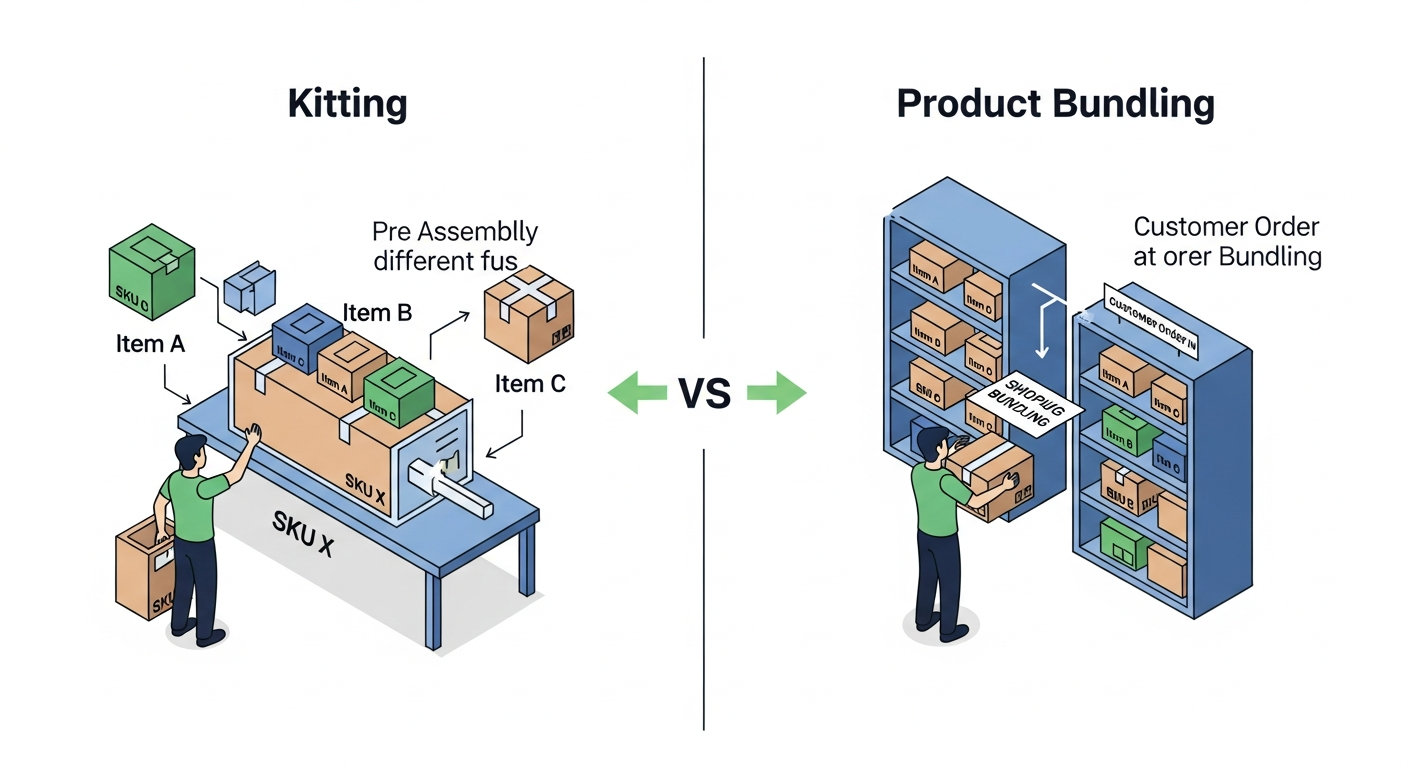
Kitting vs. bundling: kitting requires pre-assembly into a new unique SKU, whereas bundling involves picking individual items as an order is placed.
While often used interchangeably, there is a fundamental difference between kitting and bundling. Bundling is typically a marketing tactic offering a selection of existing products together, often at a discount. These items are often picked individually at the time of order. Kitting, however, is an operational strategy. It requires a pre-defined assembly phase where components are physically joined, labeled, and staged in the warehouse. While a bundle might be assembled on the fly, a kit is managed as a distinct inventory unit, requiring a more rigorous fulfillment process.
That distinction matters because your fulfillment workflow changes depending on whether you are picking items individually or managing a finished kit SKU. Launch Fulfillment’s pick, pack, and ship services help brands reduce fulfillment errors, process orders faster, and keep packaging consistent across each order.
The Evolution of Kitting in Ecommerce and B2B Fulfillment
Kitting has moved from a niche manufacturing practice to a cornerstone of modern ecommerce. Brands now rely on kitting to facilitate complex requirements, such as subscription boxes, seasonal promotional packs, and product starter sets. In B2B environments, kitting is even more critical; it ensures that specialized equipment reaches the end-user with all necessary peripheral components included, preventing downtime and installation errors.
This is especially useful for brands with recurring shipments or curated product experiences. Launch Fulfillment’s subscription box fulfillment services support custom packaging, kitting, inventory tracking, and recurring order fulfillment for brands that need consistency at scale.
The Operational Workflow: How the Kitting Process Works

Step 1: Defining the Bill of Materials (BOM)
The Bill of Materials is the “DNA” of your kit. It is a comprehensive list of every item, including packaging materials and documentation, required to build one kit. An accurate BOM is essential to prevent inventory shortages. Without a clear BOM, your fulfillment process will suffer from bottlenecks, as workers cannot complete assembly if a single component is missing.
From a warehouse perspective, the BOM is what keeps every kit repeatable. It tells the team exactly what belongs in the kit, how it should be packed, what inserts or packaging materials are required, and how the finished SKU should be tracked inside the system.
Step 2: Component Sourcing and Inventory Staging
Once the BOM is established, the logistics team must manage the flow of individual parts. This stage involves receiving, inspecting, and staging components near the kitting station. Proper staging minimizes movement and maximizes speed, ensuring that all components are readily available for the assembly team.
Strong staging also depends on accurate inventory visibility. Launch Fulfillment’s inventory management for ecommerce resources explain why real-time stock visibility is critical for preventing stockouts, overselling, and fulfillment delays.
Step 3: The Assembly Line and Specialized Packaging
This is where the physical packaging occurs. Warehouse staff follow standardized instructions to assemble the kit. Whether it’s placing items into custom gift boxes or shrink-wrapping parts together, this stage turns raw components into a final, retail-ready product. Efficiency here dictates the cost-per-kit, which directly affects your margins.
For brands in categories where presentation matters, this step can also shape customer perception. Beauty, wellness, supplement, and subscription brands often rely on kitting to make the unboxing moment feel intentional rather than transactional.
Step 4: Quality Control, Labelling, and Barcoding
Quality control is non-negotiable. Before a kit is moved to active inventory, it must be verified against the BOM. Each completed kit receives a new barcode, which links it to the parent SKU in your Warehouse Management System (WMS). This ensures that when an order is placed, the scanner identifies the kit as a single, ready-to-ship unit.
GS1’s barcode standards are a useful external reference for understanding how barcodes support product identification, scanning, and supply chain consistency. GS1 barcode standards
Step 5: Final Placement in the Warehouse Management System (WMS)
After assembly, the kits are binned in the warehouse. The WMS must reflect the inventory reduction of the individual components and the corresponding increase in the finished kit SKU. This synchronization is critical for maintaining accurate stock levels and preventing overselling.
Launch Fulfillment’s ecommerce fulfillment services include software that manages SKUs, product combinations, order management, real-time inventory tracking, and multi-channel fulfillment, which is exactly the type of infrastructure kitting depends on.
The Strategic Advantages of Logistics Kitting
Enhancing the Customer Experience through the Unboxing Moment
The “unboxing moment” is a vital touchpoint for modern brands. By utilizing kitting, you can design a curated, cohesive presentation that standard pick-and-pack methods cannot replicate. A professionally assembled kit delivers a sense of quality and intention, turning a simple purchase into a memorable brand experience that fosters customer loyalty.
This matters even more for product categories where presentation and trust influence repeat purchases. Launch Fulfillment supports category-specific workflows for beauty supply fulfillment, supplement fulfillment services, and other DTC brands that need both speed and care.
Increasing Average Order Value (AOV) with Curated Kits
Kitting allows brands to strategically pair high-velocity “hero” products with lower-moving accessories. By presenting these as a single kit, you increase the perceived value of the purchase, effectively raising the average order value. It simplifies the purchasing decision for the customer, who sees a complete solution rather than a list of individual items.
Shopify also frames product bundling as a way to increase average order value and move complementary products together, which aligns with the ecommerce strategy behind many kitting programs. Shopify’s product bundling guide
Reducing Fulfillment Errors and Improving Order Accuracy
One of the most significant benefits of kitting is the mitigation of human error. When an order consists of a single kit SKU, the picker only needs to scan one item. This reduces the complexity of the fulfillment process significantly compared to picking five or six individual items, ensuring that the customer receives exactly what they ordered every time.
Fewer picks usually mean fewer chances for mistakes. That is why kitting pairs so well with Launch Fulfillment’s order management and order processing workflows, where accuracy, routing, and speed all affect the customer experience.
Faster Order Fulfillment and Pick-and-Pack Speed
Speed is the currency of ecommerce. By consolidating multiple items into one pre-assembled kit, you eliminate the time spent walking through aisles to collect individual parts. This leads to faster throughput in the warehouse, reduced labor costs, and a more streamlined operation that can handle higher order volumes during peak seasons.
This becomes especially valuable during promotional drops, holiday spikes, or recurring subscription cycles. Instead of rebuilding the same multi-item order hundreds or thousands of times, your team can pick one finished SKU and move faster with less operational friction.
The Financial Impact: Shipping Costs and Inventory Management
Kitting should reduce costs, not create them.
Poor packaging, inefficient workflows, and inventory gaps quietly increase fulfillment costs. A better setup fixes that.
Managing Dimensional Weight (DIM) Pricing through Optimized Packaging
Shipping costs are often driven by dimensional weight (DIM), the volume a package occupies rather than its actual weight. Kitting allows brands to design optimized packaging that fits the specific dimensions of the kit’s components. By eliminating “dead space” inside the shipping box, you can significantly reduce your DIM weight charges, which lowers the cost of shipping per unit.
For more on how packaging, shipping zones, carrier rates, and product size shape total cost, see Launch Fulfillment’s ecommerce fulfillment pricing guide.
Reducing Shipping Costs with Consolidated Shipments
Shipping one large box is almost always cheaper than shipping three or four smaller packages. Kitting centralizes multiple items into one footprint, reducing total shipping labels and postage fees. For high-volume brands, these savings compound rapidly, improving the bottom-line profitability of every order fulfilled.
This is where kitting connects directly to shipping strategy. Launch Fulfillment’s ecommerce shipping services and solutions guide covers shipping methods, dimensional weight, expedited shipping, carrier selection, and fulfillment integrations that can help brands control delivery costs.
Turning Deadstock and Slow-Moving Inventory into High-Value Bundles
Every brand has slow-moving inventory taking up valuable shelf space. Kitting provides a strategic remedy: pairing these items with best-sellers. By creating a “starter pack” or a “limited edition set,” you can move stale inventory and recover working capital, turning deadstock into a value-add that customers are excited to purchase.
That said, this only works when inventory data is accurate enough to identify what is truly slow-moving. Launch Fulfillment’s inventory position guide is useful for understanding how stock availability, open orders, and replenishment timing affect smarter inventory decisions.
Improving Inventory Accuracy and Tracking across SKU Hierarchies
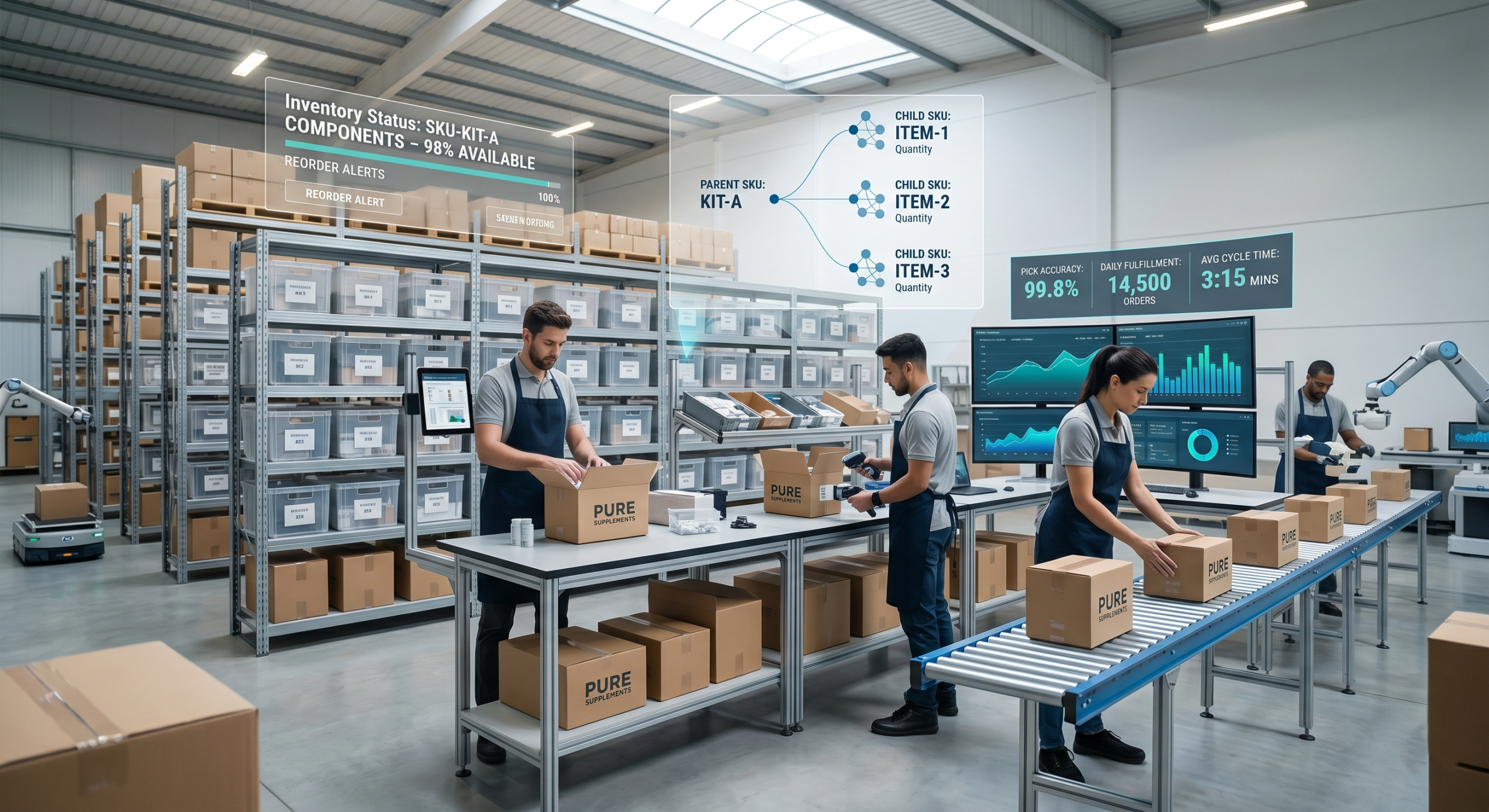
A sophisticated 3PL partner will manage kitting using an SKU hierarchy. This means the system tracks both the parent SKU (the kit) and the child SKUs (the individual components). This data transparency allows for precise reporting and automated replenishment, ensuring that you never run out of critical components that would stall your entire kitting operation.
When inventory accuracy breaks down, kitting gets messy fast. One missing child SKU can make the entire kit unavailable, even if every other component is stocked. That is why real-time component tracking is not a nice-to-have; it is the foundation of reliable kitting.
Technical Integration: Managing Kitting in Your Tech Stack
How a Warehouse Management System (WMS) Handles Parent and Child SKUs
A robust WMS is the backbone of successful kitting. It must support a tree-like data structure where the parent kit is linked to its constituent child components. When an order is placed, the WMS automatically “explodes” the kit, decrementing the stock level of each individual component in real-time. This prevents the “phantom inventory” problem that occurs when software fails to track underlying parts.
ASCM’s overview of inventory control is helpful here because it emphasizes that inventory control is about systems and procedures that maintain proper stock levels and support operational accuracy. ASCM inventory control overview
Real-Time Inventory Tracking for Individual Components
Visibility is key. Your system must provide real-time updates on component levels. If a component is running low, the WMS should flag the kit as “out of stock” on your ecommerce platform. This prevents the nightmare scenario of accepting orders you cannot fulfill, which erodes trust and damages your brand reputation.
This is also where Launch Fulfillment’s 3PL fulfillment services provide a stronger operational base for growing brands, combining warehousing, inventory visibility, order fulfillment, shipping, and returns management.
Automating Replenishment Triggers for Kit Components
Advanced systems use automated triggers to reorder components based on consumption rates. As kits are sold, the WMS calculates the depletion of child components and can automatically generate a purchase order for restocking. This proactive approach to logistics ensures that your assembly line never grinds to a halt due to missing parts.
For brands trying to improve this side of operations, Launch Fulfillment’s inventory restocking methods article gives practical context on replenishment and restocking strategy.
Integration with Ecommerce Platforms like Shopify
Integration between your WMS and your storefront, such as Shopify, Magento, or BigCommerce, is essential. When a customer orders a kit, the platform sends the order to the 3PL; the WMS then coordinates the pick of the parent SKU. This seamless loop ensures that your website front-end always shows accurate availability, creating a frictionless path from cart to door.
Launch Fulfillment’s ecommerce fulfillment services support integrations with major ecommerce platforms and help brands manage SKUs, product combinations, fulfillment, real-time inventory, and orders across sales channels.
Professional Implementation: Establishing a Kitting SOP
Designing an Efficient Kitting Station and Workflow
A dedicated kitting station should be ergonomic and logically organized. Tools, packaging materials, and components should be placed within reach to minimize unnecessary motion. A well-designed workspace significantly reduces fatigue and assembly errors, directly contributing to a higher-quality output.
In practice, the difference between a good kitting process and a frustrating one is often the station layout. The best kitting workflows reduce motion, standardize inputs, and make it easy for warehouse teams to confirm accuracy before the finished kit enters inventory.
Establishing Clear Assembly Instructions for Warehouse Staff
Never assume that the assembly process is self-explanatory. Create a visual SOP for every kit. This should include photos of the final kit, a detailed BOM, and specific instructions for packaging. When warehouse staff have clear documentation, they work faster and with greater consistency.
This is especially important when scaling seasonal kits, influencer boxes, subscription kits, or promotional drops. Consistency is what keeps a creative packaging idea from becoming a warehouse headache.
Determining Pre-Kitting vs. On-Demand Kitting Strategies
Brands must choose between two strategies:
- Pre-Kitting: Assembling kits in advance and storing them as finished goods. This is ideal for high-volume items or subscription boxes. It increases pick speed but ties up inventory space.
- On-Demand Kitting: Assembling the kit only after an order is placed. This saves space and allows for greater customization but adds time to the fulfillment process.
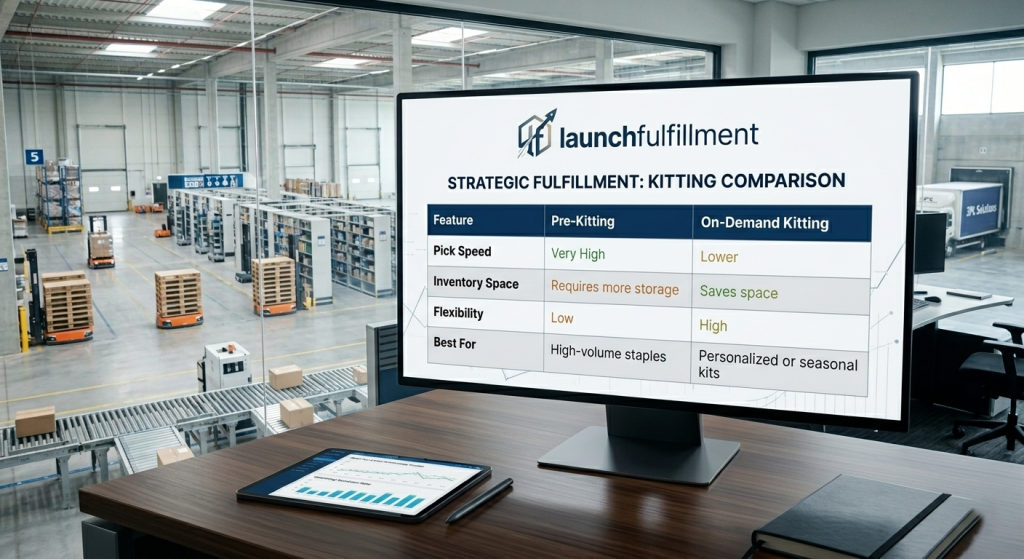
Pre-kitting is often the better fit when speed and repeatability matter most. On-demand kitting is usually better when personalization, seasonality, or inventory flexibility matters more. The right answer depends on volume, SKU complexity, storage costs, and how quickly customers expect orders to ship.
Ready to Simplify Your Kitting and Assembly Process?
If your team is spending too much time assembling kits, correcting errors, or managing inventory complexity, it may be time for a better fulfillment setup. Talk to Launch Fulfillment about custom kitting and assembly services built for growing ecommerce brands.
Ready to turn kitting into a scalable system?
Build a fulfillment operation that handles assembly, inventory, and shipping without slowing your growth.
Final Thoughts
Kitting is far more than a convenience; it is a sophisticated logistics tool that drives operational efficiency and enhances the bottom line. By mastering the balance between BOM management, WMS integration, and strategic packaging, brands can achieve significant savings in shipping and labor while simultaneously elevating the customer experience. The move from simple fulfillment to a kitting-centric model requires careful planning and a reliable technology stack, but the rewards increased AOV, reduced error rates, and a more refined unboxing experience are profound.
To begin, audit your current inventory for underperforming items and evaluate your fulfillment data to identify where kitting can streamline your throughput. Start by standardizing your BOMs, then work with your 3PL to pilot an assembly process that aligns with your brand’s growth trajectory. By treating kitting as a core operational competency rather than an afterthought, you ensure that your logistics strategy remains a competitive advantage in a crowded market.
Launch Fulfillment helps brands turn kitting from a manual burden into a scalable fulfillment process. From custom assembly and inventory tracking to pick, pack, ship, and subscription fulfillment, the right partner can help you create better customer experiences while keeping operations efficient behind the scenes.
