
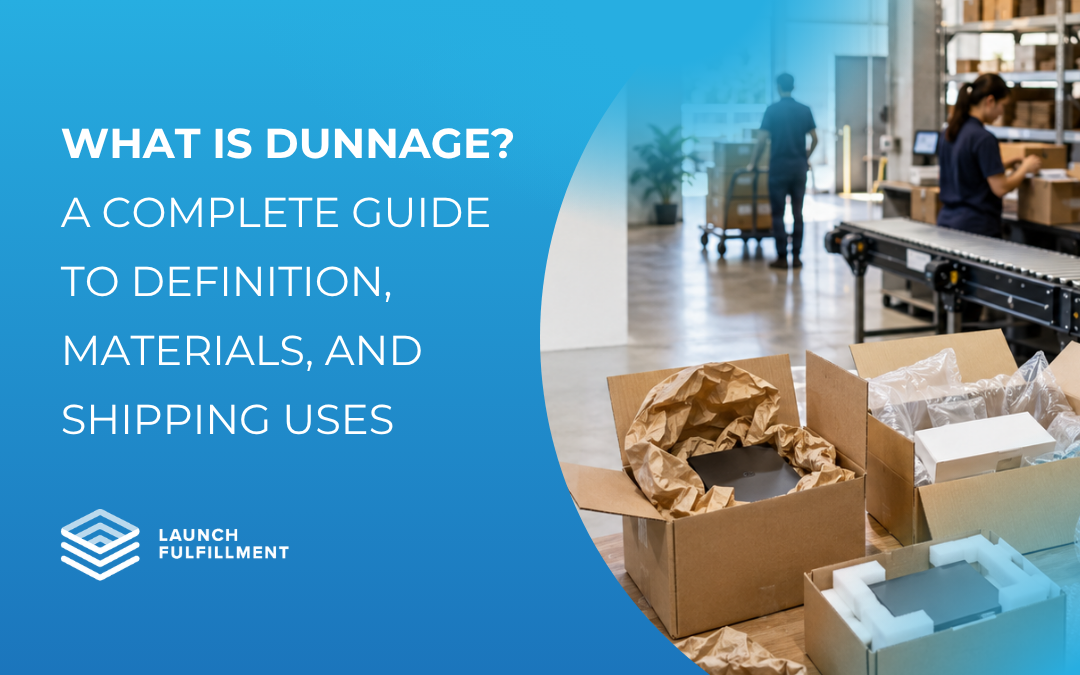
Key Takeaways
- The dunnage meaning in logistics refers to materials used to protect, stabilize, separate, cushion, or secure products during storage, handling, and shipping. It can include kraft paper, air pillows, bubble wrap, foam inserts, wood bracing, inflatable bags, and custom packaging components.
- Dunnage helps prevent product damage by reducing shock, vibration, movement, moisture exposure, and load shifting during transit. The right material depends on the product type, shipping method, package size, and level of protection needed.
- E-commerce dunnage directly affects customer experience. Void fill, interior packaging, and branded protective materials can reduce returns, improve unboxing, and help products arrive in better condition.
- Heavy-duty dunnage is essential for freight, industrial shipping, and container loads. Wood blocking, steel supports, load bars, and inflatable dunnage bags help stabilize cargo during truck, rail, ocean, and intermodal transportation.
- Choosing the right dunnage requires balancing protection, cost, shipping weight, sustainability, and fulfillment speed. Too little protection increases damage risk, while excessive packaging can raise shipping costs and create unnecessary waste.
- Sustainable dunnage materials are becoming more important for modern brands. Recycled paper, molded pulp, corrugated inserts, reusable plastic dunnage, and biodegradable materials can help reduce packaging waste while still protecting products.
- Dunnage should be treated as a strategic fulfillment asset, not just packing filler. When managed correctly, it can reduce damage claims, improve operational consistency, lower return costs, and support a more reliable customer delivery experience.
In the high-stakes arena of global logistics, the difference between a successful delivery and a costly insurance claim often comes down to a single, frequently overlooked factor: dunnage. While modern supply chains rely on advanced tracking and automated sorting, the physical protection of cargo remains a fundamental engineering challenge. Without proper dunnage, the modern global economy would be “damaged upon arrival.” This guide explores how dunnage has evolved from a rudimentary term for discarded scrap into a sophisticated tool for supply chain resilience, protecting everything from delicate electronics to industrial steel beams.
At Launch Fulfillment, we see dunnage as more than packing filler. It is part of a complete ecommerce fulfillment services strategy that protects products, supports better customer experiences, reduces returns, and helps brands ship with confidence.
Beyond the Padding: Defining Dunnage in Modern Logistics
The Etymology and Evolution: From Middle English to Modern Global Trade
The term “dunnage” traces its roots to Middle English, historically referring to the mats, boughs, or loose wood placed at the bottom of a ship’s hold. Its original purpose was simple: keep cargo off the damp hull and prevent shifting in heavy seas. Today, the definition has expanded to encompass any material used to load, secure, and protect cargo during transportation. It is no longer just about filling a void; it is about precision engineering to ensure structural integrity across air, sea, rail, and road.
For e-commerce brands, dunnage often shows up as kraft paper, air pillows, bubble wrap, foam inserts, crinkle paper, molded pulp, or custom inserts. For freight and industrial shipping, it may include wood blocking, bracing, steel supports, load bars, or inflatable dunnage bags. The material changes, but the goal stays the same: protect the product until it reaches the customer or end user.
The Three Pillars of Dunnage: Protection, Stability, and Ventilation
The utility of dunnage rests on three pillars. First, protection: shielding goods from impact and environmental hazards. Second, stability: preventing lateral or longitudinal movement that causes damage during transit. Third, ventilation: ensuring that airflow, or the lack thereof, prevents issues like condensation. By addressing these three vectors, logistics managers turn the act of packing from a chore into a strategic method for mitigating financial risk.
That is why Launch Fulfillment treats packaging decisions as part of the broader pick, pack, and ship process. Dunnage should support product safety, dimensional weight control, fulfillment efficiency, and a clean unboxing experience.
Need Smarter Packaging and Fulfillment Support?
Launch Fulfillment helps ecommerce brands protect products with better packing workflows, optimized materials, accurate fulfillment, and shipping strategies designed to reduce damage and improve customer experience.
The Physics of Protection: How Dunnage Works
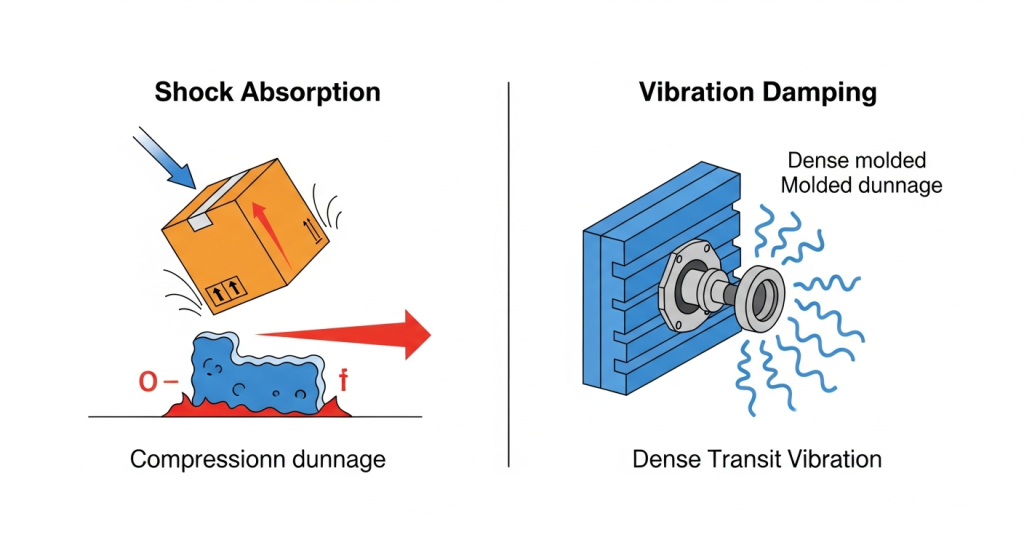
Shock vs. Vibration: Different dunnage materials are required to absorb sudden impacts (shock) versus dissipating continuous transit resonance (vibration).
Shock Absorption vs. Vibration Damping: Understanding the Impact Force
Logistics engineers must distinguish between shock and vibration. Shock is a sudden, high-magnitude event, such as a drop or a forklift collision. Protection against shock requires materials that can compress and absorb energy. Vibration, by contrast, is the cumulative resonance experienced during long-haul trucking or air freight. Vibration damping requires materials with specific density profiles that dissipate energy over time, preventing the “rattling” effect that causes fatigue in mechanical components.
This distinction matters in order fulfillment because a lightweight skincare bottle, a glass supplement jar, a subscription box, and an industrial component all need different protection strategies. Using the same dunnage for every product is easy, but easy is not always profitable.
Load Stability: Preventing Lateral Shifting in Transit
When a container is not fully packed, cargo is prone to shifting. Even minor shifts can lead to a “domino effect,” resulting in collapsed pallets and damaged goods. Bracing techniques, whether through wood frames or plastic dunnage, ensure that cargo remains locked in its designated position. This rigidity is critical for intermodal transport, where cargo moves between ship, rail, and truck, subjecting the load to varying directional forces.
For brands shipping parcel orders, the same principle applies inside the box. If a product has room to bounce, rotate, or press against weaker components, the risk of damage increases before the carrier ever reaches the doorstep.
Moisture Protection: Managing Humidity and Air Circulation
Moisture is the silent killer of cargo. In long-haul international shipping, temperature fluctuations inside a container can lead to condensation, threatening electronics and perishables. Proper dunnage allows for necessary air circulation while preventing goods from direct contact with wet floors. In sensitive shipments, desiccant packs are often integrated into the dunnage system to manage the microclimate within the packaging, ensuring that humidity levels remain within safety thresholds throughout the voyage.
Brands in supplements, beauty, wellness, and personal care should evaluate dunnage alongside fulfillment services by industry, since product category, packaging sensitivity, storage conditions, and customer expectations all influence how protective packaging should be handled.
Heavy-Duty Dunnage for Industrial Freight and Shipping Containers

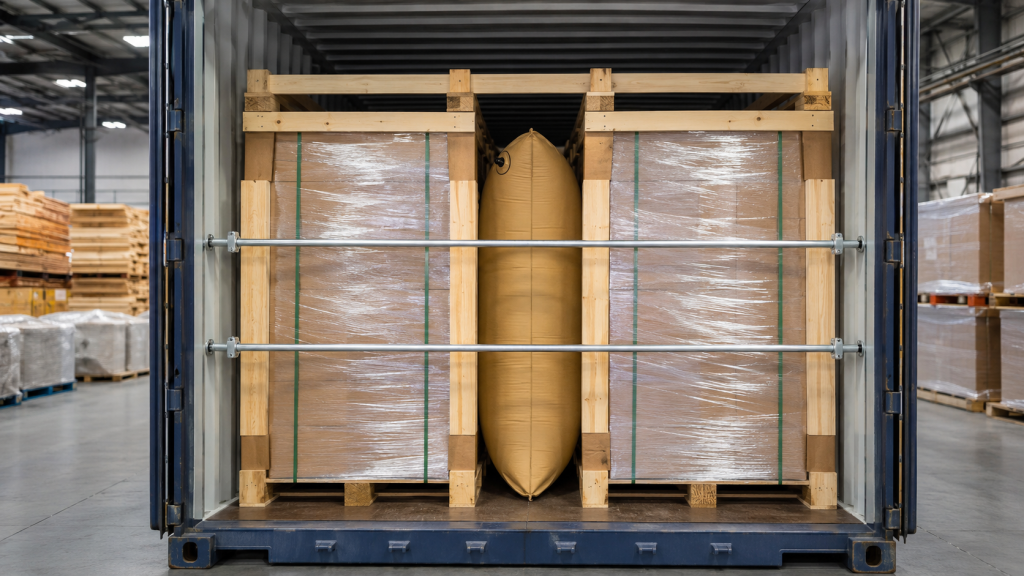 Heavy-duty dunnage helps stabilize freight, prevent shifting, and protect cargo during long-distance transportation.
Heavy-duty dunnage helps stabilize freight, prevent shifting, and protect cargo during long-distance transportation.
Wood Dunnage: From Traditional Pallets to Cribbing and Bracing
Wood remains the workhorse of industrial shipping. Its strength-to-cost ratio is unmatched for securing heavy machinery. From standard pallets to custom-built cribbing and bracing, wood dunnage provides the rigidity required to anchor large industrial loads. However, international shipments often require ISPM-15 compliant, heat-treated wood to prevent the spread of invasive pests, highlighting the regulatory complexity involved in physical freight security.
For international shipments using wood packaging materials, compliance cannot be an afterthought. USDA APHIS states that wood packaging material entering or transiting the United States must be pest-free, debarked, treated, and marked with an ISPM 15 logo when applicable. USDA APHIS ISPM 15 guidance
Steel and Load Bars: Securing Heavy Manufactured Goods and Steel Beams
For extreme weight, steel components are required. Steel bars and specialized metal cradles are used to immobilize heavy manufactured goods, such as automotive engines or steel beams, within a container. These systems are often reusable, offering a sustainable alternative to disposable wood blocking and bracing while providing the structural confidence needed for high-value industrial assets.
While most ecommerce brands will not need steel bracing, the lesson still applies: high-value or damage-prone products deserve packaging systems that match the risk level, not whatever filler happens to be sitting closest to the packing station.
Inflatable Air Bags: Stabilizing Unit Loads in Railcars and Intermodal Transport
Dunnage bags have revolutionized load stabilization in rail and intermodal transport. These inflatable bladders are inserted into voids between palletized goods. Once inflated, they conform to the shape of the cargo, providing a snug, cushioned barrier that prevents movement. Their ability to expand and contract with the shifting of the load makes them highly effective at protecting goods against the heavy shunting forces common in rail transit.
For e-commerce brands working with warehousing and fulfillment services, the same thinking can be applied at a smaller scale: right-size the package, fill the void, limit movement, and protect the customer experience.
Parcel and eCommerce Dunnage: Protecting the Customer Experience
 Parcel dunnage materials help stabilize products, protect fragile items, and improve the e-commerce unboxing experience.
Parcel dunnage materials help stabilize products, protect fragile items, and improve the e-commerce unboxing experience.
Void Fillers: Air Pillows, Packing Peanuts, and Kraft Paper
In the world of e-commerce, the “unboxing experience” is the final marketing touchpoint. Effective void fillers such as air pillows, lightweight packing peanuts, and sustainable kraft paper serve a dual purpose: they stabilize the product and signal quality to the customer. While air pillows offer excellent shock absorption for lightweight items, corrugated paper is increasingly favored for its recyclability and clean aesthetic, aligning shipping practices with modern brand sustainability goals.
Launch Fulfillment supports brands that need packaging to feel intentional, not improvised. Whether the shipment includes beauty products, supplements, apparel, bundles, or subscription boxes, the dunnage should protect the item while reinforcing the brand promise.
Interior Packaging: Bubble Wrap, Crinkle Paper, and Foam Inserts
For fragile items, interior protection is paramount. Bubble wrap remains the gold standard for surface protection, while custom-molded foam inserts are essential for high-value electronics. These materials are engineered to isolate the product from the exterior box. By utilizing protective layering, companies significantly reduce the likelihood of returns and negative reviews, turning packaging into a retention tool.
This is especially important for brands that rely on kitting and assembly services, where multiple items, inserts, samples, or components may ship together. Dunnage needs to protect each item individually and the full kit as a unit.
Sustainable Alternatives: Recycled Materials and Plastic Bracing
The transition toward sustainability is moving companies away from single-use plastics. Many brands are adopting molded pulp, recycled cardboard inserts, and biodegradable starch-based packing materials. Even in heavy industry, there is a push toward reusable plastic dunnage, durable, custom-fitted inserts that can be returned and reused for hundreds of shipments, effectively closing the loop on packaging waste.
Eco-conscious packaging should still perform. A sustainable filler that fails to prevent damage can create more waste through reships, returns, replacement products, and frustrated customers. The strongest packaging strategy balances protection, cost, sustainability, and fulfillment speed.
Protect the Product and the Unboxing Experience
Launch Fulfillment helps ecommerce brands use smarter fulfillment workflows, packaging materials, kitting support, and shipping strategy to reduce damage and deliver a better customer experience.
Industry-Specific Applications: When Dunnage Becomes a Specialty
The Distillery Niche: Maturing Casks, Evaporation Loss, and Microclimatic Differences
In the distillery industry, dunnage refers to the physical storage of maturing casks. These warehouses use specific stacking methods to manage evaporation (the “Angel’s Share”) and ensure consistent airflow around every barrel. Proper arrangement or “dunnaging” is an art form that directly impacts the flavor profile and aging speed of the spirit, proving that in some industries, dunnage is an active participant in production.
For e-commerce fulfillment, the takeaway is not about spirits. It is about specificity. The right storage and packaging method depends on the product’s materials, fragility, shelf life, temperature sensitivity, and brand presentation requirements.
Medical Device Manufacturing: Sterile Barrier Systems and ISO 11607 Compliance
Medical packaging is perhaps the most regulated application of dunnage. Under ISO 11607, every packaging component must ensure the sterility of the medical device until it reaches the point of use. Here, dunnage is not merely for cushioning; it is a critical component of the sterile barrier system, designed to withstand sterilization processes like ethylene oxide or gamma radiation without compromising the integrity of the device.
ISO states that ISO 11607-1 specifies requirements and test methods for materials, preformed sterile barrier systems, sterile barrier systems, and packaging systems intended to maintain sterility of terminally sterilized medical devices until the point of use. ISO 11607-1 overview
Automotive and Aerospace: Custom Kit Packaging and Reusable Plastic Dunnage
The automotive sector relies heavily on custom, reusable plastic dunnage. These “kit” systems are designed for specific parts, such as engine blocks or dashboard assemblies. Because these parts are shipped in a loop between suppliers and assembly plants, the dunnage is engineered for extreme durability and ergonomic handling, ensuring that parts can be extracted quickly on the assembly line without damage.
For e-commerce brands, this reinforces a practical point: custom packaging is not just about looking premium. When designed correctly, it reduces product movement, improves packing consistency, and helps fulfillment teams work faster.
Technical Standards and Compliance: The Science of Package Validation
Distribution Simulation Testing: ASTM D4169 Schedule E and Vibration Testing
Companies often turn to ASTM D4169, a gold standard for performance testing. Schedule E of this standard specifically focuses on the rigors of vehicle transport. By subjecting packages to controlled vibration, drop, and compression testing, manufacturers can validate their dunnage designs before mass-shipping. This proactive testing identifies weaknesses in the packaging strategy, allowing for optimizations that prevent damage before it occurs.
ASTM describes D4169 as a standard practice that provides a uniform system for evaluating shipping units using test methods at levels representative of actual distribution conditions. ASTM D4169 overview
FDA Regulations and Quality Management System Requirements (QMSR)
For medical and pharmaceutical logistics, packaging must align with strict Quality Management System requirements. Documentation of the packaging process, validation of protective materials, and proof of consistency are mandatory. Any change in dunnage material or configuration requires a rigorous re-validation process to ensure it continues to meet safety and sterility standards, making the choice of dunnage a critical legal and operational decision.
The FDA’s medical device Quality Management System Regulation page provides descriptions of quality system requirements, and 21 CFR Part 820 governs methods, facilities, and controls used for the design, manufacture, packaging, labeling, storage, installation, and servicing of finished devices intended for human use. FDA QMSR overview 21 CFR Part 820
The Role of Dummy Samples in Medical Package Testing
During the development of new packaging, “dummy samples”, non-functional versions of the product are used to test the efficacy of the dunnage. This allows engineers to push the limits of the packaging to see exactly where and how it might fail, without the expense of damaging real medical equipment. This methodical approach is the hallmark of a mature logistics operation.
Even outside medical devices, sample testing is a smart practice. Before sending a fragile product through thousands of customer orders, brands should test packaging under realistic shipping conditions and make adjustments before damage becomes expensive at scale.
Operational Strategy: The ROI of High-Quality Dunnage
Cost-Benefit Analysis: Damage Protection vs. Shipping Weight
The primary challenge in dunnage selection is the trade-off between weight and protection. Excess dunnage increases shipping costs, particularly in air freight, where weight is at a premium. However, the cost of a single damaged return often outweighs the cost of the extra packaging material. A sophisticated ROI analysis factors in not just the material cost, but the total cost of quality, including labor, return logistics, and the “invisible” cost of lost customer loyalty.
This is where dunnage decisions connect directly to shipping and handling costs. The cheapest filler is not always the lowest-cost option if it leads to higher damage rates, return costs, customer support tickets, or reshipments.
Inventory Management: Tracking Packaging Components within a WMS
For companies using reusable plastic dunnage or high-value pallets, the dunnage itself is an asset. These items should be tracked within a Warehouse Management System (WMS) as inventory. Losing track of reusable packaging can lead to stockouts and procurement delays, highlighting the need for internal controls that treat packaging components with the same care as the products they protect.
For e-commerce brands, packaging supplies should also be part of inventory management. Running out of the right box, insert, or protective material can slow fulfillment, force poor substitutions, and create avoidable damage risk.
Shipping Insurance and the Financial Impact of Damage Claims
Insurance premiums are heavily influenced by the history of damage claims. A company that demonstrates a commitment to robust, validated dunnage is a lower risk for insurers. By consistently reducing damage rates, companies can negotiate lower premiums and enjoy fewer disruptions to their supply chain. This is the “hidden” financial benefit of moving from generic to engineered dunnage.
Damage prevention also supports better returns management. Fewer damaged deliveries mean fewer replacements, fewer refunds, fewer support tickets, and a cleaner customer experience.
Sustainability and the Future of Dunnage Materials
The Shift from Disposable to Reusable Materials
The future of dunnage is circular. We are seeing a shift away from linear, “use-and-discard” models in favor of reusable plastic dunnage systems that integrate into returnable transit packaging (RTP) loops. Companies are increasingly auditing their packaging footprint, replacing single-use materials with robust, long-term alternatives. This not only meets regulatory environmental standards but also aligns with the growing consumer demand for reduced packaging waste, positioning sustainable shipping as a competitive advantage in a crowded global marketplace.
For e-commerce brands, sustainability should be paired with fulfillment practicality. The best dunnage materials protect the product, fit the package, support efficient warehouse workflows, and create an unboxing experience customers remember for the right reasons.
Build a Packaging Strategy That Scales
Launch Fulfillment helps ecommerce brands improve packing workflows, reduce product damage, support branded experiences, and scale fulfillment operations with packaging strategies that fit the product and the customer.
Final Thoughts
Dunnage is far more than mere padding or filler; it is an essential component of modern supply chain architecture. From the heavy-duty steel bracing required for industrial shipping to the delicate, sterile-grade barriers used in medical manufacturing, the engineering behind dunnage dictates the success of global logistics. By integrating advanced materials, adhering to rigorous standards like ASTM D4169, and focusing on the total lifecycle of packaging, businesses can effectively mitigate the risks of damage, improve their bottom line, and enhance the customer experience. Moving forward, the industry must continue to innovate by prioritizing reusability and sustainability. As supply chains become more complex, the companies that treat their dunnage as a strategic asset rather than a consumable expense will undoubtedly emerge as the leaders in resilience and reliability. Ensure your packaging strategy reflects this precision to turn every delivery into a flawless arrival.
If your current packaging strategy is creating damage, returns, or inconsistent unboxing experiences, contact Launch Fulfillment to build a fulfillment workflow that protects products from warehouse shelf to customer doorstep.
Related Posts
FAQ: Dunnage Meaning
What is the meaning of dunnage?
Dunnage refers to the protective materials used to cushion, secure, separate, or stabilize products during shipping, handling, and storage. In e-commerce fulfillment, dunnage can include kraft paper, air pillows, bubble wrap, foam inserts, corrugated dividers, crinkle paper, or molded pulp. In freight shipping, it can include wood bracing, pallets, load bars, and inflatable dunnage bags.
What is the main purpose of dunnage?
The main purpose of dunnage is to protect products from damage during transit. It helps reduce movement inside a box, absorb shock, prevent vibration damage, separate items, improve load stability, and protect shipments from moisture or impact. Good dunnage can also reduce returns, replacement costs, and customer complaints.
What are the different types of dunnage?
Common types of dunnage include paper dunnage, plastic dunnage, foam dunnage, wood dunnage, corrugated cardboard inserts, air pillows, bubble wrap, packing peanuts, molded pulp, crinkle paper, and inflatable dunnage bags. The right material depends on the product’s fragility, weight, shipping method, sustainability goals, and packaging design.
What does dunnage look like?
Dunnage can look like crumpled kraft paper inside a box, air pillows filling empty space, bubble wrap around fragile items, foam inserts holding products in place, cardboard dividers separating items, or wood bracing securing freight. In ecommerce, dunnage is usually found inside the package. In freight, it may be placed around pallets, crates, or container loads.
What does dunnage mean in trucking?
In trucking, dunnage usually refers to the materials used to secure freight and prevent cargo from shifting during transport. This can include wood blocks, rubber mats, load bars, straps, inflatable dunnage bags, pallets, or other protective materials placed around or between freight.
Is a pallet considered dunnage?
Yes, a pallet can be considered a type of dunnage because it helps support, elevate, stabilize, and protect goods during storage and transportation. Pallets also make freight easier to move with forklifts and help keep products off warehouse floors or container surfaces.
What is dunnage material?
Dunnage material is any protective material used to secure or cushion products during shipping. Examples include kraft paper, bubble wrap, foam, corrugated cardboard, molded pulp, air pillows, plastic inserts, wood blocks, and inflatable bags. The best dunnage material depends on the shipment’s size, weight, fragility, and delivery environment.
