

Key Takeaways
- Kitting and bundling serve different strategic purposes. Kitting is an operational process that improves fulfillment efficiency, while bundling is a merchandising strategy that increases conversions and order value.
- Kitting simplifies fulfillment at scale. By pre-assembling products into a single unit, brands can reduce picking complexity, improve accuracy, and streamline warehouse workflows.
- Bundling boosts revenue without changing operations. Grouping products at the storefront level helps increase average order value and improve product discovery with minimal backend changes.
- Your choice impacts more than just sales. Kitting and bundling affect inventory management, SKU structure, fulfillment speed, and overall operational complexity.
- Customer perception differs between the two. Kitting sells convenience and completeness, while bundling emphasizes value, savings, and flexibility.
- Many brands benefit from using both strategies together. A hybrid approach allows you to balance operational efficiency with merchandising flexibility.
- Execution matters as much as strategy. Poor inventory visibility, unclear workflows, or weak warehouse processes can turn a strong product strategy into operational friction.
In the hyper-competitive e-commerce arena, simply listing products is not enough. To truly stand out, capture customer attention, and drive sustainable growth, brands need strategies that improve both value perception and operational efficiency. Two of the most effective, and most often confused, approaches are product kitting and assembly services and product bundling.
While both involve grouping items together, their strategic intent, operational execution, and impact on your business are very different. At Launch Fulfillment, we see this confusion often: brands know they want to sell smarter, improve the customer experience, and simplify fulfillment, but they are not always sure whether they need a kit, a bundle, or a mix of both.
This guide breaks down kitting vs. bundling in practical terms so you can make the right decision for your business, improve operational efficiency, and create a stronger ecommerce growth strategy.

The Power of Kitting and Bundling for Modern Brands
For modern ecommerce brands, strategic product grouping is more than a merchandising tactic. Done well, it can strengthen your ecommerce fulfillment operation, increase order value, reduce friction in the buying journey, and create a more compelling customer offer.
Kitting and bundling can also support broader business goals. They can help move inventory more intelligently, simplify warehouse workflows, improve packaging consistency, and create more memorable unboxing experiences. In many cases, they also make it easier to scale order volume without creating avoidable complexity inside the warehouse.
That is why growing brands often pair product grouping strategies with a more structured third-party logistics strategy rather than treating them as one-off promotional tactics.
Not sure if you need kitting, bundling, or both?
Launch Fulfillment helps ecommerce brands design smarter product grouping strategies that improve fulfillment efficiency and increase order value—without creating operational headaches.
What You’ll Learn in This Guide
In this article, we will explain what kitting is, what bundling is, and where each approach fits best. We will also cover how they affect inventory, fulfillment, pricing, customer perception, and long-term ecommerce growth.
Just as importantly, we will look at how these strategies work in the real world. A product grouping decision may look simple on the storefront, but it can create major downstream effects in picking, packing, storage, SKU management, and replenishment. If you are trying to build a more reliable fulfillment engine, that distinction matters.
Kitting Defined: Precision Assembly for Enhanced Value
At its core, product kitting is an operations-driven strategy. It involves physically combining multiple items or components into a single pre-assembled unit that is then handled as one ready-to-ship product. This is especially useful for brands that want more control over presentation, consistency, and fulfillment speed.
What Is Product Kitting?
Product kitting is the process of grouping separate items into one cohesive package so they can be picked, packed, and shipped as a single unit. In many cases, the completed kit receives its own internal identifier and workflow treatment, allowing brands to streamline order handling and reduce warehouse friction.
For example, a brand might combine a supplement bottle, sample pack, insert card, and branded shaker into one promotional starter kit. A subscription company might assemble a monthly box with a fixed set of components before orders are released. A beauty brand may create a holiday gift kit that includes multiple SKUs packaged into one curated offer.
If you want a deeper operational definition, Launch Fulfillment covers the basics in its guide to kitting meaning and 3PL terminology.
The Kitting Process: From Components to a Ready-to-Ship Product
The kitting process usually starts with identifying which components belong together and how the final product should be assembled. From there, inventory is staged, components are gathered, packaging is prepared, and the kit is built according to a defined spec sheet or assembly process.
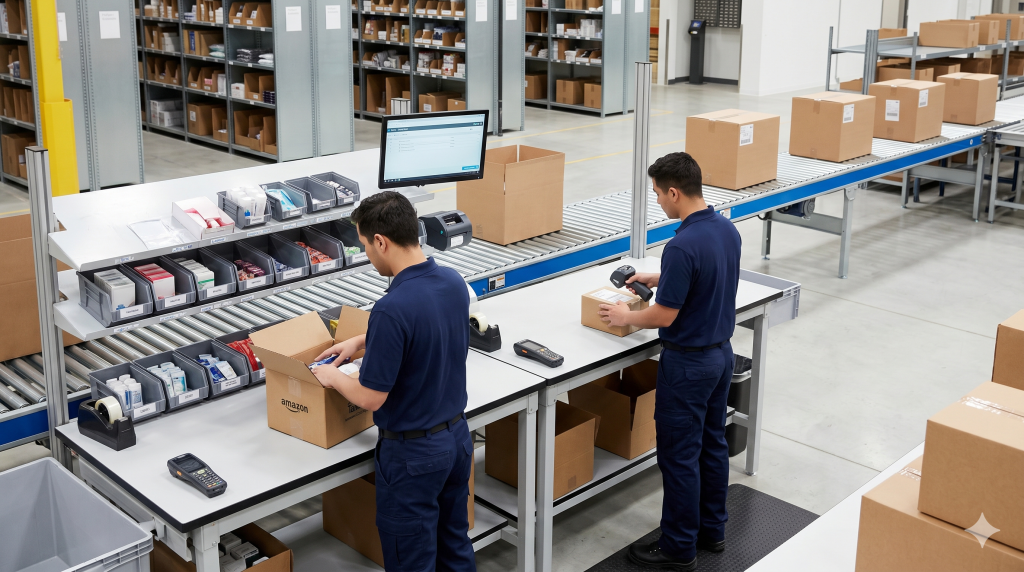
In a well-run fulfillment environment, this often happens in a dedicated work cell or assembly area. Teams verify the count, check for packaging accuracy, insert any required marketing materials, and complete a quality control review before the finished unit is moved into available inventory.
This is one reason brands that offer kits often benefit from working with a partner that already understands how fulfillment works across receiving, storage, assembly, and shipping.
Common Applications of Product Kitting
Kitting is widely used across ecommerce categories. Common examples include:
- Subscription boxes
- Influencer or PR mailers
- Starter packs for new customers
- Gift sets and seasonal launches
- Promotional event kits
- Pre-configured product collections
It is especially effective when the customer is buying a complete experience, not just a collection of separate items. That is why brands with recurring shipments often rely on subscription box fulfillment capabilities that include accurate kitting, packaging, and deadline-driven execution.
Bundling Defined: Strategic Grouping for Customer Appeal
Product bundling is more of a sales and merchandising strategy than an assembly strategy. Instead of creating a physically prebuilt item, bundling usually means offering two or more existing products together as a single purchase option, often at a discount or with stronger perceived value.
What Is Product Bundling?
Bundling involves presenting separate products together in a way that encourages customers to buy more in one transaction. The products may remain separate in your backend systems, but they are marketed as a package to improve conversion and increase average order value.
For example, a skincare brand might bundle a cleanser, toner, and moisturizer into a “routine set.” A coffee brand could bundle beans, filters, and a mug into a giftable package. A tech store may group a laptop stand, wireless mouse, and keyboard as a productivity bundle.
The products are usually still distinct items, but the offer is framed to feel more complete, more convenient, or more valuable.
Common Types of Bundling Strategies
Bundling can take several forms depending on the goal:
- Pure bundles sold only as a package
- Mixed bundles offered both individually and together
- Add-on bundles shown during checkout
- BOGO and tiered discount offers
- Cross-sell bundles based on complementary products
These strategies can be powerful when you want to increase cart size without changing your physical product assortment. They are often used in ecommerce stores that want to lift merchandising performance while keeping warehouse handling relatively simple.
Where Bundling Works Best
Bundling tends to work well when products already complement one another and the primary goal is conversion. It is often a strong fit for promotional campaigns, product education, and value-based merchandising.
Brands also use bundling to introduce slower-moving products, improve product discovery, and increase perceived savings without relying entirely on sitewide discounts.
Kitting vs. Bundling: The Core Differences

Kitting and bundling may look similar on the surface, but they affect operations very differently. Understanding that difference is where better decisions start.
1. Inventory Management and SKU Structure
Kitting usually creates a more structured inventory event because multiple components are being tied to one finished configuration. That requires disciplined stock tracking and clear assembly rules. Inventory management matters here because every component must be available at the right time in the right quantity.
ASCM notes that inventory management helps organizations track stock as it moves in and out of a warehouse, which is exactly why kitting becomes difficult when inventory visibility is weak. External reference
Bundling, by contrast, often leaves products as separate items in the system while the offer exists primarily at the merchandising level. That can make bundling easier to launch, but it can still create fulfillment complexity if order routing and availability rules are not thought through carefully.
2. Fulfillment Workflow Impact
Kitting is typically more efficient at order time because the work is done in advance. Once a kit is assembled correctly, the warehouse only has to pick one finished unit instead of several separate components. That can reduce touches, shorten pick paths, and improve consistency.
Bundling can still be operationally sound, but if the items are picked separately for every order, the fulfillment team may be handling multiple SKUs per shipment instead of one prebuilt unit. In high-volume environments, that difference adds up quickly.
ASCM describes fulfillment as beginning with order placement and ending with dispatch, which is a helpful reminder that product grouping decisions influence the entire flow, not just the storefront. External reference
3. Pricing and Margin Strategy
Bundling often gives brands more pricing flexibility. You can use a bundle to create stronger perceived value, increase basket size, or attach slower-moving items to stronger sellers. Kitting can support this too, but it also introduces labor, assembly time, and packaging considerations that need to be reflected in margin planning.
That does not mean kitting is more expensive in practice. In many cases, it is the opposite. If pre-assembly reduces labor at order time, improves accuracy, and cuts fulfillment friction, the operational savings can justify the setup effort.
Need help deciding whether your product grouping strategy belongs in merchandising, operations, or both? Talk to Launch Fulfillment about building a fulfillment workflow that supports growth without creating unnecessary complexity.
4. Customer Perception
Kitting usually sells convenience and completeness. It tells the customer, “Everything you need is already here.” Bundling often sells value and savings. It tells the customer, “You are getting more for your money.”
Both can improve the customer experience, but they do so in different ways. The right choice depends on what the customer is really buying: a solution, a routine, a set, a gift, a starter experience, or a promotional deal.
Ready to optimize your fulfillment strategy?
If your current setup is slowing down operations or limiting growth, Launch Fulfillment can help you implement kitting, bundling, or hybrid workflows that scale cleanly.
When to Choose Kitting
Kitting is usually the better fit when:
- Your products need to arrive together in a specific format
- The unboxing experience matters
- You want to reduce per-order picking complexity
- You are shipping recurring or standardized product combinations
- You need tighter quality control over what gets assembled and sent
It is also a strong option for brands that need more than basic pick-and-pack. Launch Fulfillment’s custom kitting and assembly services are built for brands that need precision, repeatability, and scalability rather than one-off manual work.
When to Choose Bundling
Bundling is usually the better fit when:
- Your main goal is increasing average order value
- You want to improve merchandising without changing physical prep workflows
- Your products are already sold individually and pair well together
- You are testing seasonal offers or promotional packages
- You want more flexibility in pricing and discounting
Bundling can be especially effective for brands with an established catalog and clear cross-sell opportunities. It is a useful growth lever, but it works best when paired with strong product logic and operational follow-through.
Can You Use Both? Absolutely.
For many brands, the best answer is not kitting or bundling. It is both. You might pre-assemble a core product kit for efficiency, then bundle that kit with another item for a campaign, launch, or seasonal push.
This hybrid approach often gives brands the best of both worlds: operational simplicity in the warehouse and stronger merchandising flexibility on the storefront.
It also aligns well with a broader fulfillment-by-industry strategy because the right setup depends heavily on what you sell, how often you ship, and what customers expect from your category.
Operational Best Practices for Kitting and Bundling
Build Around Inventory Accuracy
Whether you are assembling kits or offering bundles, poor inventory visibility creates downstream problems fast. Missing components, inaccurate available stock, and unclear reorder timing can all delay orders and frustrate customers.
The SBA notes that poor inventory management can be costly and time-consuming, which is why brands should treat inventory control as a growth issue, not just a warehouse issue. External reference
If inventory planning is a weak point, it is worth reviewing concepts like buffer stock and replenishment planning alongside Launch Fulfillment’s recent guide to the safety stock formula.
Clarify Product Identification
When kits or pre-defined assortments are involved, product identification becomes even more important. GS1 explains that GTINs are used to uniquely identify trade items, which reinforces why bundled or kitted configurations need clear product logic and accurate backend setup. External reference
For brands trying to understand how identifiers and catalog structure affect fulfillment, the broader relationship between SKUs, barcodes, and warehouse handling should not be overlooked.
Design for Warehouse Efficiency
Warehouse teams need clear instructions, stable processes, and consistent packaging standards. If a kit requires special inserts, labeling, lot tracking, or fragile-item handling, those details should be documented before scale exposes the cracks.
Launch Fulfillment’s ecommerce fulfillment services and warehouse kitting guide both support the same principle: better process design leads to fewer touches, better accuracy, and more dependable customer outcomes.
Common Pitfalls to Avoid
- Creating bundles that do not feel valuable or logically connected
- Underestimating labor and packaging requirements for kits
- Launching a grouped offer without inventory safeguards
- Ignoring how product grouping affects returns and exchanges
- Choosing a storefront strategy that your warehouse cannot support consistently
One of the biggest mistakes brands make is treating product grouping as a marketing-only decision. In reality, the success of a kitted or bundled offer depends just as much on warehouse execution, replenishment planning, and operational discipline.
Stop letting fulfillment limit your growth
From custom kitting to scalable 3PL operations, Launch Fulfillment helps brands streamline workflows, reduce errors, and ship with confidence at scale.
In Conclusion: Strategically Grouping Your Way to Ecommerce Growth
Kitting and bundling are not interchangeable tactics. They are distinct strategic tools, and each one solves a different problem.
Kitting is best when you need precision, repeatability, and operational control. Bundling is best when you want to improve merchandising, increase perceived value, and drive larger purchases. Many brands benefit most from using both together, provided the backend systems and fulfillment workflows can support the offer cleanly.
At Launch Fulfillment, we believe product grouping should not just help you sell more. It should also help you ship smarter, create a better customer experience, and scale with fewer operational headaches.
Looking to streamline your fulfillment with kitting or bundled product strategies? Talk to Launch Fulfillment and see how we can optimize your operations.
Related Posts
Kitting vs Bundling FAQ
What is kitting and bundling in ecommerce?
Kitting and bundling are both product grouping strategies, but they serve different purposes. Kitting involves physically assembling multiple items into a single ready-to-ship unit, while bundling groups products together for sale without necessarily pre-assembling them. Kitting improves fulfillment efficiency, while bundling is typically used to increase conversions and average order value.
How does product kitting work?
Product kitting works by combining individual components into a pre-assembled package before orders are placed. Inventory is staged, items are gathered, assembled according to a defined process, and stored as a single unit. When an order comes in, the warehouse picks one finished kit instead of multiple separate items, improving speed and accuracy.
What is an example of product bundling?
A common example of bundling is a skincare set that includes a cleanser, toner, and moisturizer sold together at a discounted price. The products remain separate items in the system, but are marketed as a complete routine to increase perceived value and encourage larger purchases.
What is an example of product kitting?
An example of kitting is a subscription box or starter kit where multiple items—such as products, inserts, and packaging—are pre-assembled into a single unit before shipping. This allows the warehouse to treat the kit as one SKU during fulfillment.
What are the different types of product bundling?
Common types of bundling include pure bundles (sold only as a package), mixed bundles (available individually or grouped), add-on bundles at checkout, and promotional bundles like BOGO or tiered discounts. Each type is designed to increase average order value and improve product discovery.
What is the purpose of product bundling?
The primary purpose of bundling is to increase revenue per transaction by encouraging customers to purchase multiple items together. It also helps improve product visibility, move slower inventory, and create stronger perceived value without relying solely on discounts.
What is the purpose of product kitting?
The purpose of kitting is to streamline fulfillment operations by reducing picking complexity, improving accuracy, and ensuring consistency in packaging and presentation. It is especially useful for repeatable product sets, subscription models, and curated customer experiences.
