
Key Takeaways
- Fulfillment is a growth lever, not just an operational task. The way you handle inventory, shipping, and returns directly impacts customer experience, margins, and scalability.
- There is no one-size-fits-all solution. The right fulfillment model depends on your stage of growth—what works for a startup will break at scale.
- In-house fulfillment offers control, but comes with operational complexity. It’s ideal early on or for highly customized experiences, but can quickly become a bottleneck as order volume increases.
- 3PL partnerships unlock scalability and efficiency. Outsourcing fulfillment allows brands to reduce overhead, improve delivery speed, and focus on revenue-driving activities.
- Growth-stage ecommerce brands benefit the most from switching to a 3PL. This is where operational strain peaks and scalability becomes critical to maintaining customer satisfaction.
- Hybrid fulfillment models can bridge the gap. Combining in-house and outsourced logistics allows brands to balance control with flexibility, especially during transitions or seasonal spikes.
- Your fulfillment strategy should evolve as your business grows. Regularly reassessing costs, performance, and customer expectations ensures your logistics don’t limit your growth.
Fulfillment as a Strategic Growth Enabler
In the fast-paced world of e-commerce, fulfillment isn’t just about getting products to customers; it’s a critical strategic enabler for growth. The way you manage your orders, inventory, and shipping profoundly impacts your brand reputation, operational efficiency, and ultimately, your bottom line. As your business scales, the initial, often manual, fulfillment processes that worked in your startup phase can quickly become bottlenecks. This necessitates a strategic re-evaluation of your logistics. The fundamental choice lies between managing fulfillment entirely in-house or entrusting it to a third-party logistics provider. This decision is not static; it must evolve with your business. This article will guide you through understanding both models, assessing your current growth stage, and making an informed choice that fuels sustainable e-commerce expansion.
At Launch Fulfillment, we’ve seen this firsthand: the brands that scale best are usually the ones that stop treating fulfillment like a back-office chore and start treating it like a growth lever. That shift matters even more in a market where U.S. retail e-commerce sales reached $316.1 billion in Q4 2025 and accounted for 16.6% of total retail sales, according to the U.S. Census Bureau. That kind of volume raises the stakes for operational execution.
The Core Dilemma: In-House vs. Outsourced Logistics
At its heart, the decision boils down to control versus efficiency. In-house fulfillment means your business retains direct management over every aspect of the process, from warehousing and inventory management to picking, packing, and shipping. This offers maximum control over brand experience, customization, and quality assurance. However, it demands significant investment in infrastructure, technology, and personnel, along with the operational overhead of managing these components.
Conversely, partnering with a 3PL provider involves outsourcing these critical logistics functions. A 3PL offers expertise, established infrastructure, and economies of scale, handling the complexities of warehousing, inventory management, order fulfillment, and shipping on your behalf. This model typically provides greater scalability, potentially lower per-unit costs at higher volumes, and frees up your internal resources to focus on core business activities like marketing, product development, and sales. The trade-off here is relinquishing direct control over certain operational touchpoints and relying on a partner’s capabilities and service levels.
Not sure if in-house fulfillment is still the right fit?
Launch Fulfillment helps ecommerce brands evaluate when to keep fulfillment in-house, when to outsource, and what a smarter next step looks like as order volume grows.
Why Your Growth Stage Dictates the Right Choice
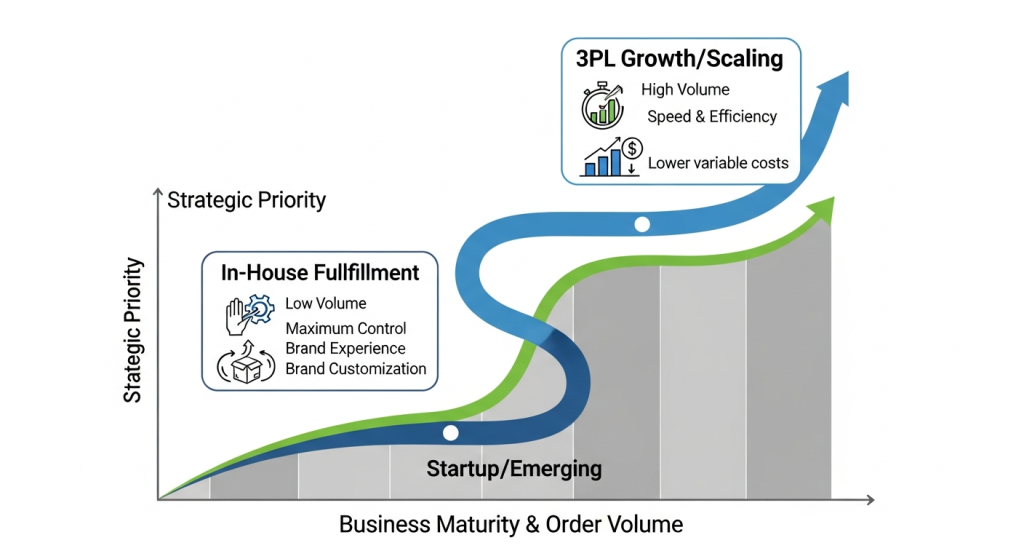
The optimal fulfillment strategy evolves with your business. While in-house offers control for startups, 3PLs provide the scalability needed during rapid growth.
The optimal fulfillment strategy is rarely a one-size-fits-all solution. It is inextricably linked to your e-commerce business’s stage of development. What works for a burgeoning startup with a handful of orders daily will not suffice for a rapidly scaling enterprise, nor for a mature brand with a global customer base.
Emerging & Startup e-commerce businesses are often focused on validating their product-market fit, building initial brand awareness, and conserving capital. Their fulfillment needs are typically characterized by low order volume, a desire for low upfront investment, and flexibility to pivot.
Growth & Scaling e-commerce businesses experience rapid increases in order volume. Their primary concerns shift towards efficiency, speed of delivery, cost optimization at scale, and maintaining consistent customer satisfaction amidst complexity.
Mature & Established e-commerce businesses operate at high volumes with consistent demand. Their focus turns to optimizing every facet of the supply chain, enhancing the premium customer experience, ensuring brand loyalty, and navigating a competitive landscape with sophisticated logistics.
Understanding these distinct needs is paramount to selecting a fulfillment strategy that supports, rather than hinders, your trajectory. If you serve specialized verticals like beauty, wellness, supplements, or subscription brands, the right logistics model matters even more because compliance, presentation, and speed all tend to carry more weight than in generic retail.
Article Roadmap: Navigating Fulfillment Strategies Across Your E-commerce Journey
This article will provide a comprehensive roadmap for navigating the critical decision between in-house and 3PL fulfillment. We will begin by defining the fundamental characteristics of each model. Subsequently, we will introduce a framework to analyze fulfillment needs based on distinct e-commerce growth stages. This will be followed by deep dives into the specific scenarios where in-house and 3PL fulfillment excel at each stage. We will also explore the strategic utility of hybrid logistics models. Finally, we will equip you with a decision-making framework and guidance on when and how to re-evaluate your chosen strategy for continuous growth and adaptability.
If you need a more foundational primer before comparing models, Launch Fulfillment’s guides on what order fulfillment is and how fulfillment 3PL works provide useful context.
Understanding the Fundamentals: In-House and 3PL Fulfillment
To make an informed decision, it’s essential to grasp the core mechanics of each fulfillment approach.
In-House Fulfillment: The DIY Approach
In-house fulfillment involves your business managing all aspects of storing inventory, processing orders, and shipping them to customers. This typically includes:
- Warehousing: Securing and managing physical warehouse space, including shelving, equipment, and utilities.
- Inventory Management: Tracking stock levels, conducting cycle counts, and ensuring accurate inventory data.
- Order Processing: Receiving orders from sales channels, verifying details, and preparing them for picking.
- Picking: Locating and retrieving the correct items from warehouse shelves.
- Packing: Assembling orders, choosing appropriate packaging materials, and ensuring items are protected during transit.
- Shipping: Selecting carriers, negotiating rates, generating shipping labels, and managing outgoing shipments.
- Returns Management (Reverse Logistics): Handling returned products, inspecting them, and processing refunds or exchanges.
This model offers granular control over every step, allowing for unique branding opportunities in packaging and direct oversight of the customer experience from your own facilities. It also means your team becomes responsible for the daily details behind pick, pack, and ship execution, which can be manageable at one growth stage and painful at the next.
3PL (Third-Party Logistics) Fulfillment: The Partnership Model
A 3PL provider acts as an outsourced logistics partner, offering a suite of services designed to handle the entire fulfillment process. Key services include:
- Warehousing and Storage: Utilizing their own network of strategically located warehouses to store your inventory.
- Inventory Management: Employing technology to track stock levels, forecast demand, and manage stockouts.
- Order Fulfillment: Efficiently picking and packing orders from their facilities.
- Shipping and Delivery: Leveraging their carrier relationships to offer competitive shipping rates and faster delivery times.
- Returns Processing: Managing the complexities of receiving, inspecting, and processing customer returns.
- Value-Added Services: Often including kitting, assembly, custom packaging, and quality control checks.
By partnering with a 3PL, businesses offload the operational burden, capital investment, and labor management associated with fulfillment, allowing them to focus on strategic growth. That’s especially relevant for brands trying to improve margin visibility, shorten delivery windows, and avoid getting buried under warehouse overhead before they’re ready.
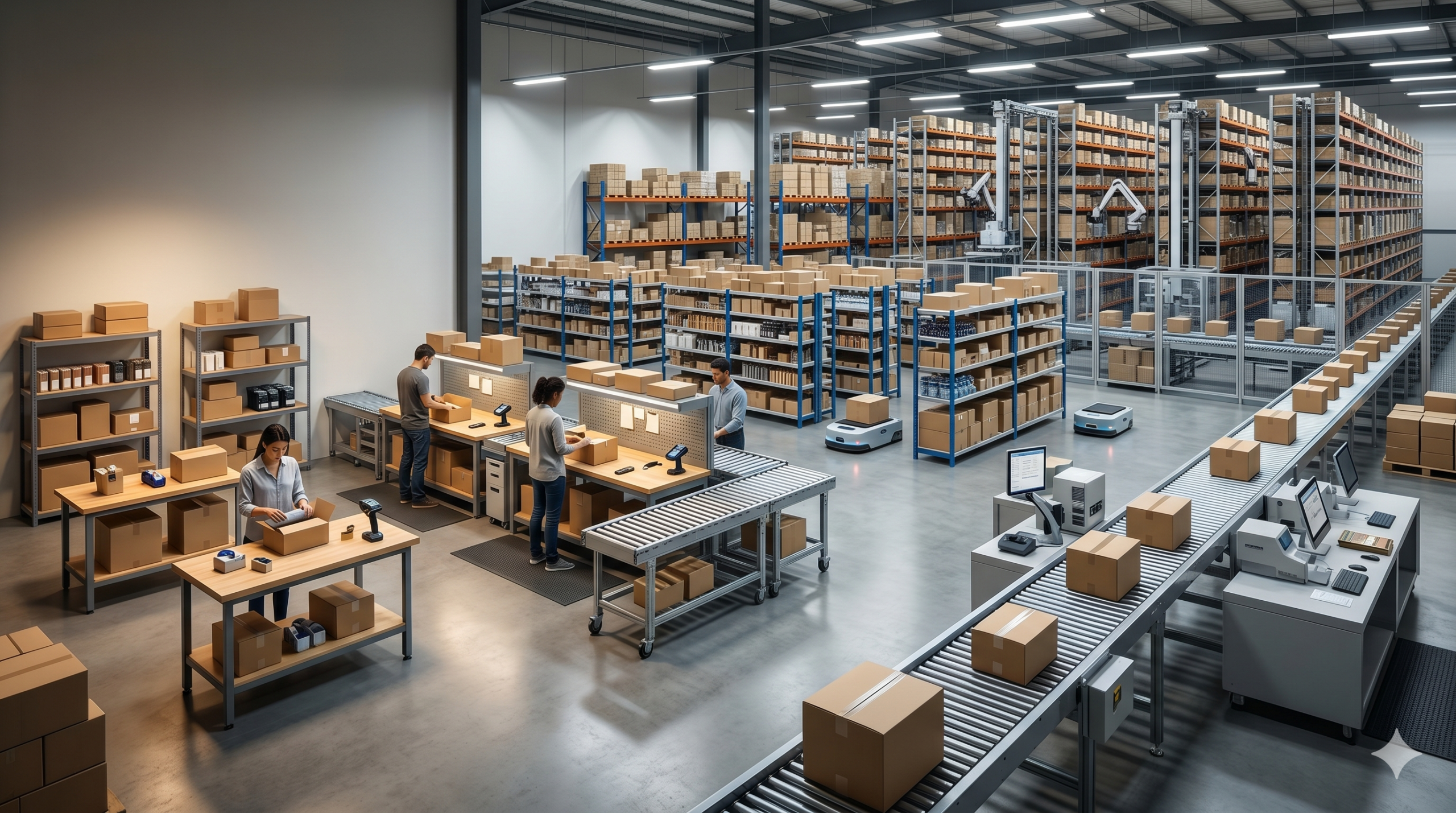
The E-commerce Growth Stage Matrix: Decoding Your Fulfillment Needs
Your business’s current stage of growth is the most critical determinant of your ideal fulfillment strategy. Each stage presents unique challenges and opportunities that shape your logistical requirements.
Stage 1: Emerging & Startup E-commerce (Validation & Foundation)
At this nascent stage, the primary focus is on product-market fit, establishing an initial customer base, and conserving capital.
Characteristics: Low to moderate order volume (e.g., under 50-100 orders/day), limited operational experience, tight budgets, emphasis on learning and flexibility.
Fulfillment Needs: Simplicity, minimal upfront investment, adaptability to changing product offerings or demand, direct oversight for quality control. The priority is often on getting products to market efficiently without significant operational overhead.
Stage 2: Growth & Scaling E-commerce (Expansion & Efficiency)
This phase is marked by rapid order volume increases and a growing customer base.
Characteristics: Moderate to high order volume (e.g., 100-1000+ orders/day), expanding product lines, increasing complexity in operations, need for faster delivery, and a desire to optimize costs as volume grows.
Fulfillment Needs: Scalability to handle peak seasons and rapid growth, improved delivery speed and reliability, cost-efficiency at scale, robust inventory management, and freeing up internal resources to focus on sales and marketing efforts.
Stage 3: Mature & Established E-commerce (Optimization & Market Leadership)
Established businesses have a consistent, high order volume and a strong brand presence.
Characteristics: High and consistent order volume, well-defined customer base, focus on customer lifetime value and brand loyalty, competitive market positioning, and often international reach.
Fulfillment Needs: Advanced optimization for efficiency and cost control, premium customer experience enhancement (e.g., unboxing, returns), supply chain resilience, leveraging technology for automation, and potentially managing complex international logistics.
If your team is already seeing errors compound across receiving, storage, order routing, shipping, and returns, it helps to step back and evaluate your operation through the lens of inbound, outbound, and reverse logistics rather than treating fulfillment as one giant blob of stress.
Deep Dive: In-House Fulfillment – When and Why It Fuels Growth
Managing fulfillment internally can be a powerful engine for growth under specific circumstances.
In-House for Emerging & Startup E-commerce
For very early-stage businesses, in-house fulfillment is often the de facto choice.
Why it works:
- Cost-Effectiveness at Low Volume: With minimal orders, the fixed costs of setting up a basic in-house operation (e.g., using a spare room, garage, or small rented space) are lower than 3PL fees.
- Direct Brand Control: You can personally oversee every aspect of picking, packing, and shipping, ensuring your brand’s quality standards and unique packaging touches are met precisely. This is crucial for building initial brand identity and customer trust.
- Learning the Logistics: Managing fulfillment in-house provides invaluable firsthand experience in inventory management, order processing, and the nuances of shipping, which can inform future strategic decisions.
- Flexibility for Product Testing: If you’re experimenting with new products or variations, in-house control allows for immediate adjustments to inventory and fulfillment processes.
For many founders, this stage is less about perfection and more about learning. The trade-off is that the same hands-on control that feels empowering at 20 orders per day can start feeling like a hostage situation at 120. That’s usually when brands begin comparing their internal workload against outsourced options and reading guides on when it makes sense to switch to a new 3PL.
In-House for Growth & Scaling E-commerce
While often associated with outsourcing, in-house fulfillment can still be advantageous for scaling businesses under certain conditions.
Why it works:
- Potential Cost Savings at Specific Volumes: If your order volume reaches a predictable and significant peak, and you have optimized your internal operations, it can become more cost-effective than paying 3PL fees. This is highly dependent on your efficiency and negotiated carrier rates.
- Highly Customization Needs: Businesses with very specific, intricate, or frequently changing packaging requirements, or those requiring specialized kitting or assembly that many 3PLs may not easily accommodate, might opt to keep it in-house for direct control.
- Maintaining a Unique Customer Experience: For brands where the fulfillment experience itself is a core part of the brand promise (e.g., luxury goods, personalized items), maintaining direct control can be paramount to delivering that exceptional customer experience.
- Leveraging Existing Infrastructure: If you already own or lease significant warehouse space for other business operations, expanding your fulfillment capacity might be more economical than paying for external warehousing.
That said, this only works when your systems mature fast enough. If your warehouse team is improvising inventory counts on spreadsheets and praying nothing gets oversold, you may be underestimating the operational drag. The margin picture also gets murkier when you haven’t fully modeled labor, storage, packaging, returns, and carrier costs. That’s why many brands eventually compare in-house execution against modern 3PL pricing models and more transparent fulfillment cost structures.
In-House for Mature & Established E-commerce
For highly established players, in-house fulfillment can represent a strategic imperative for maintaining market leadership.
Why it works:
- Ultimate Control & Integration: Direct control over every operational detail allows for seamless integration with proprietary technology systems (e.g., custom WMS, AI-driven inventory forecasting) and maintains absolute authority over the supply chain.
- Proprietary Processes: Businesses with unique, highly optimized, or proprietary fulfillment processes that provide a significant competitive advantage often keep these in-house to protect their intellectual property and execution.
- Exceptional Brand Standards: For global brands where maintaining an absolutely uniform and premium brand experience across all touchpoints, including packaging and delivery, is critical, in-house operations offer the highest degree of assurance.
- Economies of Scale in Operations: At massive volumes, an extremely well-run, lean, and automated in-house operation can potentially achieve operational costs lower than even the most competitive 3PLs.
In other words, mature brands can justify in-house fulfillment when they truly have the systems, scale, and capital to make it an advantage rather than an ego project in steel-toe boots.
Deep Dive: 3PL Fulfillment – When and Why It Accelerates Growth
Partnering with a third-party logistics provider is often the key to unlocking rapid and sustainable growth.
3PL for Emerging & Startup E-commerce
Even at the earliest stages, a 3PL can offer significant benefits.
Why it works:
- Access to Expertise: You immediately gain access to the logistics expertise of a professional provider, avoiding costly mistakes and learning curves.
- Low Upfront Investment: Avoids significant capital expenditure on warehouse space, equipment, and software. Instead, you pay for services as you use them, aligning costs with revenue.
- Focus on Core Business: Allows founders to concentrate on product development, marketing, sales, and customer acquisition without getting bogged down in operational details.
- Scalability from Day One: Provides the ability to scale order fulfillment capacity instantaneously as your business grows, without needing to lease more space or hire more staff.
This is particularly valuable if your team would be better served building demand than bubble-wrapping boxes at 11:47 p.m. A good fit here is often an ecommerce fulfillment partner that can support growth without forcing you into enterprise-level complexity on day one.
3PL for Growth & Scaling E-commerce
This is often the sweet spot where 3PLs provide the most significant impact.
Why it works:
- Scalability is Paramount: 3PLs are built to handle fluctuations in order volume, from daily growth to massive seasonal spikes, ensuring you can meet customer demand without internal strain.
- Faster Delivery & Improved Customer Experience: Many 3PLs have multiple warehouse locations across the country, enabling them to store inventory closer to your customers, reducing shipping times and costs, and boosting customer satisfaction.
- Operational Efficiency & Cost Reduction: Leveraging a 3PL’s established processes, technology, and bulk shipping rates can lead to significant cost savings per order compared to building out your own infrastructure.
- Reduced Operational Burden: Frees your team from managing day-to-day warehouse operations, allowing them to focus on strategic growth initiatives. This includes handling the complexities of picking, packing, and managing logistics.
- Access to Technology: 3PLs utilize advanced Warehouse Management Systems (WMS) and Order Management Systems (OMS) that provide real-time inventory visibility and efficient order processing, often more sophisticated than what a startup could afford.
If your brand is growing fast, this is usually the most practical transition point. Faster delivery, cleaner inventory visibility, and fewer fulfillment fires create more room for revenue-generating work. It also helps when your partner already understands warehousing, fulfillment, FBA prep, and logistics services as part of one connected system instead of four separate headaches wearing a trench coat.
3PL for Mature & Established E-commerce
For established businesses, 3PLs offer advanced capabilities and strategic advantages.
Why it works:
- Global Expansion: 3PLs with international networks can facilitate entry into new markets, handling customs, duties, and international shipping complexities more effectively than many businesses can manage independently.
- Supply Chain Optimization: They can help optimize the entire supply chain, identifying efficiencies in inventory positioning, transportation modes, and delivery routes.
- Specialized Logistics: For businesses dealing with specialized products (e.g., hazardous materials, temperature-controlled goods), 3PLs often have the necessary certifications and infrastructure.
- Technology Integration: Advanced 3PLs offer robust technology platforms that can integrate with your existing ERP or e-commerce platforms, providing sophisticated analytics and automation.
- Risk Mitigation: Diversifying fulfillment across multiple 3PL warehouses can build resilience into your supply chain, mitigating risks from regional disruptions.
For enterprise and late-stage brands, this conversation often shifts from “Do we outsource?” to “Which parts should we outsource for maximum resilience?” That is a smarter question, and usually a more profitable one.
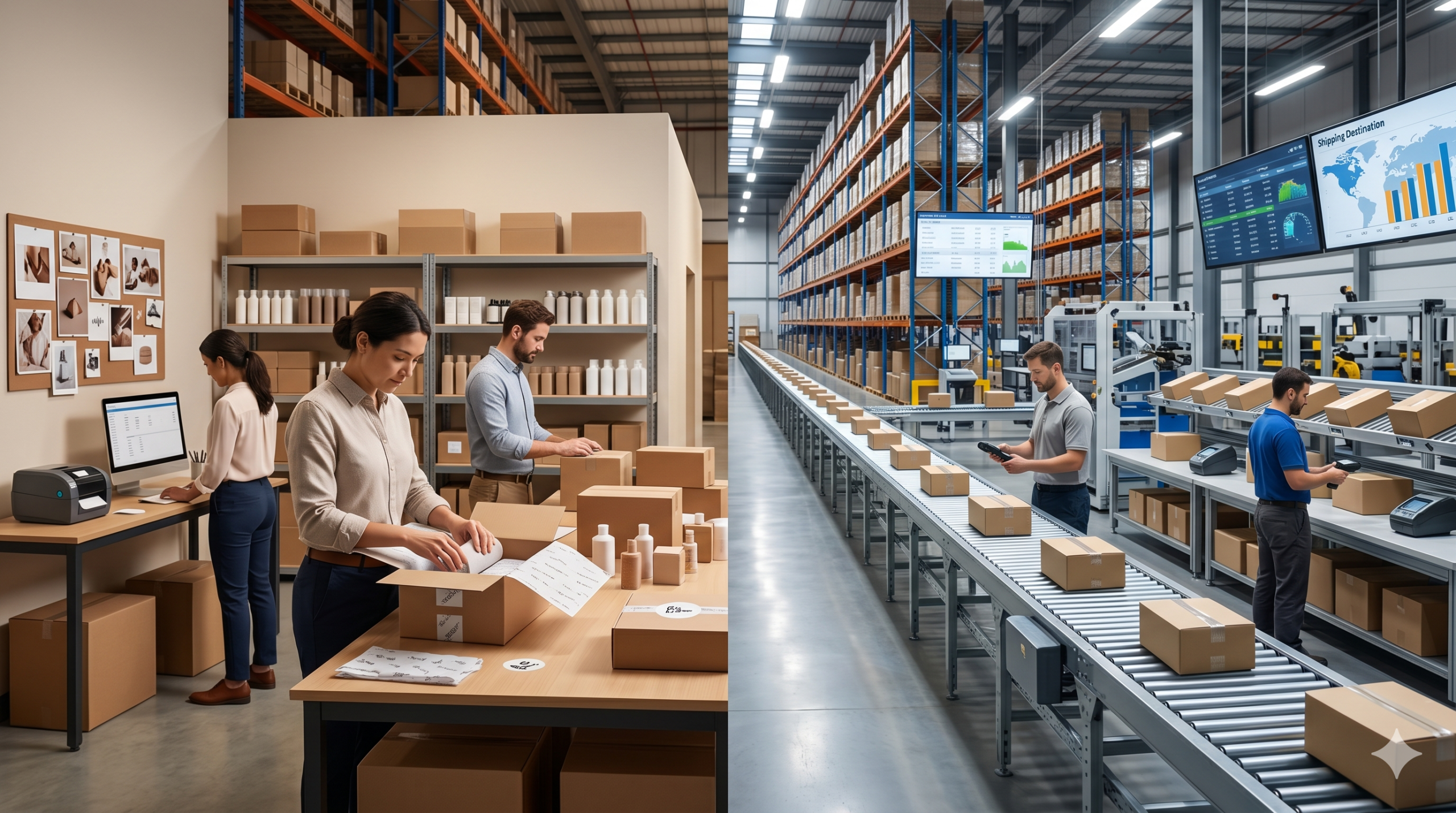
The Hybrid Logistics Model: A Strategic Compromise for Specific Growth Pains
While in-house and 3PL represent the primary models, a hybrid approach can offer a flexible solution for specific business needs.
Understanding Hybrid Approaches
A hybrid model involves using a combination of in-house fulfillment and third-party logistics services. This could manifest in several ways:
- In-house Core + 3PL Overflow: Managing a steady volume of orders internally while outsourcing excess volume during peak seasons or promotional periods to a 3PL.
- In-house Domestic + 3PL International: Handling all domestic orders in-house for maximum control, while using a 3PL for international shipping and fulfillment.
- In-house Standard + 3PL Specialty: Fulfilling standard products in-house while outsourcing niche or specialized product lines (e.g., oversized items, perishable goods) to a 3PL with the appropriate capabilities.
- In-house for Key Markets + 3PL for Others: Fulfilling orders for core domestic markets in-house while leveraging a 3PL network for broader geographic reach or faster delivery in secondary markets.
When a Hybrid Model Makes Sense
- Seasonal Spikes: Businesses experiencing predictable but significant seasonal demand spikes can use a 3PL to handle the overflow, avoiding the costs and complexities of scaling in-house operations only to scale them back down.
- Testing New Markets: Before committing to full international expansion, using a 3PL to manage fulfillment in a new region allows for testing the market with lower risk.
- Product Diversification: If your product catalog includes vastly different types of items requiring unique handling (e.g., fragile collectibles vs. bulky electronics), a hybrid approach can leverage the best capabilities for each.
- Balancing Control and Scalability: For businesses that want to maintain direct control over a significant portion of their fulfillment but need the flexibility to scale rapidly, a hybrid approach offers a strategic balance.
- Cost Optimization: By strategically allocating fulfillment tasks between in-house and 3PL, businesses can potentially optimize costs by leveraging the most cost-effective solution for each specific need.
Hybrid models can also make sense for brands with heavy kitting or subscription box needs, where a portion of the catalog requires hands-on assembly while the rest is better handled through a broader fulfillment network.
Decision Framework: Essential Questions to Guide Your Choice by Growth Stage
To select the right fulfillment strategy, ask yourself the following questions, tailored to your current growth stage.
For Emerging & Startup E-commerce
- What is my current order volume and projected short-term growth? (Low volume likely favors in-house initially)
- What is my available capital for investment in warehousing, equipment, and staff? (Limited capital strongly points to 3PL)
- How critical is direct control over packaging and brand experience at this stage? (High criticality might lean in-house for early branding)
- What is my capacity for managing operational complexities like inventory, shipping, and returns? (Low capacity suggests outsourcing to a 3PL)
- What are the costs associated with setting up and running a small in-house operation versus 3PL fees? (Compare direct costs and opportunity costs)
For Growth & Scaling E-commerce
- How rapidly is my order volume increasing, and how predictable are these increases? (Rapid, unpredictable growth necessitates a scalable solution like a 3PL)
- What are my target delivery speeds, and how important are multiple shipping points for customer satisfaction? (Faster delivery and wider reach often require a 3PL network)
- Can I achieve better per-unit fulfillment costs with in-house operations at my current/projected volume, considering all overheads? (Requires a detailed cost-benefit analysis)
- How much time and resources can my team dedicate to managing fulfillment versus focusing on growth activities? (Scaling requires freeing up resources, often achievable with a 3PL)
- What is the impact of fulfillment errors (e.g., wrong items, late deliveries) on customer satisfaction and my brand reputation? (A 3PL’s expertise can minimize these)
For Mature & Established E-commerce
- What are my objectives for customer experience and brand differentiation through fulfillment? (High standards might require in-house or a highly specialized 3PL)
- Do I have unique logistical requirements (e.g., international, specialized handling, B2B integration) that are best met by in-house expertise or a specific 3PL partner?
- How can I optimize my entire supply chain for cost, speed, and resilience? (3PLs can offer integrated solutions and network optimization)
- What is the ROI of investing further in in-house technology and infrastructure versus partnering with a 3PL for advanced capabilities?
- What are the risks associated with my current fulfillment model, and how can I mitigate them? (Diversification via multiple 3PLs can enhance resilience)
For a reality check, it helps to compare your operation against practical benchmarks: shipping cost discipline, labor efficiency, system visibility, and returns handling. Resources like the USPS business shipping hub, the U.S. Small Business Administration’s business management guidance, and NIST’s supply chain risk materials are useful reminders that fulfillment decisions touch cost, continuity, and customer trust all at once.
Ready to build a fulfillment strategy that can scale with your brand?
If your current operation is slowing growth, creating shipping friction, or eating margin, Launch Fulfillment can help you map out a fulfillment setup built for speed, visibility, and long-term scale.
When to Re-evaluate or Transition Your Fulfillment Strategy
Your fulfillment strategy should not be a set-it-and-forget-it decision. As your business evolves, so too should your logistics. Continuous assessment is key to sustained growth.
Triggers for Change (Regardless of Current Model)
- Inability to Meet Demand: Consistently missing order deadlines, stockouts, or an inability to scale during peak periods are clear signs your current fulfillment is insufficient.
- Rising Operational Costs: If in-house costs are escalating beyond benchmarks, or 3PL fees are no longer competitive relative to service levels, it’s time to investigate alternatives.
- Decreasing Customer Satisfaction: Negative feedback related to shipping times, order accuracy, packaging, or returns is a direct indicator of fulfillment issues.
- Limited Scalability: If your current fulfillment method inherently caps your growth potential, a transition is inevitable.
- Introduction of New Products/Markets: Expanding your product catalog or entering new geographical markets often necessitates a change in fulfillment strategy to accommodate new demands.
- Technological Advancements: New logistics technologies or innovations by 3PLs might offer significant advantages over your current setup.
Navigating the Transition
Transitioning fulfillment models, whether from in-house to 3PL, 3PL to in-house, or exploring hybrid options, requires careful planning:
- Thorough Due Diligence: If moving to a 3PL, research potential partners extensively. Assess their services, technology, client testimonials, financial stability, and compatibility with your brand. If moving in-house, meticulously plan infrastructure, staffing, and technology needs.
- Define Clear KPIs: Establish measurable goals for the transition, such as improved delivery times, reduced costs, increased order accuracy, and enhanced customer satisfaction.
- Phased Rollout: Implement changes gradually where possible. For example, test a new 3PL with a subset of SKUs or a specific region before a full migration.
- Data Migration and Integration: Ensure seamless transfer of inventory data, order history, and customer information. Plan for integration with your existing e-commerce platforms and systems.
- Communication: Clearly communicate the changes to your internal team, suppliers, and customers to manage expectations and ensure a smooth transition.
If you’re evaluating providers, it also helps to compare how potential partners explain shipping and handling costs, how they think about order fulfillment operations, and whether they can support your vertical rather than just your parcel volume.
Closing Thoughts
Choosing between in-house and 3PL fulfillment is a pivotal strategic decision that directly influences your e-commerce business’s ability to grow and thrive. It’s not merely an operational choice but a foundational element of your customer experience and competitive strategy.
Your growth stage is the most crucial factor in determining the right path. Emerging businesses often benefit from the low upfront cost and hands-on learning of in-house fulfillment, while growth-stage companies typically find the scalability, efficiency, and expertise of 3PLs essential for rapid expansion. Mature businesses may leverage either model strategically, focusing on optimization, unique brand experiences, or global reach. The hybrid model offers a flexible middle ground for specific challenges.
Ultimately, the most successful e-commerce businesses view their fulfillment strategy not as a fixed destination, but as an evolving partnership. Regularly assessing your operational needs against your business objectives, customer expectations, and market dynamics will ensure you remain agile, efficient, and well-positioned for continued success. By strategically aligning your fulfillment approach with your growth trajectory, you transform a core operational function into a powerful engine for sustainable e-commerce expansion.
And if you’re at the point where fulfillment is starting to shape growth more than support it, that’s usually the sign to stop winging it and start building a logistics model that actually fits the business you’re becoming.
Related Posts
Thinking about switching 3PLs or upgrading your fulfillment model?
Whether you’re comparing providers, planning a transition, or trying to improve service without adding operational chaos, Launch Fulfillment can help you find the right fit for your next stage of growth.
In House vs 3pl Fulfillment FAQ
What is the difference between 3PL and in-house fulfillment?
The main difference between 3PL and in-house fulfillment comes down to ownership and scalability. In-house fulfillment means your team manages warehousing, inventory, and shipping internally, giving you full control. A 3PL (third-party logistics provider) handles these operations for you, offering greater efficiency, faster delivery, and the ability to scale without investing in infrastructure or labor.
What is the difference between a fulfillment center and a 3PL?
A fulfillment center is a facility where orders are stored, picked, packed, and shipped. A 3PL is a broader service provider that may include fulfillment centers but also offers additional services like inventory management, transportation, returns processing, and logistics optimization. In short, a fulfillment center is one component of a 3PL solution.
What are the disadvantages of using a 3PL?
The main disadvantages of a 3PL include reduced direct control over operations, reliance on a third-party partner, and potential variability in service quality. Some businesses may also find pricing structures complex. However, for growing ecommerce brands, these trade-offs are often outweighed by scalability, efficiency, and cost savings.
What are the disadvantages of in-house fulfillment?
In-house fulfillment can become expensive and difficult to manage as order volume increases. Common challenges include rising labor costs, limited warehouse space, inventory inaccuracies, slower shipping times, and the operational burden of managing logistics. These issues often create bottlenecks that restrict growth.
What are the pros and cons of 3PL vs in-house logistics?
In-house fulfillment offers full control, customization, and direct oversight of the customer experience. However, it requires significant investment and operational management. A 3PL provides scalability, faster shipping, and lower operational burden, but requires trusting an external partner. The best option depends on your growth stage, order volume, and operational complexity.
What is 1PL, 2PL, 3PL, 4PL, and 5PL logistics?
These terms describe levels of logistics outsourcing.
- 1PL: You handle everything internally
- 2PL: You outsource transportation (e.g., carriers)
- 3PL: You outsource fulfillment and logistics operations
- 4PL: A partner manages your entire supply chain strategy
- 5PL: Focuses on large-scale, technology-driven logistics networks
Most ecommerce brands operate within the 3PL model when outsourcing fulfillment.
