
Key Takeaways
- Apparel fulfillment services help growing clothing brands manage complex logistics needs like size and color variants, garment handling, branded packaging, returns, and seasonal demand spikes.
- Clothing brands require more specialized fulfillment than general ecommerce products because apparel involves high SKU counts, fabric care, fit expectations, and a higher risk of returns.
- Accurate inventory management is essential for apparel brands because one product style can quickly become dozens of SKUs across sizes, colors, fits, and seasonal variations.
- Value-added services such as polybagging, folding, hang tags, custom inserts, kitting, and branded packaging help protect the customer experience and reinforce brand identity.
- Returns are a major part of apparel fulfillment. Fast inspection, grading, refurbishing, and restocking can help recover more value and improve customer retention.
- The right fulfillment tech stack should support real-time inventory syncing, ecommerce platform integrations, WMS visibility, forecasting, and wholesale or EDI requirements as the brand grows.
- Choosing the best apparel fulfillment services means looking beyond price and evaluating accuracy, scalability, returns workflows, packaging support, technology, and how well the 3PL protects your brand promise.
Apparel brands in 2026 operate in a high-stakes environment where logistics is no longer just a backend function they are the primary engine of customer retention. If your growth is currently hampered by stockouts, inconsistent packaging, or a mounting backlog of return processing, you are not alone. The transition from a lean startup to a scaling apparel brand requires a shift from self-fulfillment to specialized logistics. This guide explores how to navigate the complex world of apparel-specific 3PLs to ensure your supply chain serves your brand equity rather than eroding it.
At Launch Fulfillment, we see apparel fulfillment as one of the clearest places where operations and brand experience meet. A clothing brand can have strong creative, great product photography, and high-performing paid ads, but if the wrong size ships, the packaging feels inconsistent, or returns take too long to process, the customer experience breaks.
As our CEO says: “Our mission is to be the Chick-fil-A of fulfillment — combining reliability, technology-forward systems, and sincere partnerships.”
Why Specialized Apparel Fulfillment is Non-Negotiable in 2026
Generalist logistics providers often treat clothing like any other commodity, such as hardware or non-perishables. This is a fatal oversight for fashion. Apparel fulfillment requires an intimate understanding of fabric care, seasonal velocity, and the emotional expectations of the end buyer.
That is why growing clothing brands need more than basic warehousing. They need ecommerce fulfillment services that support size and color accuracy, apparel-specific packaging, fast shipping, returns management, inventory visibility, and the kind of presentation customers expect from a modern fashion brand.
The SKU Complexity Challenge: Managing Color, Size, and Style Variants
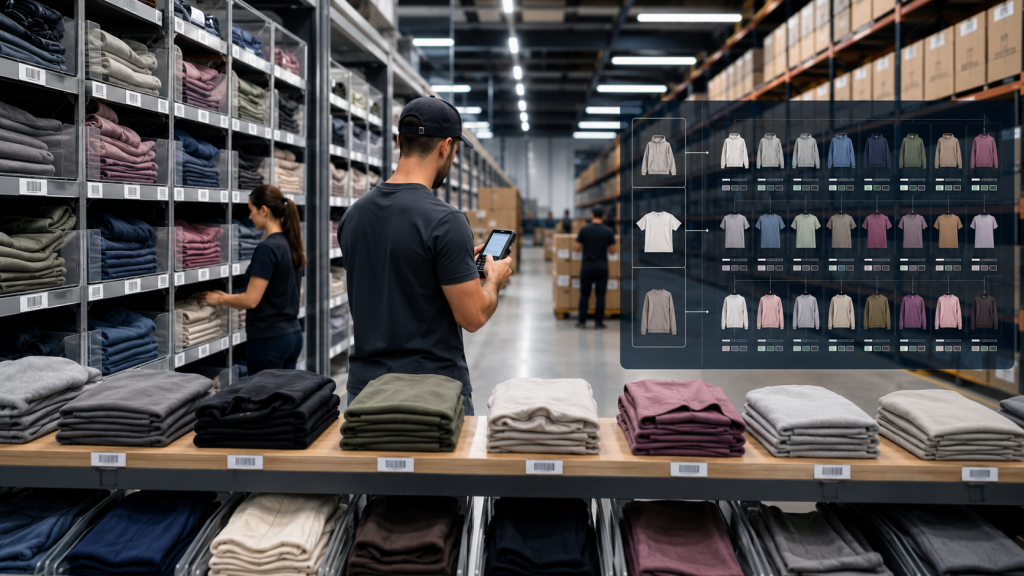
Apparel fulfillment services help clothing brands manage complex size, color, and style variants with accurate inventory visibility.
SKU Proliferation: How a single apparel design exponentially increases inventory tracking complexity.
Apparel brands are plagued by high SKU counts. A single T-shirt design released in four colors and five sizes immediately creates 20 unique SKUs. If you add multiple fabric iterations, that number grows exponentially. An effective inventory management system must track these variants with granular precision to prevent overselling during flash sales. Without robust software, you face “ghost inventory” where your backend indicates stock, but the physical warehouse cannot locate a specific size, resulting in canceled orders and damaged customer trust.
Launch Fulfillment’s inventory management support helps ecommerce brands reduce stock confusion, improve visibility, and keep fulfillment decisions tied to accurate on-hand inventory. For apparel brands with complex variants, this is foundational.
High-Velocity Returns and the “Try-Before-You-Buy” Culture
Apparel return rates frequently exceed 20% to 30%, a reality exacerbated by the “try-before-you-buy” shopping culture. Unlike static consumer goods, clothing must be inspected for wear, perspiration marks, or pet hair upon arrival. If your fulfillment partner lacks a rigorous grading and refurbishing workflow, you are losing significant capital on every return that ends up in a clearance pile instead of back on the virtual shelf.
The National Retail Federation projects that online sales returns will remain a major retail challenge, with an estimated 19.3% of online sales returned in 2025. For apparel brands, that makes 3PL fulfillment services with returns support especially important because every delayed inspection can turn sellable inventory into trapped cash.
Seasonal Scalability: Preparing for Merch Launches and Collection Releases
Apparel brands live and die by the launch calendar. Peak season doesn’t just mean the winter holidays; it means every drop or influencer collaboration. Your 3PL must have the agility to scale order processing throughput in under 48 hours to accommodate a surge in demand, then pivot to lean operations during slower periods. If your logistics partner cannot handle sudden spikes without a degradation in order accuracy, your brand reputation is at risk.
Launch Fulfillment’s fulfillment services by industry are designed for brands that need workflows tailored to their product type, customer expectations, packaging standards, and growth stage.
Need Fulfillment Built for Apparel Growth?
Clothing brands need accurate SKU handling, polished packaging, fast shipping, and returns workflows that protect sellable inventory. Launch Fulfillment helps growing apparel brands scale without letting logistics damage the customer experience.
The Value-Added Services (VAS) That Protect Your Brand Identity
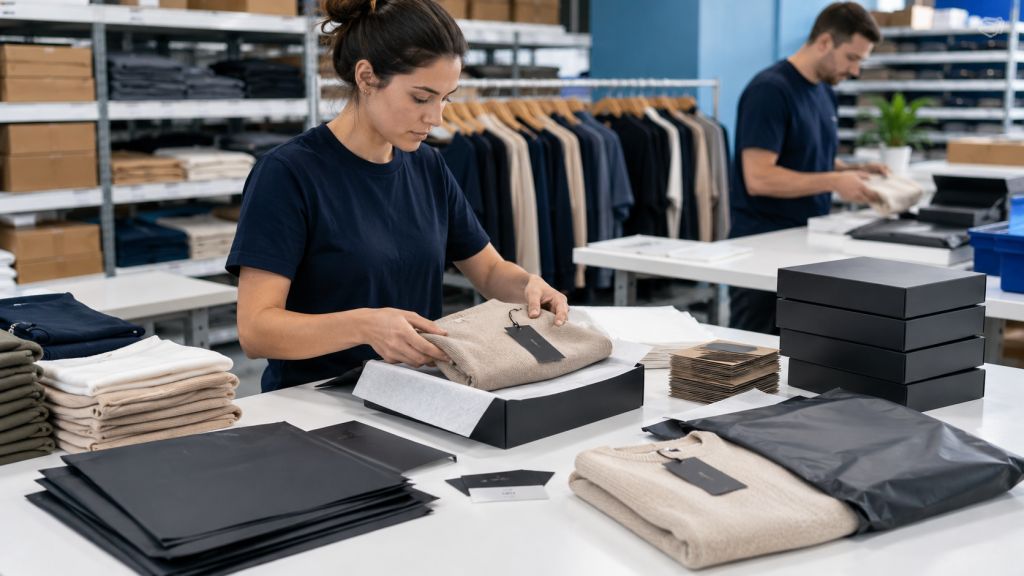
Specialized apparel fulfillment protects the customer experience through careful garment handling, branded packaging, and quality control.
Your fulfillment center is the final touchpoint before the product meets the customer. Value-Added Services (VAS) are the difference between a “commodity shipment” and a premium brand experience.
Specialized Garment Handling: Polybagging, Steaming, and Garment-on-Hanger (GOH)
Wrinkled or improperly packed clothing significantly increases return rates. Premium apparel requires dedicated GOH storage to preserve the drape of high-end fabrics. Services like automated steaming and professional folding protect the garment’s integrity, ensuring that when the customer opens the package, the item looks as crisp as it did on the e-commerce photography.
Professional order fulfillment gives apparel brands a repeatable process for receiving, storing, picking, packing, and shipping garments in a way that protects presentation and reduces avoidable customer frustration.
“Working with Launch has been an absolute game changer for my business. With Launch handling all the product kitting and fulfillment, I’m able to focus on scaling.”
Custom Branded Packaging: Creating a Premium Unboxing Experience
The unboxing experience is an extension of your marketing. High-end apparel brands leverage custom inserts, branded poly mailers, and personalized notes to drive social media virality. A partner that supports custom collateral insertion into the order fulfillment flow allows you to surprise and delight your customer without adding hours to your internal workload.
Shopify’s guidance on creating a memorable unboxing experience reinforces the same idea: packaging can shape how customers perceive the value of the brand. For apparel, that means the mailer, fold, insert, and return instructions all matter.
Kitting and Assembly: Handling Patches, Woven Labels, and Care-Tags
Often, garments arrive from factories needing final touches. Fulfillment centers that offer in-house kitting, attaching woven labels, adding custom hang-tags, or assembling gift bundles save you the shipping cost of sending goods to a secondary prep house. This B2B-to-DTC bridge is crucial for brands that need to label inventory differently for retail boutiques versus individual web store orders.
Launch Fulfillment’s kitting and assembly services help brands build repeatable workflows for product bundles, promotional kits, inserts, hang tags, and other value-added apparel prep needs.
On-Demand Personalization: Embroidery and Screen Printing Services
Direct-to-garment customization is a massive value-add for modern apparel brands. By partnering with a facility that offers on-demand embroidery, you can launch personalized merchandise without holding finished inventory of every possible name or monogram, dramatically reducing your risk profile.
For brands that do offer personalization, fulfillment accuracy becomes even more important. A personalized garment cannot always be returned to standard inventory, so quality control and clear order processing are essential.
Tech-Stack Essentials: Orchestrating a 2026 Supply Chain
Technology is the nervous system of modern logistics. You need a 3PL that integrates directly with your existing software ecosystem.
Multi-Channel Order Orchestration and Real-Time Inventory Syncing
Your inventory management system must sync across every sales channel. Whether you are selling on Shopify, Instagram, or through a wholesale portal, the data must be live. This eliminates the risk of selling stock that has already been allocated to a retail or wholesale order, protecting your brand from multi-channel overselling.
A strong warehouse management system helps brands connect inventory counts, order status, picking workflows, and fulfillment activity. For apparel brands, this is what keeps size and color variants from turning into stockout chaos.
AI-Driven Demand Forecasting for High-SKU Inventory Management
Human error is the enemy of efficient inventory control. AI-driven forecasting tools analyze your historical velocity to predict which sizes or colors will move fastest during upcoming launches. This allows for proactive replenishment, ensuring you have enough stock to meet demand without over-committing capital to dead-stock items.
For planning support, Launch Fulfillment’s guide to inventory management demand forecasting explains why demand planning matters when brands need to avoid both stockouts and overstock.
Warehouse Management Systems (WMS) and EDI Capabilities for Wholesale
As you grow, retail partnerships will require EDI (Electronic Data Interchange) compliance. A 3PL with robust EDI capabilities can handle the standardized document exchange required by major department stores, making your brand a reliable, low-maintenance partner for retail buyers.
GS1 US notes that GS1 standards for apparel and general merchandise can improve supply chain visibility, data quality, and operational efficiency across sales channels. That level of data discipline becomes more important as apparel brands expand from DTC into wholesale and retail.
Seamless Integration with Shopify Plus and Other eCommerce Platforms
Your WMS should offer native, plug-and-play integrations with Shopify Plus. This ensures that as soon as an order is placed, the order processing workflow begins automatically, from picking to label generation, with zero manual data entry.
Launch Fulfillment’s fulfillment warehousing facilities are built to support ecommerce brands with storage, order processing, shipping workflows, and operational visibility as volume grows.
Protect Apparel Inventory From SKU Chaos
Apparel fulfillment gets complicated fast when sizes, colors, bundles, returns, and sales channels multiply. Launch Fulfillment helps clothing brands improve inventory visibility, order accuracy, and fulfillment consistency.
Winning the Returns Game: Transforming Logistics into Retention
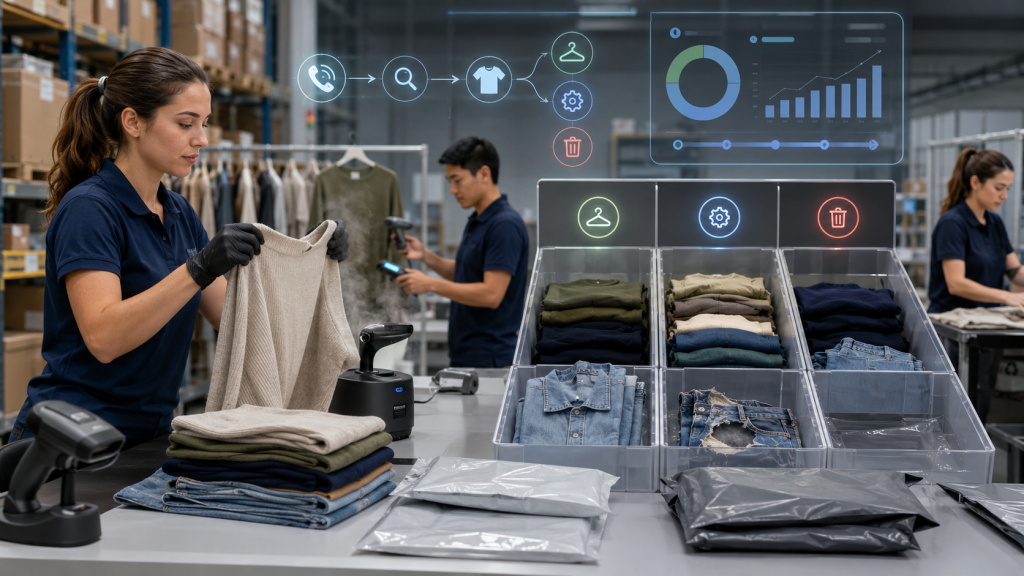
Apparel returns can become a retention tool when garments are inspected, graded, refurbished, and restocked quickly.
“Launch handles the holiday rush like champs! I can’t recommend them enough if you’re looking for a fulfillment partner that can keep up when things get hectic.”
The Economics of Reverse Logistics: Grading, Refurbishing, and Restocking
Efficiency in reverse logistics means shorter “time-to-shelf” for returned items. By utilizing a 3PL that grades incoming apparel immediately, distinguishing between “sellable as new,” “requires steaming,” and “damaged”, you maximize your recovery value.
For clothing brands, reverse logistics should be treated as a revenue recovery workflow, not just a customer service obligation. The faster clean items are inspected and restocked, the more value you preserve.
Real-Time Returns Dashboards and Integration with Loop
Integrating return management platforms like Loop into your logistics workflow provides customers with a seamless portal for exchanges. A fast exchange process is a primary driver of customer retention; when a customer can easily swap a size, they are far more likely to return for a second purchase.
Launch Fulfillment’s order management and order processing support helps brands keep order activity, fulfillment status, and customer-facing workflows more organized as order volume grows.
Sustainable Returns: Reducing Carbon Footprints and Plastic Waste
Consumers in 2026 demand sustainability. Using resealable, compostable mailers and optimizing return routes to minimize carbon footprints is no longer a “nice to have.” It is a brand requirement that resonates with the modern, eco-conscious shopper.
The EPA’s guidance on sustainable packaging notes that efficient packaging materials can help companies save money while reducing waste. For apparel brands, that means mailers, inserts, polybags, and returns packaging should be designed with both brand experience and operational efficiency in mind.
The 2026 Compatibility Matrix: Finding Your Fulfillment Match
Seed Stage: Best for Low MQC (Minimum Quantity Commitments)
If you are just starting, prioritize 3PLs that offer flexible, “pay-as-you-grow” terms. Avoid long-term contracts that lock you into high MQC requirements that might stifle your early cash flow.
Early-stage brands should also review 3PL pricing models carefully. Storage, pick and pack, receiving, packaging, kitting, returns, and account support can all affect the true cost of fulfillment.
Growth Stage: Scaling with Omnichannel Support and International Shipping
Once you reach consistent volume, look for partners with multiple nodes. Spreading inventory across geographically distributed warehouses reduces shipping zones and speeds up delivery times, which is essential for competing with major retailers.
Launch Fulfillment’s guide to shipping zones explained breaks down why distance affects cost and delivery speed. Apparel brands should use zone strategy to reduce shipping friction without sacrificing customer experience.
Enterprise Level: Port-Adjacent Locations and Bespoke SLA Contracts
For large brands, port-adjacency is key to reducing inland freight costs. Negotiate bespoke Service Level Agreements (SLAs) that penalize for inaccuracies and incentivize high-speed turnaround during your peak collection drops.
Enterprise apparel brands should also make sure their fulfillment partner has documented SOPs for launch windows, inbound receiving, SKU setup, returns grading, packaging changes, wholesale requirements, and escalation handling.
Best Apparel Fulfillment Services by Category
ShipBob: Best Overall for Multi-Channel Apparel Growth. Offers an intuitive dashboard, wide network, and solid Shopify integration.
Bergen Logistics: Best for High-End Fashion and Specialized Garment Handling. Their expertise in GOH and inspection is industry-leading.
Flexport: Best for Integrated Freight and Global Distribution. Ideal for brands importing directly from overseas factories.
GoBolt: Best for Sustainable, Tech-First Logistics. They are leading the charge in zero-emission local delivery and eco-packaging.
Printful: Best for Low-Risk Merchandise and Print-on-Demand Launches. Perfect for testing new designs without holding inventory.
These categories can help brands understand the wider apparel fulfillment landscape, but the right choice depends on your operating model. A fashion brand with high SKU complexity, branded packaging, returns pressure, and seasonal drops should evaluate not only price, but also inventory accuracy, communication, flexibility, technology, and value-added services. Launch Fulfillment’s 3PL partner advantage is built around being more than a warehouse vendor; the goal is to support growth with accuracy, visibility, and operational care.
“Launch Fulfillment is extremely fast and accurate, even during the busy holiday season. Proactive communication from their team helped us avoid delays.”
Strategic Logistics: Navigating Peak Season and Seasonal Spikes
The secret to conquering peak season is preparation in the off-season. Establish a “pre-flight” communication protocol with your 3PL three months before any major launch. Ensure your SKU counts are cleaned, your packaging components are pre-kitted, and your WMS is stress-tested.
Brands preparing for major launches should also review questions to ask a 3PL before signing or renewing a fulfillment agreement. A good partner should be able to explain how they handle seasonal spikes, returns, packaging changes, SKU complexity, and urgent inventory issues.
Ready to Scale Apparel Fulfillment Without Operational Chaos?
Launch Fulfillment helps growing apparel brands manage complex SKUs, branded packaging, returns, seasonal spikes, and customer-ready shipping with a fulfillment operation built for scale.
Final Thoughts
Logistics is not just a cost center; it is the physical representation of your brand’s promise to the customer. As we navigate 2026, the brands that thrive will be those that view their fulfillment partner as a strategic ally rather than a commodity vendor. By prioritizing high-SKU inventory management, investing in specialized garment handling, and treating returns as a retention tool, you build a foundation for long-term growth.
Next Steps for Your Brand
- Audit your current return rate: Identify if the issue is sizing, fabric, or logistics-related.
- Review your tech stack: Ensure your WMS and Shopify integration are fully synced.
- Analyze your VAS needs: Does your current 3PL protect your brand identity with proper garment care and custom packaging?
- Stress-test your 3PL: Request a mock seasonal surge plan from your provider.
- Evaluate multi-node potential: Assess if moving inventory closer to your customers can lower your shipping zones and costs.
Make the shift toward a professional logistics infrastructure today. The operational stability you gain will allow you to focus on what matters most: designing the apparel your customers love.
For growing clothing brands, fulfillment should protect the customer experience, not create extra friction. Launch Fulfillment helps apparel brands build scalable systems for inventory management, order processing, custom packaging, shipping, and returns so the operation supports the brand instead of holding it back.
Related Posts
FAQs About Apparel Fulfillment Services
What is apparel fulfillment services?
It’s the process of handling apparel items in a fulfillment center, supported by warehouse management systems and order processing systems, with a focus on returns management systems and reverse logistics.
What kind of packaging is required?
Fashion brands rely on branded boxes, custom packaging, unique packaging, and folding & polybagging to protect items and support customer satisfaction.
How do 3PLs handle shipping?
They use multiple shipping carriers, optimized shipping methods, and Virtual Carrier Networks to provide two-day shipping, overnight services, or international services.
What is fulfillment technology?
It’s the use of fulfillment tools, inventory management systems, and order processing systems to streamline workflows and provide real-time inventory visibility.
Why is omni-channel fulfillment important?
It ensures consistent service across DTC websites, wholesale orders, and marketplaces like Amazon or BigCommerce.
