
Key Takeaways
- A complete beauty fulfillment checklist should include storage, packaging, shipping, inventory management, and returns workflows. Beauty brands require specialized fulfillment operations that protect product quality and customer trust at every stage.
- Climate-controlled storage and FEFO inventory rotation are essential parts of a beauty fulfillment checklist. Proper temperature management, expiration tracking, and lot visibility help preserve skincare and cosmetic product integrity.
- A strong beauty fulfillment checklist prioritizes both product protection and premium presentation. Fragile packaging, branded inserts, and optimized shipping materials all influence the customer experience and reduce damage during transit.
- Beauty fulfillment checklist best practices should include scalable inventory and order management systems. Real-time inventory visibility and flexible warehouse workflows help brands handle influencer campaigns, seasonal spikes, and rapid e-commerce growth.
- Returns management is a critical component of any beauty fulfillment checklist. Hygiene-focused inspection protocols, product-condition reviews, and clear return policies help beauty brands stay compliant and protect consumers.
- Shipping efficiency should be built into every beauty fulfillment checklist. Optimizing dimensional weight, carrier selection, and shipping zones can reduce fulfillment costs without sacrificing delivery experience.
- The best beauty fulfillment checklist supports long-term ecommerce growth and brand reputation. From compliance and storage to packaging and customer experience, every operational detail contributes to retention, loyalty, and profitability.
The beauty industry operates under a unique paradox: the need for high-end, aspirational presentation paired with the uncompromising grit of clinical-grade logistics. For e-commerce brands, the supply chain is no longer just a backend utility; it is a primary driver of customer lifetime value (LTV). While general retailers might view fulfillment as a generic cost center, beauty brands must treat it as a strategic extension of their product quality. From the precise temperature controls required for organic serums to the strict hygiene protocols surrounding returns, the operational stakes are exceptionally high. This guide outlines the essential pillars of modern beauty fulfillment, balancing regulatory compliance with the refined experience customers demand.
At Launch Fulfillment, we know beauty fulfillment is not just about getting a box out the door. It is about preserving product integrity, protecting customer trust, and making every shipment feel like it came from a brand that understands the details. That is why specialized beauty supply fulfillment matters for skincare, cosmetics, wellness, and personal care brands that cannot afford generic warehouse handling.
Why Beauty Fulfillment Requires a Specialized Strategy
The High Stakes of Cosmetics Logistics: Safety, Efficacy, and Brand Reputation
In the beauty sector, the product is often chemically reactive. Exposure to extreme heat or moisture can destabilize formulations, leading to ingredient degradation, color shifts, or separation. When a customer receives a product that has been compromised by poor storage, the brand’s reputation suffers instantly. Unlike apparel, where a fit issue is a minor inconvenience, a compromised cosmetic product is a safety and efficacy concern. Delivering a “perfect” unboxing experience is an insurance policy against the erosion of trust.
This is where a general warehouse approach starts to break down. Beauty brands need ecommerce fulfillment services that account for temperature sensitivity, packaging presentation, lot visibility, returns hygiene, and customer experience in one connected operation.
Moving Beyond General E-commerce: Unique Challenges of the Beauty Industry
General e-commerce strategies often fail to account for the shelf-life volatility of beauty items. While a pair of shoes remains viable indefinitely, a moisturizer has a finite expiration window. Furthermore, the aesthetic expectations for beauty packaging are significantly higher than for standard consumer goods. Balancing these high-touch branding needs with the harsh realities of shipping logistics requires a specialized approach to warehouse management and packaging engineering.
Launch Fulfillment supports brands across specialized categories through fulfillment services by industry, including beauty, supplements, wellness, and subscription-based ecommerce. Beauty fulfillment sits right at the intersection of product care and brand theater. The product has to arrive safe, clean, and intact, but it also has to feel premium.
Need a Fulfillment Partner Built for Beauty Brands?
Launch Fulfillment helps beauty and skincare brands protect product quality, improve packaging consistency, manage inventory accurately, and deliver premium customer experiences at scale.
Phase 1: Storage and Inventory Management Best Practices

Climate-Controlled Warehousing: Managing Temperature and Humidity Sensitive Products
Cosmetics are sensitive to environmental fluctuations. Your warehouse must maintain a consistent climate to preserve the chemical integrity of your stock. Fluctuating temperatures can accelerate the breakdown of active ingredients like Vitamin C or retinol, rendering products ineffective long before their shelf-life expires.
For beauty brands, storage conditions are part of the customer experience before the customer ever sees the product. A fulfillment partner with strong warehousing and fulfillment services should help protect inventory from avoidable degradation, poor handling, and process gaps that can shorten product life.
Implementing FEFO (First-Expired, First-Out) and Lot Tracking
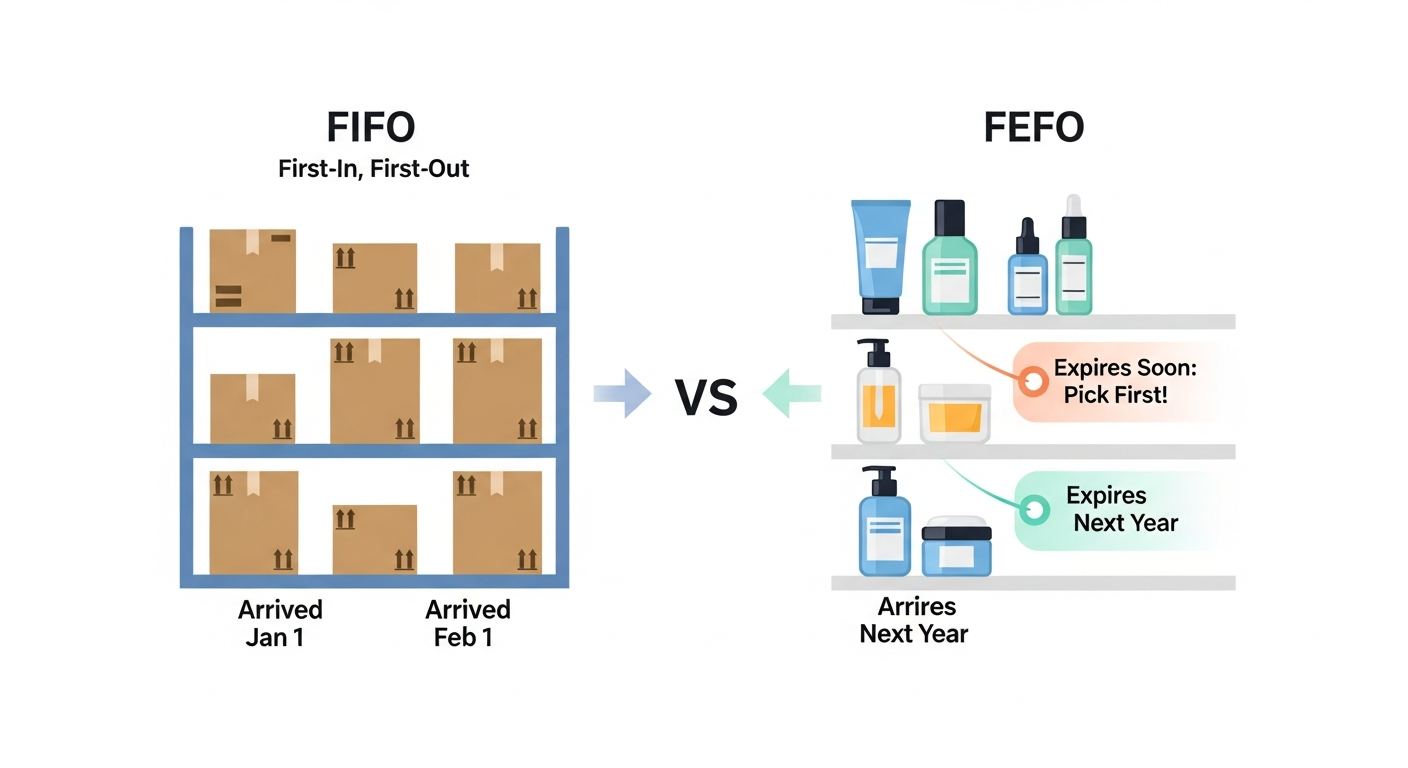
Implementing FEFO (First-Expired, First-Out) and Lot Tracking
FEFO (First-Expired, First-Out) is critical for beauty fulfillment, ensuring products with the shortest shelf life are shipped first to maintain efficacy and prevent waste.
Inventory management in beauty is defined by FEFO. Unlike FIFO (First-In, First-Out), FEFO ensures that stock with the earliest expiration date is picked and shipped first. This methodology is critical for minimizing waste and ensuring customers receive fresh, potent products. Robust lot tracking is equally essential, allowing your business to perform precise recalls if a specific manufacturing batch is identified as defective or non-compliant.
Strong inventory management is non-negotiable here. Beauty brands need visibility into SKU counts, expiration windows, lot numbers, stock rotation, and replenishment timing. If those details live in five spreadsheets and one person’s memory, the operation is already wearing roller skates on a marble floor.
Regulatory Compliance: Adhering to MoCRA, FDA, and GMP Standards
The Modernization of Cosmetics Regulation Act (MoCRA) has significantly tightened oversight. Brands must now maintain meticulous records of their supply chain. This includes documentation of where products are stored and their safety profiles. Operating under Good Manufacturing Practices (GMP) ensures your storage facility minimizes cross-contamination risks, keeping your business compliant with federal mandates and protecting you from liability.
The FDA describes MoCRA as the most significant expansion of its authority to regulate cosmetics since the Federal Food, Drug, and Cosmetic Act was passed in 1938. Beauty brands should review the FDA’s MoCRA guidance and cosmetics labeling resources when building compliance workflows around storage, labeling, records, and customer safety.
Specialized Storage for Hazardous Materials (Perfumes, Aerosols, and Flammables)
Many beauty products, such as perfumes and aerosol sprays, are classified as hazardous materials due to their alcohol or propellant content. These items require segregated storage areas that meet fire safety codes. Failure to store these properly can lead to severe fines or dangerous warehouse conditions.
If your catalog includes fragrance, aerosols, nail products, or flammable liquids, confirm whether your provider can support the correct handling rules before inventory arrives. This is also a strong reason to evaluate broader 3PL fulfillment services rather than assuming every warehouse is equipped for every product type.
Preventing Shrinkage: Security Measures for High-Value Beauty Merchandise
Beauty products are frequent targets for theft due to their small size and high retail value. Implementing high-density security, including restricted access zones and comprehensive CCTV monitoring, is vital. Using automated tracking for inventory cycle counts helps detect shrinkage early, preventing significant losses in your sales revenue.
Shrinkage is not just a warehouse problem; it is a margin problem. Beauty brands should ask about cycle count cadence, restricted-access inventory areas, lot tracking, reporting visibility, and shrinkage accountability before selecting a provider. Launch Fulfillment’s guide on questions to ask a 3PL is a useful companion when vetting those controls.
Phase 2: Strategic Packaging and the “Unboxing” Experience
Balancing Aesthetics and Protection: Engineering for Fragile Glass and Liquids
The unboxing experience is the first physical interaction a customer has with your brand. However, this aesthetic must be reinforced with structural integrity. Using custom-molded inserts prevents glass containers from colliding, which is the primary cause of shipping damage. Effective engineering protects your bottom line by reducing the costs associated with replacing damaged products.
For beauty brands, packaging has to do two jobs at once: protect the product and present the brand. A fulfillment partner should understand pick, pack, and ship services well enough to support fragile components, liquids, branded inserts, dunnage selection, and consistent presentation without slowing down order flow.
Sustainable Packaging: Meeting Modern Consumer Demands for Eco-Friendly Materials
Modern consumers demand sustainability. Integrating recyclable, compostable, or reusable packaging materials is now a competitive necessity. Beyond being an ethical choice, sustainable packaging signals to the customer that your brand aligns with their values, strengthening long-term loyalty.
If your brand makes environmental claims around packaging, make sure those claims are accurate and substantiated. The Federal Trade Commission’s Green Guides are designed to help marketers avoid misleading environmental claims, including claims around recyclable, compostable, degradable, and recycled-content materials.
The Circular Logistics Advantage: Using Resealable Packaging to Facilitate Easier Returns
Packaging should be designed for the entire lifecycle, including potential returns. Incorporating resealable adhesive strips allows customers to repackage items easily if they decide to return them. This small design detail reduces the likelihood of product damage during transit back to your warehouse, making it easier for your team to process the item.
This is especially useful for beauty brands because the return condition matters. A resealable shipper can reduce damage on the way back, support faster inspection, and help your team separate resealable unopened products from items that must be disposed of for hygiene reasons.
Optimizing Dimensional Weight to Control Shipping Costs
Shipping costs are often the largest variable expense for beauty e-commerce brands. Avoid excessive void fill or oversized boxes that increase dimensional weight pricing. By optimizing box sizes, you reduce your overall shipping spend while maintaining a premium unboxing aesthetic.
Beauty products are often small, dense, fragile, or oddly packaged, which makes right-sizing especially important. Launch Fulfillment’s dimensional weight calculator FAQ and guide to calculating shipping and handling costs can help brands understand how packaging decisions affect billed weight and margin.
Branding and Personalization: Utilizing Custom Inserts and Samples
Personalization drives repeat sales. Including curated product samples or personalized brand inserts creates a “gift-like” experience. These small touches provide a high ROI by encouraging customers to try new products and increasing their overall basket size.
This is where kitting and assembly services can become a growth lever. Sample packs, influencer mailers, promotional kits, and seasonal beauty sets all require repeatable workflows that protect the customer experience while keeping warehouse labor efficient.
Build a Beauty Fulfillment Workflow That Feels Premium
From fragile glass packaging to custom inserts, samples, and branded unboxing, Launch Fulfillment helps beauty brands create fulfillment workflows that protect products and strengthen customer loyalty.
Phase 3: Efficient Order Fulfillment and Scaling for Growth
Leveraging Order Management Systems (OMS) for Real-Time Inventory Visibility
An advanced OMS is the backbone of your operations. It provides real-time visibility across all sales channels, ensuring that your inventory counts are accurate. This prevents overselling and allows your customer service team to provide accurate updates to shoppers, fostering a sense of reliability.
Real-time order and inventory visibility is especially important when beauty brands sell across Shopify, Amazon, TikTok Shop, retail partners, and subscription channels. Launch Fulfillment’s fulfillment and 3PL warehousing resources explain how inventory, warehouse workflows, and order processing fit together inside a scalable fulfillment operation.
Managing “Viral” Surges: Preparing for Influencer Launches and Social Media Spikes
Viral social media trends can cause unpredictable spikes in orders. Scaling your fulfillment throughput requires a flexible warehouse team and pre-planned strategies for high-volume periods. Effective automation, such as automated label printing and batch picking, ensures your team can process these sudden surges without sacrificing accuracy.
Beauty brands live closer to the “viral spike” than almost any other category. A creator post, product review, or launch campaign can turn a quiet Tuesday into a warehouse cardio event. That is why scalable order fulfillment matters before demand arrives, not after the printer starts smoking.
International Shipping: Navigating Customs Requirements, Duties, and Tax Implications
Expanding globally requires a deep understanding of international compliance. Partnering with a logistics provider experienced in cross-border regulations ensures that products are properly labeled and that duties are collected correctly, preventing costly shipment rejections at the border.
For international beauty orders, brands should align product restrictions, customs descriptions, duties, taxes, labeling, and carrier selection before launch. This is also where a broader ecommerce shipping services and solutions strategy can help balance delivery speed, cost, and customer expectations.
Shipping Carrier Selection: Balancing Speed (Next Day) with Cost-Efficiency
Selecting the right carrier is about balancing customer expectations for speed with your business goals for margins. For routine orders, cost-effective ground shipping is appropriate; for high-value or urgent orders, prioritize carriers that offer reliable tracking and insurance options.
Carrier selection should also account for shipping zones, DIM weight, delivery promise, and product fragility. If your customers expect premium delivery, the cheapest option may not be the best option. If your margins are thin, the fastest option may not be sustainable. Beauty fulfillment sits right in that balancing act.
Phase 4: Mastering the Beauty Return Process

Creating a Transparent Return and Refund Policy: Clear Disclosure and State Compliance
Your return policy must be easily accessible and transparent. In states like California and New York, consumer protection laws mandate clear disclosure of return terms. Being upfront about whether you offer full refunds or store credit manages customer expectations and reduces conflict.
The California Department of Justice notes that when a store clearly displays a limited or no-refund policy, refunds and exchanges are not required by law, which reinforces why visible return-policy communication matters. California DOJ refund guidance. Beauty brands should also work with legal counsel on state-specific return and refund obligations, especially when hygiene restrictions affect resale.
Building a Frictionless Journey: Digital Return Forms and Prepaid Labels
The return journey should be as smooth as the purchase journey. Using an automated portal for digital return forms allows customers to request returns quickly. Providing pre-paid shipping labels removes friction and increases the likelihood that the customer will return to your site for future purchases.
Launch Fulfillment’s returns management support helps brands think beyond “send it back.” Returns should protect the customer relationship, preserve operational visibility, and help teams make fast decisions about inspection, restocking, disposal, or replacement.
The Hygiene Factor: Strict Safety Protocols for Inspecting Returned Merchandise
Safety is non-negotiable. Returned beauty products, especially those that have been opened, must undergo rigorous inspection. If a product shows signs of being used, it cannot be safely resold. Implement a strict protocol for disposing of compromised goods to protect the health of your future customers.
This is one of the clearest reasons beauty returns require category-specific SOPs. A generic returns process may work for apparel or accessories, but opened skincare, cosmetics, and personal care products need stricter review to avoid contamination risk and brand damage.
Restocking vs. Disposal: Determining Resalable Status for Opened vs. Unopened Products
Categorize returns into “resalable” and “disposed.” Unopened, pristine products can be returned to inventory. Opened products, even if they look unused, should typically be marked for disposal to prevent health risks. Clearly defining these categories in your internal documentation prevents staff from accidentally restocking defective or contaminated items.
Your return SOP should define product condition, tamper-evident packaging, seal status, lot number, customer reason code, disposal documentation, and refund outcome. It is not glamorous, but neither is refunding a customer because someone restocked a moisturizer that should have been tossed. Beauty logistics has very little room for “probably fine.”
Fraud Prevention: Identifying Used Product Returns and Monitoring “Returnless” Scams
Implement tracking systems to monitor return behavior. Frequent returns from the same customer may indicate fraudulent activity. By identifying patterns of abuse such as “wardrobing” (using a product for an event and then returning it), you can protect your business from unnecessary financial losses.
Fraud prevention should be balanced with customer experience. The goal is not to punish legitimate customers, but to identify repeat abuse patterns, product-condition inconsistencies, and return flows that create margin loss.
Legal and Regulatory Compliance for Beauty Brands
Conspicuous Display: Meeting California and New York State Law Requirements
Retailers must display their return policies conspicuously. In California, for example, if you do not offer a full refund, you must explicitly state that fact in a way that is clearly visible to the customer before the purchase is finalized. Compliance here is essential to avoid class-action litigation and build consumer trust.
Return-policy language should be easy to find on product pages, checkout flows, order confirmations, and customer service pages. Beauty brands should also ensure policies match the reality of product safety. If opened products cannot be restocked, that needs to be clear before the customer buys.
Consumer Protection Laws and Warranty Terms for Electronic Beauty Tools
If your business sells electronic beauty tools, such as light-therapy masks or sonic cleansers, you are subject to additional consumer protection regulations. Ensure that your warranty terms are clearly defined and that you have a process for handling defective electronic merchandise.
Electronic beauty tools may require separate workflows for warranty claims, serial tracking, inspection, and replacement. If these products live alongside cosmetics in your catalog, make sure your fulfillment and returns process separates cosmetic hygiene rules from device warranty rules.
Scale Beauty Fulfillment Without Losing the Details
Launch Fulfillment helps beauty, skincare, wellness, and personal care brands manage inventory, packaging, shipping, kitting, and returns with the care premium products require.
Final Thoughts
Mastering beauty fulfillment is about bridging the gap between delicate product requirements and high-volume operational efficiency. By prioritizing climate-controlled storage, FEFO-based inventory management, and transparent, compliant return policies, you can turn your logistics network into a competitive advantage. Remember that every touchpoint from the secure packaging of a serum to the ease of processing a return is an opportunity to reinforce your brand identity. As you implement these best practices, focus on building a system that is as resilient as it is customer-centric. By staying ahead of regulatory changes and focusing on the “hygiene factor” in your operations, you will protect your business from unnecessary risks and secure long-term loyalty in an increasingly crowded beauty market. Start by auditing your current return workflows and ensuring your storage environment meets the strict standards demanded by today’s cosmetic formulations.
If your beauty brand is ready for fulfillment that protects product integrity, premium presentation, and customer trust, contact Launch Fulfillment to talk through your storage, packaging, shipping, and returns requirements.
Related Posts
FAQ: Beauty Fulfillment Checklist
What is a beauty fulfillment checklist?
A beauty fulfillment checklist is a structured framework used by beauty and skincare brands to manage storage, inventory, packaging, shipping, compliance, and returns processes. It helps ensure products are handled safely, shipped accurately, and delivered with a premium customer experience.
Why do beauty brands need specialized fulfillment services?
Beauty products often require climate-controlled storage, lot tracking, expiration management, fragile packaging protection, and hygiene-focused returns handling. Specialized beauty fulfillment services help brands protect product integrity, maintain compliance, and reduce operational risks.
What should be included in a beauty fulfillment checklist?
A strong beauty fulfillment checklist should include inventory management, FEFO rotation, climate-controlled warehousing, packaging standards, dimensional weight optimization, returns inspection protocols, shipping workflows, and compliance procedures for cosmetics and personal care products.
How can beauty brands reduce fulfillment and shipping costs?
Beauty brands can reduce fulfillment costs by optimizing packaging sizes, improving inventory forecasting, minimizing shipping-zone exposure, and using efficient kitting and packing workflows. Proper dimensional weight management also helps reduce shipping expenses over time.
What is the best way to manage beauty product returns?
The best beauty returns process includes clear return policies, digital return portals, hygiene-focused inspection procedures, and strict guidelines for separating resalable inventory from opened or contaminated products. Strong returns management protects both customer trust and product safety.
