
Key Takeaways
- Understanding 3PL pricing models is essential for protecting e-commerce profit margins. The lowest fulfillment quote is not always the most cost-effective once shipping, storage, returns, and operational fees are included.
- 3PL pricing models can vary significantly based on your order profile and operational complexity. Transactional, flat-rate, cost-plus, and hybrid pricing structures each impact scalability, forecasting, and long-term fulfillment costs differently.
- Total Cost of Ownership (TCO) matters more than a low pick fee. Brands should evaluate warehousing, packaging, shipping, labor, technology, and returns management together when comparing fulfillment providers.
- Shipping costs and dimensional weight pricing can dramatically increase fulfillment expenses. Oversized packaging, inefficient box selection, and long shipping zones often create hidden margin erosion.
- The best 3PL pricing models align with your business stage and fulfillment needs. Startups, subscription brands, enterprise retailers, and high-SKU operations all require different fulfillment pricing strategies.
- Hidden fees are one of the biggest risks in e-commerce fulfillment. Integration costs, peak season surcharges, account management fees, storage overages, and returns processing can significantly affect your true cost per order.
- Calculating fulfillment cost per order requires operational visibility. Brands should regularly audit SKU velocity, shipping zones, inventory storage, packaging costs, and carrier markups to ensure their 3PL pricing model supports profitable growth.
Selecting a third-party logistics (3PL) provider is often treated as a simple search for the lowest “per-pick” fee. However, this common approach ignores the complex reality of supply chain economics. When you focus solely on a single line item, you risk overlooking hidden costs that can erode your profit margins as your order volume grows. To truly understand the financial commitment of outsourcing your fulfillment, you must master the concept of Total Cost of Ownership (TCO).
At Launch Fulfillment, we see this all the time: brands compare a few pick-and-pack fees, choose the lowest quote, then discover the real cost hiding in storage, packaging, returns, shipping zones, special projects, and carrier markups. The better question is not “What is the cheapest 3PL?” It is “What is the true cost per order once every operational variable is included?”
Understanding the Total Cost of Ownership (TCO) in Fulfillment
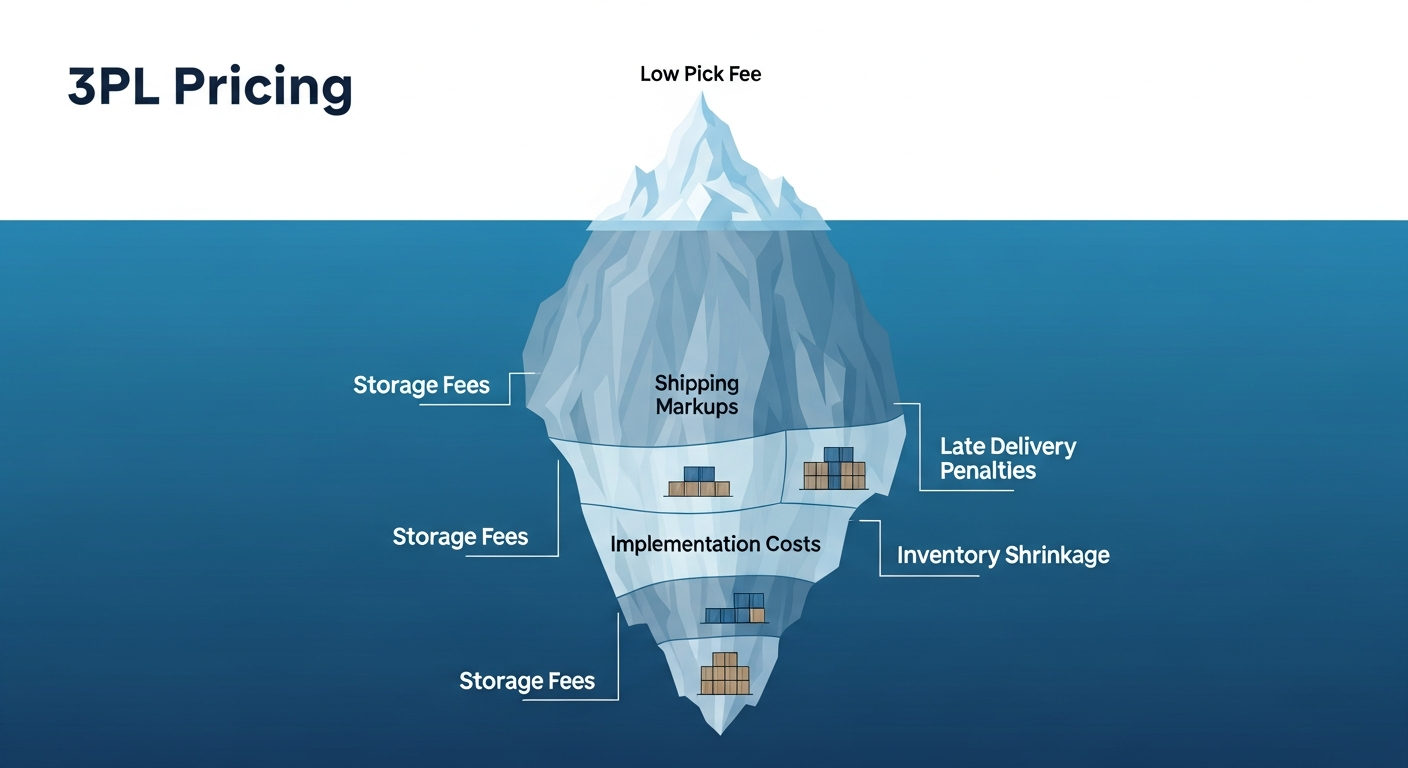
The 3PL Pricing Iceberg: A low pick fee is often just the tip of the iceberg, hiding significant operational and logistical costs below the surface.
Why the Lowest “Pick Fee” Isn’t Always the Best Deal
Many 3PLs use low, aggressive pick fees as marketing bait to lure prospective clients. These providers often compensate for those low margins by padding storage fees, inflating shipping markups, or charging excessive implementation costs. If you prioritize the lowest picking fee without auditing the entire invoice, you are likely overpaying for the services that actually drive your business.
This is why brands should compare quotes against a complete ecommerce fulfillment pricing model instead of evaluating one attractive line item in isolation. A low pick fee can still lead to a high landed cost if the rest of the fee structure works against your margin.
Defining TCO: Moving Beyond the Monthly Invoice
TCO represents the cumulative cost of your logistics operations, including warehousing, labor, shipping, and technology integration. It encompasses both explicit fees and the “hidden” costs, such as damage, inventory shrinkage, and late delivery penalties. To calculate TCO, you must aggregate every dollar spent on inventory management and shipping to see your actual landed cost per unit.
A realistic TCO model should include warehousing and fulfillment services, receiving, storage, pick and pack, packaging materials, kitting, returns, shipping, account management, technology, and exceptions. Shopify’s fulfillment cost guide also frames fulfillment costs around warehousing, packaging, shipping, and operational profitability, which reinforces why ecommerce brands should evaluate more than basic handling fees. Shopify fulfillment cost guidance
The Impact of Fulfillment Efficiency on Your Bottom Line
Efficiency isn’t just about speed; it is about cost containment. High-performing 3PLs leverage advanced technology to reduce touchpoints, minimize human error, and optimize packing workflows. When your operations are streamlined, you reduce the time and capital tied up in the fulfillment process, directly increasing your net profit margins.
That is the practical value of choosing a technology-forward 3PL fulfillment services partner. Real-time inventory tracking, same-day processing, optimized shipping, and clean returns workflows all support lower error rates and stronger margin control.
Need Clarity on Your True Fulfillment Costs?
Launch Fulfillment helps ecommerce brands understand the full cost of fulfillment, including storage, pick and pack, kitting, returns, packaging, and shipping. Get pricing clarity before hidden fees start eating into your margins.
The Core Components: A Breakdown of 3PL Fee Structures
Inbound Logistics: Receiving, SKU Scan Fees, and Replenishment
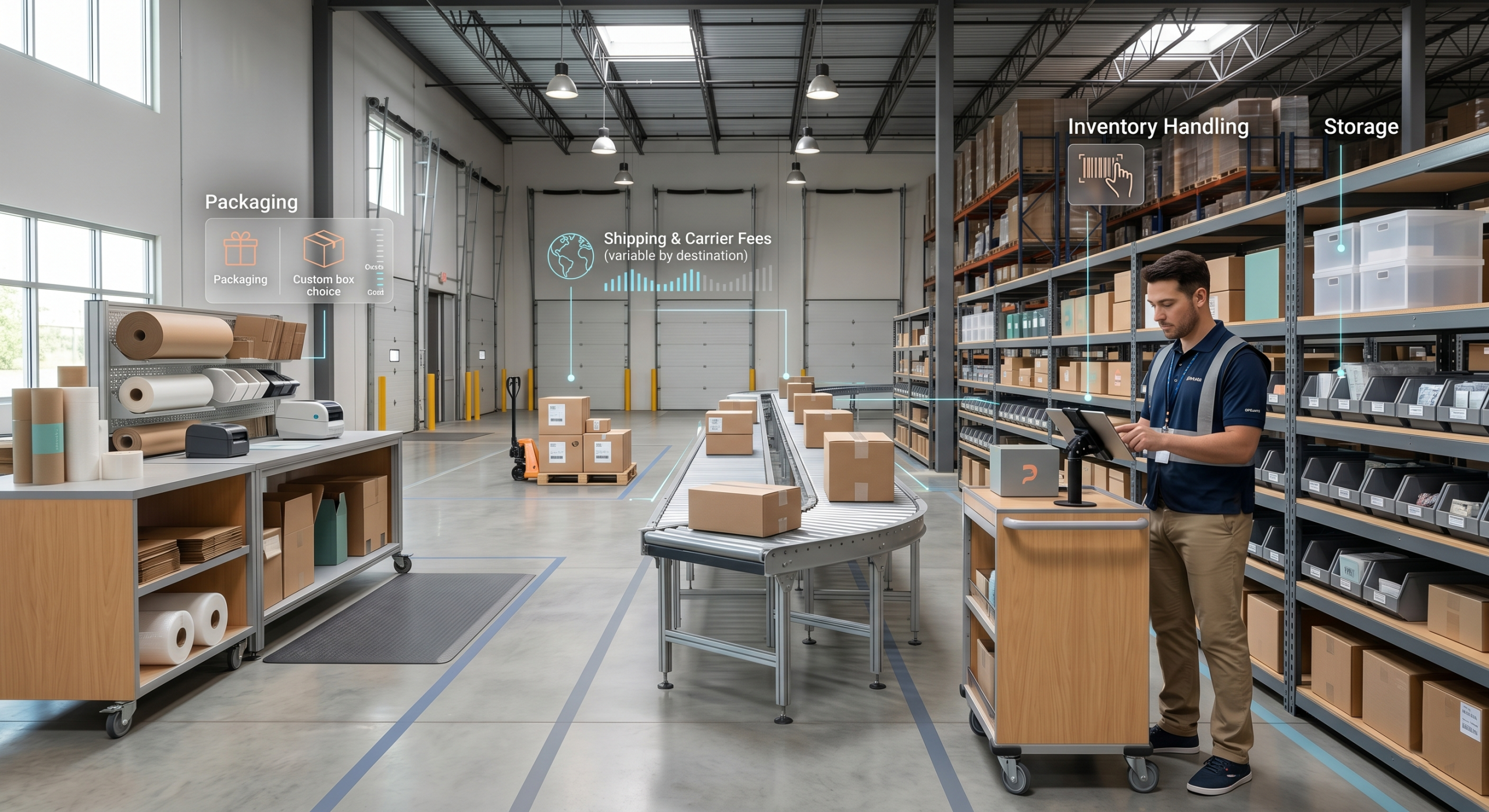
Inbound logistics is where your relationship with a 3PL begins. Most providers charge a fee for receiving goods, often based on the number of pallets or the time taken to unload a container. You will also encounter SKU scan fees, which cover the labor required to identify and enter items into the warehouse management system (WMS). Managing your replenishment schedule efficiently is critical to avoiding rush processing fees.
Inbound costs also depend on how clean your supplier documentation is. Poor carton labels, inconsistent SKU data, missing ASNs, and unclear replenishment plans create receiving delays before fulfillment even begins. Strong inventory management gives your 3PL the information needed to receive and replenish products accurately.
Warehousing Costs: Storage Rates, Pallet Fees, and Inventory Control
Storage is rarely a flat rate. Most 3PLs charge based on the physical footprint your inventory occupies, typically measured by the pallet or the cubic foot. If you have slow-moving items, these costs can accumulate rapidly. Effective inventory control requires constant monitoring of your SKU density to ensure you aren’t paying for wasted warehouse space.
For brands with seasonal demand, storage cost management should include SKU velocity, safety stock, replenishment cadence, and dead-stock cleanup. Launch Fulfillment’s guide to the safety stock formula can help teams balance availability without paying to store too much inventory.
Outbound Operations: Picking, Packing, and Packaging Materials
Outbound costs include the physical handling of orders. “Picking” refers to the labor involved in locating items, while “packing” involves preparing them for transit. Many clients overlook the cost of packaging materials; however, using branded boxes or dunnage can add significant weight and volume to an order. Strategic kitting pre-bundling items can reduce these labor costs by consolidating multiple movements into one.
If your orders frequently require multiple SKUs, inserts, bundles, or branded presentations, compare standard pick fees against the cost of kitting and assembly services. In many cases, pre-assembly reduces touches at order time and improves consistency.
Shipping Costs: Dimensional Weight Pricing vs. Actual Weight
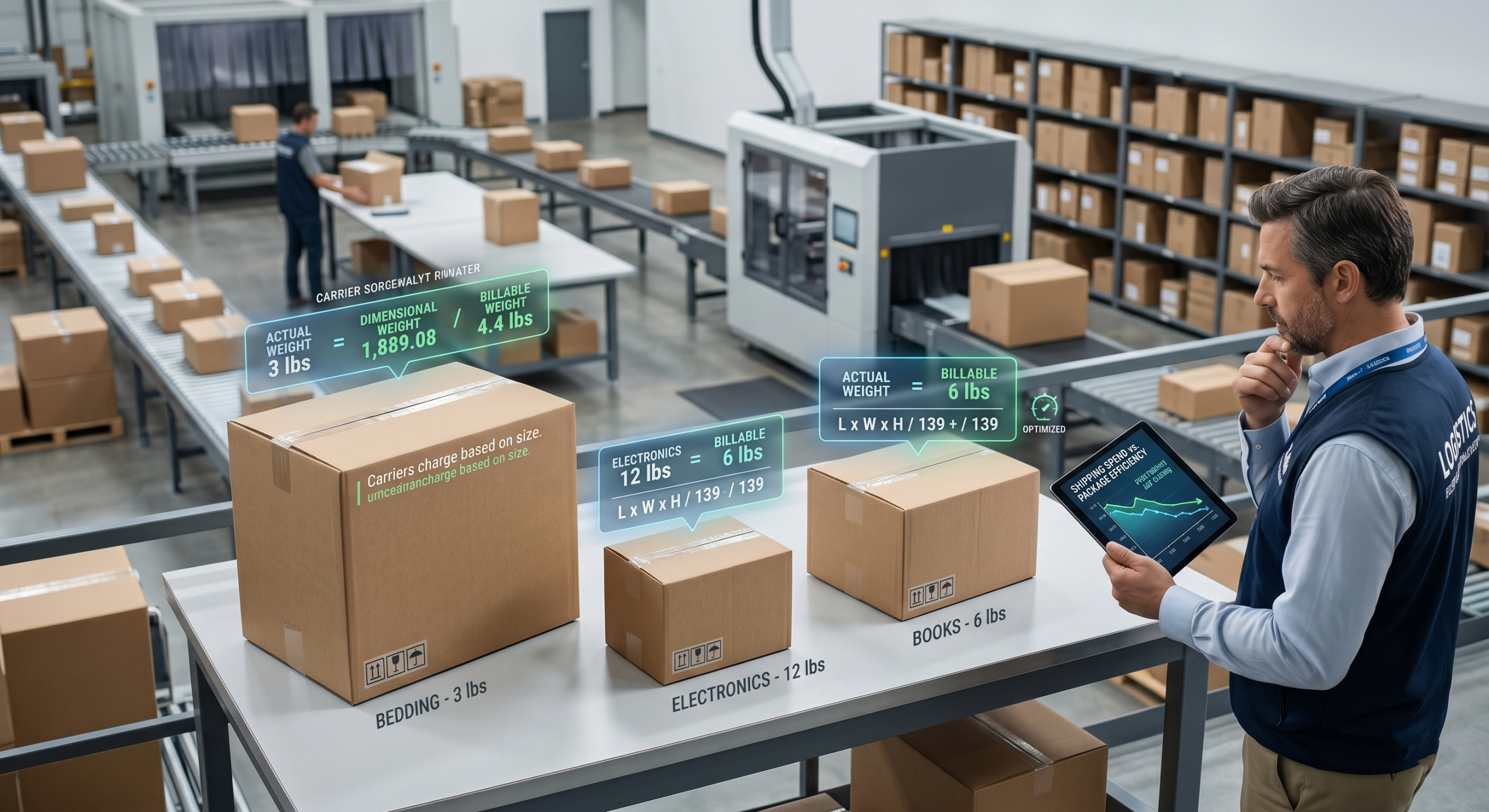
Shipping is often the largest expense in your logistics budget. Carriers charge based on either the actual weight of the package or its dimensional (DIM) weight, whichever is higher. If your packaging is too large for the product inside, you will be penalized by DIM weight pricing. Optimizing your box sizes is one of the most effective ways to lower your shipping costs.
UPS explains that dimensional weight compares the amount of space a package occupies with its actual weight, and dimensional weight may apply when a package is large relative to its weight. UPS dimensional weight guidance, USPS also notes that shape, weight, and size can affect pricing for large packages, including oversized or dimensional weight charges. USPS parcel size and weight standards
Launch Fulfillment’s dimensional weight calculator FAQ is useful for estimating how box size can change billed weight before those costs appear on your invoice.
4 Primary 3PL Pricing Models Explained
Transactional (Activity-Based) Pricing: Pay for What You Use
Transactional pricing is the most common model for small-to-mid-sized businesses. You are billed based on the number of activities performed: one fee for picking, one for packing, and one for storage. This provides maximum transparency but can lead to fluctuating monthly bills that are difficult to forecast as your order volume scales.
This model works well when order volume is variable, and you want costs to rise and fall with activity. It is often a strong fit for brands that need flexible e-commerce fulfillment services without locking into fixed monthly commitments too early.
Fixed (Flat-Rate) Pricing: Predictability for High-Volume Brands
In a flat-rate model, the 3PL charges a single, all-inclusive price per order. This simplifies accounting and provides high predictability for your financial planning. However, it often requires a minimum order volume commitment and may include a premium to account for the provider’s risk in averaging out the costs across various order types.
Flat-rate pricing can make sense for high-volume brands with consistent order profiles, but it can become expensive if your product mix, packaging needs, or SKU count varies significantly.
Cost-Plus Pricing: Transparency and Large-Scale Operations
Cost-plus pricing is favored by large enterprises. The 3PL bills you for the actual costs incurred, such as labor hours and carrier rates, plus a pre-negotiated management fee or margin. This model requires a high level of trust and robust data reporting, but it offers the most transparency regarding how your money is being spent.
For enterprise brands, cost-plus only works when the provider offers clean reporting, strong SLA accountability, and transparent carrier-rate handling. That is also why brands should know the right questions to ask a 3PL before signing any contract.
Hybrid Models: Balancing Scalability with Risk Mitigation
Many modern 3PLs offer hybrid structures that combine transactional fees for standard orders with fixed management fees for specialized services. This allows companies to enjoy the flexibility of pay-as-you-go logistics while maintaining a stable foundation for core operations, making it an ideal choice for scaling e-commerce brands.
Hybrid pricing is often the most realistic fit for brands that have standard fulfillment needs plus recurring projects like kitting, branded packaging, subscription boxes, FBA prep, wholesale orders, or retail compliance workflows.
Strategic Matchmaking: Choosing a Model Based on Your Order Profile
High-Volume, Low-SKU Brands: Efficiency-First Models
If your business moves a high volume of a limited number of SKUs, you should prioritize providers with automated picking systems. Your goal is to maximize throughput and minimize the time spent per package. Transactional models often work well here, provided you negotiate tiered discounts for volume.
High-volume brands should also review whether their provider can support accurate pick, pack, and ship services at scale. The wrong warehouse layout or picking process can turn a simple catalog into an expensive fulfillment operation.
Subscription Boxes and Kitting-Heavy Businesses: Project-Based Fees
Businesses that rely heavily on kitting require a different approach. Because the labor involved in assembling sets is significant, look for providers that offer project-based pricing rather than standard picking fees. This prevents your costs from spiraling during peak seasonal cycles when kitting demands are high.
For recurring box programs, compare project fees against dedicated subscription box fulfillment support. Subscription operations require timing discipline, component accuracy, packaging consistency, and predictable labor planning.
E-commerce Startups: Leveraging Flexible Variable Costs
Startups should avoid fixed-cost contracts that demand long-term volume commitments. Instead, opt for transactional models that allow you to scale costs in direct alignment with your growth. Flexibility is more valuable than a lower rate during the early, unpredictable stages of a brand’s lifecycle.
If your brand is still learning its demand curve, it may also help to compare in-house vs. 3PL fulfillment before committing to a pricing model. The right decision depends on order volume, labor constraints, customer expectations, and your ability to manage fulfillment internally.
Enterprise Brands: The Need for Dedicated Account Management and SLAs
Enterprise brands require more than just shipping; they need Service Level Agreements (SLAs) that guarantee performance. If your business depends on rapid, reliable deliveries, ensure your contract includes penalties for missed SLAs. In this tier, cost-plus models are often preferred because they allow for granular oversight of operational performance.
For larger brands, the fulfillment relationship should feel like a partnership, not a ticket queue. Launch Fulfillment’s 3PL partner advantage explains why communication, accountability, and proactive problem-solving matter as much as the rate sheet.
Not Sure Which 3PL Pricing Model Fits Your Brand?
Launch Fulfillment helps ecommerce brands compare fulfillment costs by order profile, SKU complexity, shipping needs, returns volume, and growth stage, so pricing supports scale instead of becoming a surprise.
The “Hidden” Costs That Impact Your Profit Margins
Integration Fees: Connecting Shopify, BigCommerce, and WMS
Modern fulfillment relies on seamless technology. If your 3PL’s system does not integrate easily with your storefront, you will face high implementation fees or ongoing costs for manual data entry. Ensure the provider offers robust API capabilities to minimize human error and administrative labor.
Shopify explains that webhooks allow apps to subscribe to events and receive updates, which is critical for keeping order and fulfillment systems aligned. Shopify webhook documentation. If your provider cannot support reliable integrations, manual work becomes the hidden fee that never shows up cleanly on the quote.
Reverse Logistics: The Real Cost of Returns Management
Returns are the silent killer of profitability. Reverse logistics processing, inspecting, and restocking items is labor-intensive. Many 3PLs do not disclose these costs until they hit your invoice. Negotiate a clear “returns handling” fee upfront to avoid sudden margin hits.
The National Retail Federation’s 2025 Retail Returns Landscape notes that returns are becoming increasingly important to both retailers and consumers, with return operations shaping cost, policy, and customer experience decisions. NRF 2025 Retail Returns Landscape. For e-commerce brands, returns management should be priced and planned as a core fulfillment function, not an afterthought.
Overage Fees and Peak Season Surcharges
During holidays, shipping volumes surge, and many carriers and 3PLs implement peak surcharges. If your contract doesn’t clearly outline how these fees are calculated, you could see a 20–30% increase in costs during your most critical sales period. Always audit these terms before signing a contract.
Peak-season planning should include storage overages, labor surcharges, expedited receiving fees, carrier surcharges, special project charges, and customer support impact. Otherwise, your best sales month can become your most expensive operations month.
Administrative and Support Fees: Account Management and Implementation
Beyond physical operations, there are often soft costs for account management, support, and specialized reporting. If you require a dedicated client success manager, be prepared for this to be reflected in your overall pricing. Clarify whether these support services are included in your core fees or billed as additional line items.
Dedicated support can be worth the cost if it improves communication, resolves issues quickly, and surfaces margin-saving opportunities. The key is making sure you know whether account management is included, optional, or quietly buried in another line item.
How to Calculate Your Fulfillment Cost Per Order
Step 1: Auditing Your Current Data (Order Volume and SKU Density)
Start by pulling your last six months of shipping data. Calculate your average daily order volume and categorize your inventory by SKU density. Understanding how many units move through your warehouse helps you determine if you are paying for efficient high-velocity storage or expensive, slow-moving dead stock.
Your data audit should include order volume, units per order, SKU velocity, storage footprint, average package dimensions, return rate, shipping zones, and special project frequency. If your team cannot pull those numbers, your cost-per-order model is already flying with one eye closed.
Step 2: Factoring in Freight Forwarding and Inbound Transportation
Do not evaluate fulfillment in a vacuum. Your inbound freight costs must be factored into your total product cost. If your 3PL also handles inbound container unloading, treat these charges as part of your procurement overhead rather than just fulfillment.
This is especially important for brands importing inventory or working with multiple suppliers. Inbound freight, receiving accuracy, and replenishment timing all influence the final fulfillment cost per order.
Step 3: Calculating Labor Costs for Special Projects and Kitting
Determine the average time spent on “value-added services” like kitting or custom packaging. If these tasks take your team longer than five minutes per order, your current labor cost per order is likely higher than your 3PL’s baseline, indicating a need for better automation or process refinement.
For more complex workflows, review whether your provider supports custom kitting and assembly services with project-based pricing, documented SOPs, and clear quality control.
Step 4: Accounting for Carrier Markups and Shipping Zones
Most 3PLs receive volume discounts from major carriers. However, they often keep a portion of those discounts as a margin. You must audit the difference between the rates you are charged and the actual carrier rates for the shipping zones you target. If the markup exceeds 15–20%, negotiate a more transparent rate structure.
Shipping zones can make or break your cost per order. Launch Fulfillment’s guide to shipping zones explains how distance from the fulfillment origin affects delivery cost, while its ecommerce shipping services and solutions page covers shipping strategy, carrier selection, and cost optimization.
Ready to Calculate Your Real Cost Per Order?
Launch Fulfillment can help you evaluate your current fulfillment spend, identify hidden costs, and build a pricing model that supports profitable ecommerce growth.
Final Thoughts
Calculating the true cost of fulfillment requires a shift in perspective. You must stop looking for the “cheapest” rate and start building a TCO model that reflects your actual business volume and operational complexity. By understanding the nuances of inbound logistics, outbound efficiency, and the “hidden” costs of returns, you can transform your logistics strategy from a necessary expense into a competitive advantage.
To succeed, perform a quarterly audit of your fulfillment data. Identify your SKU velocity, compare your shipping zone markups against standard carrier rates, and verify that your current pricing model still supports your growth stage. Whether you opt for a transactional, fixed, or hybrid model, the goal is always the same: operational transparency that protects your margins. Use this framework to demand clarity from your providers, enforce your SLAs, and ensure your logistics infrastructure is built to scale alongside your brand. The best 3PL partner is the one that prioritizes your profitability as much as their own.
If you want a fulfillment partner that helps you understand the full picture, not just the cheapest line item, contact Launch Fulfillment to talk through your order profile, pricing structure, and growth goals.
Related Posts
FAQ: 3PL Pricing Models
What are the most common 3PL pricing models?
The most common 3PL pricing models are transactional pricing, flat-rate pricing, cost-plus pricing, and hybrid pricing models. Each structure charges differently for storage, picking, packing, shipping, and value-added services depending on the brand’s operational needs.
How do 3PL pricing models affect ecommerce profitability?
3PL pricing models directly impact ecommerce margins because fulfillment costs include more than just pick-and-pack fees. Storage rates, shipping costs, dimensional weight pricing, returns processing, and account management fees all influence total cost per order.
What hidden fees should brands watch for in 3PL contracts?
Common hidden fees include storage overages, dimensional weight markups, integration fees, returns processing costs, peak-season surcharges, pallet fees, and special project labor. Reviewing a sample invoice is one of the best ways to identify unexpected fulfillment costs before signing a contract.
Which 3PL pricing model is best for ecommerce startups?
Many ecommerce startups prefer transactional 3PL pricing because costs scale alongside order volume. This gives growing brands flexibility without locking them into large fixed monthly fulfillment commitments too early.
How can ecommerce brands lower fulfillment costs?
Brands can reduce fulfillment costs by optimizing packaging sizes, improving inventory forecasting, reducing shipping-zone exposure, and selecting the right 3PL pricing model for their order profile and operational complexity.
