
Key Takeaways
- Strong order fulfillment operations are essential for scaling ecommerce brands efficiently and maintaining a positive customer experience. As order volume increases, fulfillment workflows, inventory accuracy, shipping speed, and warehouse organization become critical growth factors.
- Manual fulfillment processes create operational bottlenecks that limit scalability. E-commerce brands relying on spreadsheets, disconnected systems, or manual order handling often struggle with inventory errors, delayed shipments, and rising labor inefficiencies.
- Inventory visibility is one of the most important components of successful order fulfillment operations. Real-time inventory tracking, accurate SKU management, and demand forecasting help prevent stockouts, overselling, and fulfillment disruptions.
- Warehouse optimization strategies improve speed, accuracy, and throughput. Techniques like ABC analysis, batch picking, barcode scanning, and organized slotting systems help fulfillment teams process higher order volumes more efficiently.
- Integrated fulfillment technology creates better operational control. Connecting ecommerce platforms, WMS systems, ERPs, shipping software, and analytics tools into a single ecosystem reduces manual errors and improves workflow automation.
- Shipping strategy directly impacts profitability and customer satisfaction. Distributed fulfillment, optimized packaging, carrier diversification, and shipping zone management all help ecommerce brands reduce costs while improving delivery performance.
- The best order fulfillment operations are designed for long-term scalability. Whether fulfillment is handled in-house, through a 3PL, or using a hybrid model, scalable systems and operational consistency are critical for sustainable e-commerce growth.
The transition from a growing e-commerce startup to a scalable enterprise is rarely a linear path. It is often marked by the friction of manual processes struggling to keep pace with rising order volumes. When you find your team spending more time reconciling spreadsheets than focusing on growth, you have hit the scaling threshold. At this inflection point, order fulfillment must evolve from a back-end cost center into a strategic engine for competitive advantage.
At Launch Fulfillment, we believe strong fulfillment is one of the clearest signs that a brand is ready to scale. When ecommerce fulfillment services, inventory visibility, shipping strategy, warehouse workflows, and returns all work together, fulfillment becomes a growth engine instead of a daily operational headache.
Recognizing the Scaling Threshold: When Your Fulfillment Process Needs an Upgrade
Identifying Bottlenecks in Manual Processing
The first sign that your infrastructure is failing is the “spreadsheet wall.” If your order processing requires manual data entry across multiple tabs or platforms, you are losing money on every shipment. Common bottlenecks include excessive time spent on manual picking lists, high rates of order entry errors, and a lack of visibility into inventory levels. When human effort becomes the primary constraint to your output, you are no longer scaling; you are simply treading water.
This is where brands often begin evaluating order fulfillment partners, warehouse systems, and process automation. If your team is manually reconciling orders every morning, the problem is not effort. It is infrastructure.
Moving from “Survival Mode” to Strategic Optimization
“Survival mode” is characterized by reactive shipping and ad-hoc problem-solving. Strategic optimization, by contrast, involves shifting your mindset from individual order management to system-wide throughput. This requires auditing your fulfillment cycle from the moment a customer clicks “buy” to the arrival at their doorstep to identify where friction occurs. By replacing ad-hoc workarounds with standardized workflows, you gain the agility needed to handle traffic spikes without burning out your staff.
Launch Fulfillment’s 3PL fulfillment services are built for that shift: storage, fulfillment, shipping, returns, and inventory tracking working as a connected system instead of disconnected tasks.
Ready to Scale Fulfillment Without the Chaos?
Launch Fulfillment helps growing ecommerce brands replace manual fulfillment bottlenecks with scalable warehouse workflows, inventory visibility, shipping support, and reliable order processing.
Laying the Foundation: Advanced Inventory Intelligence

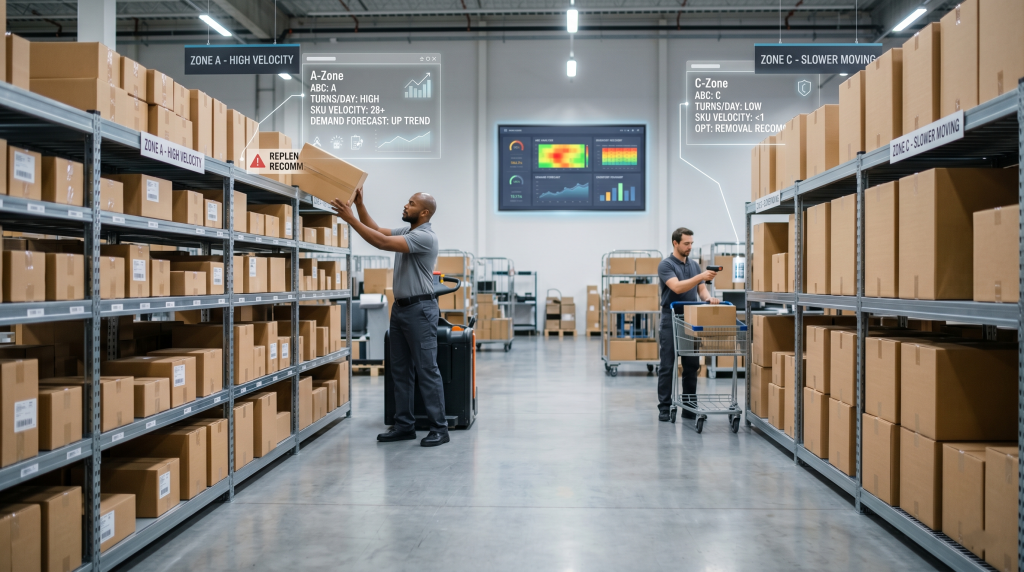 Advanced inventory intelligence improves SKU organization, replenishment workflows, and fulfillment accuracy.
Advanced inventory intelligence improves SKU organization, replenishment workflows, and fulfillment accuracy.
Implementing ABC Analysis for Data-Driven Slotting Optimization
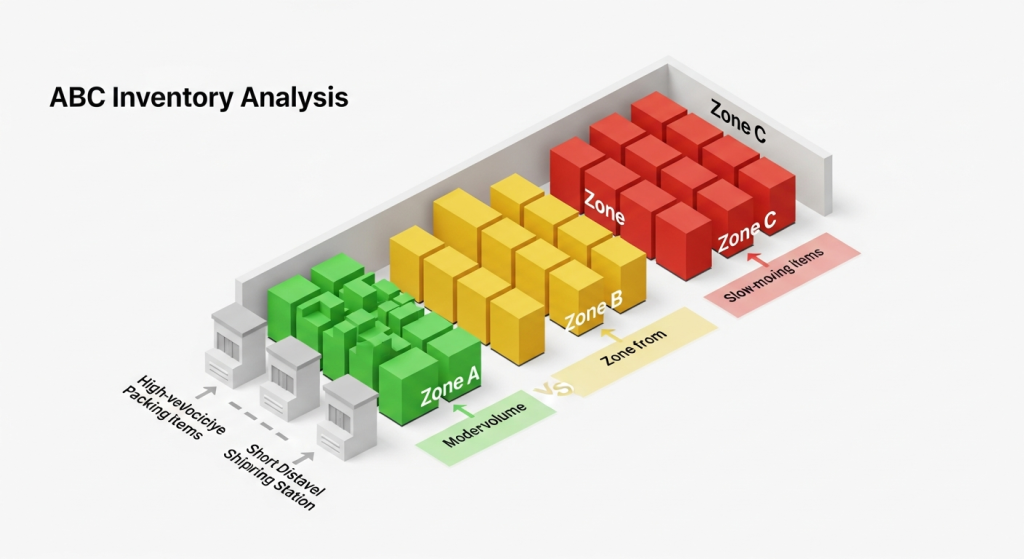
ABC Analysis in action: Organizing your warehouse by inventory velocity minimizes travel time for your picking team.
To maximize operational efficiency, your warehouse must be organized around velocity. ABC analysis allows you to categorize inventory based on turnover rates: A-items are your high-velocity movers, B-items have moderate volume, and C-items are slow-moving. By placing your A-items closest to the packing stations, you drastically reduce the travel time for your picking team, which is often the highest hidden cost in warehouse operations.
ABC analysis becomes even more powerful when tied to inventory management, slotting strategy, SKU velocity, and reorder planning. Fast-moving products should be easy to access, easy to count, and easy to replenish.
Transitioning to Real-Time Inventory Tracking and Product Traceability
Scalability demands absolute confidence in your inventory data. Moving from periodic counts to perpetual, real-time inventory tracking is essential. Implementing robust inventory control measures, such as serialized scanning or batch tracking, ensures that you know exactly what is in stock and where it is located at all times. This visibility is the prerequisite for scaling; you cannot sell what you cannot guarantee.
Launch Fulfillment’s guide on cycle count vs. physical inventory explains how ongoing count accuracy supports stronger stock visibility and fewer fulfillment errors.
Forecasting Customer Demand to Balance Inventory Levels
Effective inventory management is as much about predicting the future as managing the present. By leveraging historical sales data and seasonal trends, you can optimize your stock levels, reducing the capital tied up in slow-moving goods while preventing stockouts of best-sellers. A balanced inventory strategy supports a resilient supply chain, ensuring that your fulfillment operations remain fluid even during volatile periods.
For growing brands, demand planning should also connect to the reorder point formula, safety stock, and supplier lead times. Shopify’s inventory management guidance emphasizes that inventory management helps merchants monitor products and make informed decisions about stock levels. Shopify inventory management guidance
The Scaling Tech Stack: Integrating Your Fulfillment Ecosystem
Creating a Single Source of Truth: Multi-Channel Integration (Shopify, ERPs, and WMS)
A fragmented tech stack is the enemy of efficiency. To scale, you need a single source of truth that synchronizes your storefront, your ERP, and your Warehouse Management System (WMS). This integration ensures that inventory updates happen in real-time across all sales channels, preventing overselling and streamlining order processing. When your systems communicate seamlessly, order management becomes an automated background function rather than a manual, error-prone task.
Shopify’s fulfillment overview explains that Shopify provides order fulfillment and management features to help merchants process, fulfill, and ship customer orders efficiently. Shopify fulfillment features overview. For brands outsourcing fulfillment, Launch Fulfillment’s fulfillment and 3PL warehousing resources explain how warehouse systems, inventory, picking, packing, and shipping connect.
Leveraging AI-Driven Automation and Real-Time Analytics
Automation is not merely about replacing labor; it is about empowering your team to work on higher-value tasks. AI-driven solutions can analyze order patterns to suggest optimal shipping methods, bundle items for consolidated shipping, or predict staffing requirements based on real-time analytics. These insights turn raw data into actionable intelligence, allowing you to fine-tune your operations and maintain high levels of customer satisfaction even as volume increases.
Automation should support better decisions, not just faster clicks. The goal is to reduce manual work, improve order accuracy, and create cleaner data for forecasting, labor planning, and fulfillment performance reviews.
Bridging the Gap with Amazon APIs and Third-Party Ecosystem Integrations
For many e-commerce brands, Amazon is both a partner and a benchmark. Utilizing Amazon APIs to connect your internal inventory with Amazon’s Multi-Channel Fulfillment (MCF) can provide a powerful bridge during peak demand. Integrating third-party logistics (3PL) solutions and shipping software into your ecosystem allows you to leverage external infrastructure without losing control over your data or brand identity.
If you are evaluating a fulfillment partner, ask how integrations, data ownership, inventory visibility, and system handoffs are handled before signing. Launch Fulfillment’s guide on questions to ask a 3PL can help you pressure-test those details.
Optimizing Warehouse Operations for Maximum Throughput
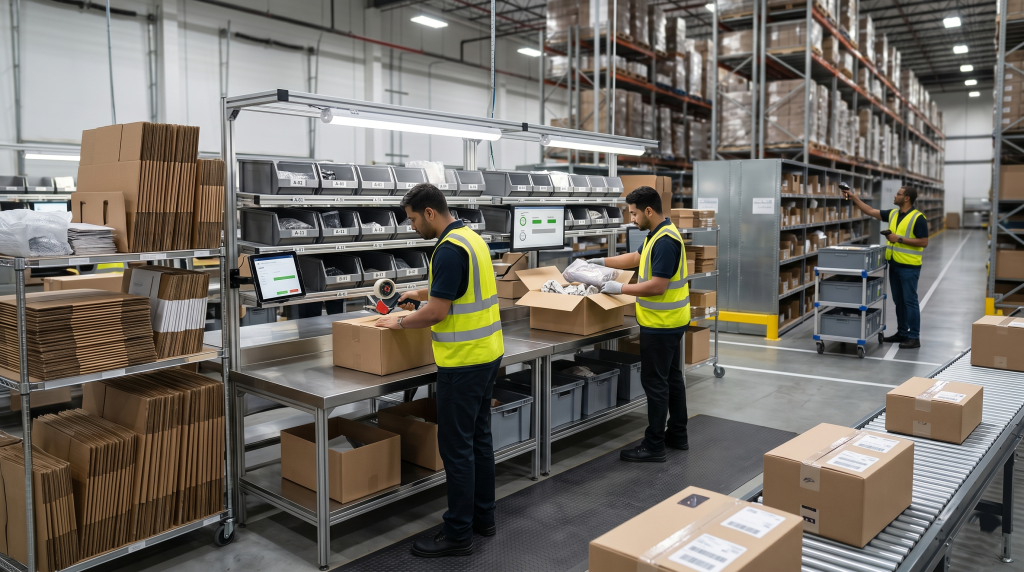 Optimized pick-pack-ship workflows help ecommerce brands improve warehouse throughput, shipping accuracy, and operational scalability.
Optimized pick-pack-ship workflows help ecommerce brands improve warehouse throughput, shipping accuracy, and operational scalability.
Refining the Order Picking Process: Transitioning to Batch and Wave Picking
As order volume grows, “pick-to-order” methods become inefficient. Transitioning to batch picking, where a picker collects multiple orders in a single pass, or wave picking, where orders are grouped by location or carrier, can increase throughput by over 50%. These strategies minimize the distance traveled within the facility and allow for more streamlined order processing at the packing bench.
Efficient pick, pack, and ship services depend on smart warehouse layout, clear picking logic, accurate inventory, and consistent packing workflows. That is where operational design starts turning into margin protection.
Deploying Barcode Scanning and RFID Tracking to Eliminate Human Error
Manual picking is prone to errors that hurt your bottom line. Deploying barcode scanning or RFID tracking systems mandates accuracy at every scan, ensuring that the right item goes to the right customer every time. This investment pays for itself by reducing the costs associated with returns, re-shipping, and the loss of customer trust caused by picking errors.
GS1 explains that Global Trade Item Numbers uniquely identify trade items in the supply chain, making them a useful foundation for cleaner barcode and product identification workflows. GS1 GTIN guidance
Scaling Physical Infrastructure: From Warehouse Layout to Robotics and Conveyor Systems
Physical optimization is the natural evolution of process refinement. As you grow, consider the workflow layout. Can you implement vertical storage? Would a conveyor system reduce the physical strain on your team? Robotics, such as autonomous mobile robots (AMRs), are increasingly accessible for scaling businesses, providing the flexibility to handle surges in volume without the massive overhead of permanent, fixed infrastructure.
For many brands, this is the moment when the in-house vs. 3PL fulfillment decision becomes urgent. Scaling infrastructure internally can be powerful, but it also adds labor, equipment, rent, insurance, management time, and operational complexity.
Need a Fulfillment Engine Built for Higher Volume?
Launch Fulfillment helps ecommerce brands improve warehouse workflows, inventory visibility, pick-pack-ship accuracy, and shipping performance as order volume grows.
Outbound Strategy: Solving the Last-Mile Delivery Challenge
Adopting a Distributed Fulfillment Strategy to Reduce Shipping Zones and Costs
Shipping distance is the primary driver of cost and transit time. By adopting a distributed fulfillment strategy utilizing multiple warehouses or 3PL nodes geographically closer to your customers, you can significantly reduce shipping zones. This not only lowers your overall postage costs but also shortens delivery windows, which is a major factor in improving overall customer satisfaction.
Launch Fulfillment’s guide to shipping zones explains how distance, warehouse location, and carrier zone logic affect shipping cost and delivery speed.
Implementing Route Optimization Software for Efficient Delivery Estimates
If you are managing local or regional deliveries, route optimization software is non-negotiable. These solutions ensure your drivers are taking the most efficient paths, saving on fuel and maintenance while providing your customers with highly accurate delivery windows. Reliability in the last mile is a key indicator of professional, high-performance e-commerce operations.
For most e-commerce brands, this also means using better carrier selection logic and e-commerce shipping services that balance delivery speed, shipping cost, package profile, and customer location.
Balancing Speed and Sustainability: Packaging Strategies and Carrier Diversification
Speed is critical, but it must be balanced with sustainability and cost. A robust outbound strategy involves diversifying your carrier mix to mitigate the risks of reliance on a single provider. Additionally, optimizing your packaging by ensuring boxes are properly sized for items reduces shipping costs and enhances the unboxing experience, reinforcing your brand’s commitment to quality and environmental stewardship.
Packaging also affects dimensional weight. Launch Fulfillment’s dimensional weight calculator FAQ helps brands understand how package size can influence billable weight and carrier cost. UPS also explains that dimensional weight reflects the density of a package and can affect shipping charges when a package is large relative to its actual weight. UPS dimensional weight guidance
Scaling the Post-Purchase Experience: Beyond the Unboxing
Proactive Communication and Real-Time Order Tracking
The journey does not end when the package leaves the warehouse. In fact, the post-purchase phase is a critical window for retention. Providing proactive communication such as automated SMS or email updates regarding the status of an order transforms a passive wait into a managed expectation. With 79% of customers reporting that they value transparency in the delivery process, robust tracking is a pillar of modern loyalty.
Real-time tracking also helps reduce WISMO tickets, support pressure, and customer anxiety. In other words, better tracking is not just a customer experience feature. It is also a support-cost reduction tool.
Turning Returns and Exchanges into Loyalty Opportunities with Automated Handling
Returns are often viewed as a loss, but they should be managed as a retention tool. By automating your returns and exchanges through a branded self-service portal, you reduce the strain on your support team and make the process frictionless for the customer. A quick, painless return experience often builds more long-term trust than a perfect transaction.
Launch Fulfillment’s returns management support helps brands build clearer workflows for inspection, restocking, disposal, exchanges, and customer communication.
Enhancing Brand Reputation through a Branded Unboxing Experience
Your fulfillment process is the only time your brand has a physical presence in the customer’s home. Investing in a branded, thoughtful unboxing experience creates a tangible connection. Even simple additions, like customized inserts or high-quality, recyclable packaging, elevate the perception of your brand. Fulfillment is a sensory touchpoint; treat it as an extension of your marketing strategy.
For brands using samples, bundles, inserts, influencer mailers, or subscription boxes, kitting and assembly services can help make branded fulfillment more consistent and scalable.
Strategic Pivots: Navigating the In-House vs. Third-Party Logistics (3PL) Decision
Analyzing the Total Cost of Fulfillment: Labor, Energy, and Warehouse Costs
Before deciding to outsource or expand, calculate the “Total Cost of Fulfillment.” This includes more than just the hourly rate of warehouse staff. Factor in energy consumption, climate control, insurance, equipment maintenance, and the opportunity cost of management time. Many companies overlook the hidden costs of scaling an in-house facility, which can make outsourcing a far more attractive financial decision.
Launch Fulfillment’s ecommerce fulfillment pricing guide can help brands compare fulfillment costs beyond the obvious pick fee, including storage, shipping, kitting, returns, packaging, and operational complexity.
When to Outsource: Evaluating 3PLs for Global Reach and Specialized Support
Outsourcing to a 3PL becomes the logical next step when the complexity of logistics outweighs your core competency of product development. A high-quality 3PL partner provides global reach, advanced WMS integration, and specialized support for peak season fluctuations. Evaluate potential partners not just on cost, but on their ability to grow with you and their track record for maintaining your specific customer service standards.
For specialized categories like beauty, supplements, wellness, subscription boxes, and DTC health products, explore fulfillment services by industry so operations match the product, packaging, compliance, and customer experience requirements of the category.
Hybrid Models: Using Just-in-Time Fulfillment and Dropshipping to Support Growth
You do not need to choose between 100% in-house or 100% outsourced operations. Many brands utilize a hybrid model, keeping high-velocity products in their own warehouse while using dropshipping or 3PL support for slow-moving or bulky items. This flexibility allows you to manage capital risk while ensuring your fulfillment operations remain resilient and responsive to market demands.
A hybrid model can be especially useful when brands are testing new products, expanding into new markets, managing oversized SKUs, or trying to reduce warehouse congestion without fully outsourcing every workflow.
Compare In-House Fulfillment Against Scalable 3PL Support
Launch Fulfillment helps ecommerce brands evaluate total fulfillment cost, warehouse complexity, inventory accuracy, shipping performance, and customer experience before deciding how to scale.
Maintaining Operational Excellence and Compliance
Benchmarking Techniques: Key Performance Indicators (KPIs) for Scaling
You cannot manage what you do not measure. To scale effectively, track critical KPIs such as Order Cycle Time, Order Accuracy Rate, Return Rate, and Cost Per Order. Benchmarking these metrics against industry standards helps you identify performance gaps before they become critical failures. Establishing a culture of operational excellence requires consistent monitoring and a commitment to continuous improvement based on the data you collect.
Shopify’s order fulfillment and shipping overview emphasizes that fulfillment features help merchants manage the process from setup through final delivery, which aligns with tracking KPIs across the full order lifecycle. Shopify order fulfillment overview. Launch Fulfillment’s e-commerce operations manager guide also explains why operations leaders need visibility across fulfillment, inventory, shipping, systems, and customer experience.
Final Thoughts
Scaling your e-commerce fulfillment is not merely about increasing output; it is about building a resilient, intelligent engine that supports sustainable growth. By diagnosing your bottlenecks, investing in the right technology, and shifting toward a strategic, data-driven approach, you transform fulfillment from a logistical challenge into a key value proposition.
The transition from manual processing to advanced, automated systems requires patience, but the rewards, including lower operational costs, higher customer satisfaction, and a more agile business, are essential for long-term viability. As you grow, keep the “human” element at the center of your decision-making: ensure your team is trained and empowered, and your customers feel valued through every stage of the journey. Start by auditing your current tech stack for “single source of truth” gaps and implementing ABC analysis to clear your warehouse floor. With a firm foundation in inventory intelligence and a clear strategy for the last mile, you will be well-positioned to navigate the complexities of high-volume e-commerce and emerge as an industry leader.
If your fulfillment process is approaching the scaling threshold, contact Launch Fulfillment to talk through your inventory, warehousing, shipping, returns, and order fulfillment needs.
Related Posts
FAQ: Order Fulfillment Operations
What are order fulfillment operations?
Order fulfillment operations refer to the complete process of receiving, processing, packing, shipping, tracking, and managing customer orders. Strong order fulfillment operations help ecommerce brands improve inventory accuracy, shipping speed, warehouse efficiency, and customer satisfaction.
What are the 7 steps of order fulfillment?
The 7 common steps of order fulfillment operations include:
- Receiving inventory
- Storing products
- Inventory management
- Order processing
- Picking items
- Packing and shipping
- Returns management
Each step plays an important role in maintaining operational efficiency and delivering a positive customer experience.
Why are order fulfillment operations important for ecommerce brands?
Efficient order fulfillment operations help ecommerce businesses reduce shipping delays, improve order accuracy, maintain inventory visibility, lower operational costs, and increase customer retention. Fulfillment performance directly impacts brand reputation and long-term scalability.
How can ecommerce brands improve order fulfillment operations?
Brands can improve order fulfillment operations by implementing real-time inventory tracking, warehouse management systems (WMS), barcode scanning, optimized picking workflows, automation tools, and distributed fulfillment strategies. Many growing brands also partner with 3PL providers to improve scalability and operational efficiency.
Should ecommerce brands outsource order fulfillment operations to a 3PL?
Outsourcing order fulfillment operations to a 3PL can help ecommerce brands scale faster, reduce warehouse overhead, improve shipping performance, and access advanced fulfillment infrastructure without managing operations internally. The right decision depends on order volume, operational complexity, growth stage, and internal resources.
