

Logistics can be classified in several ways, but ecommerce and supply chain operations commonly organize the movement of goods into three core flows: inbound, outbound, and reverse logistics.
- Inbound logistics moves products, materials, and inventory from suppliers into a business or fulfillment center.
- Outbound logistics moves finished orders from storage or production to the customer.
- Reverse logistics moves returned, damaged, recyclable, or reusable goods back through the supply chain.
Together, these three types of logistics cover the product journey from receiving and storage through order fulfillment, delivery, returns, and recovery.
Understanding how each process works can help ecommerce brands reduce delays, improve inventory visibility, control fulfillment costs, and create a more reliable customer experience.
The Three Main Types of Logistics at a Glance
Inbound logistics brings inventory into the business, outbound logistics delivers orders to customers, and reverse logistics manages products moving back through the supply chain.
| Type | Direction | Main Activities | Primary Goal |
|---|---|---|---|
| Inbound logistics | Supplier to business | Transportation, receiving, inspection, putaway, storage | Keep inventory available and accurate |
| Outbound logistics | Business to customer | Order processing, picking, packing, shipping, delivery | Deliver correct orders on time |
| Reverse logistics | Customer back through supply chain | Returns, inspection, restocking, repair, recycling, disposal | Recover value and manage returns efficiently |
What is Inbound Logistics? A Brief Overview
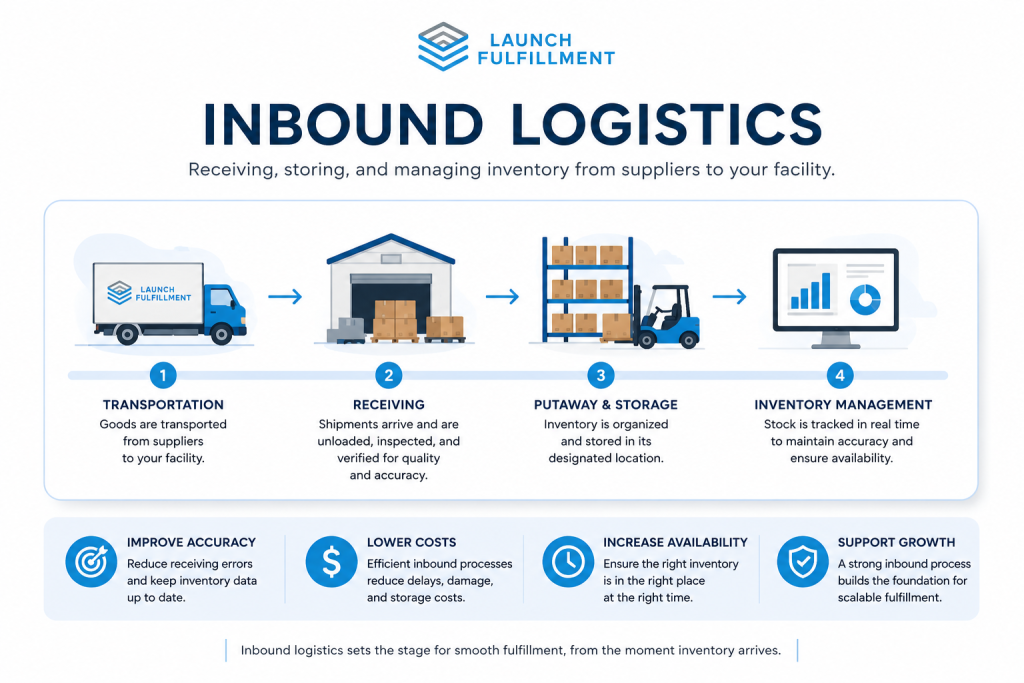
Inbound logistics involves receiving and storing goods from suppliers and vendors. It oversees the movement of materials from their origin to their destination.
Here are a few key components of inbound logistics:
- Transportation: Selecting transport methods, speeds, and carriers to move goods from vendors to their destinations.
- Receiving: Handling materials upon arrival, including unloading and verifying quality and quantity.
- Storing: Organizing and warehousing verified goods.
- Inventory Management: Managing inventory, including adding raw materials, components, and ready-to-sell products to the inventory management system (IMS).
- Reverse Logistics: Handling returns and adding goods back into the supply chain. This part of the definition can be confusing. Reverse logistics is a type of logistics that involves adding goods back into the supply chain. Therefore, people still consider it inbound logistics.
Accurate receiving and storage depend on having a dependable inventory management process that tracks stock from arrival through fulfillment.
Businesses need to understand inbound logistics to deliver products on time and operate efficiently. This involves getting the materials, goods, and services needed to meet customer demands.
At Launch Fulfillment, inbound logistics is a primary logistic service we provide. We pride ourselves on the strategic partnership we have with local and foreign manufacturers that help move the supply chain along from the bottom up.
Outbound Logistics Overview
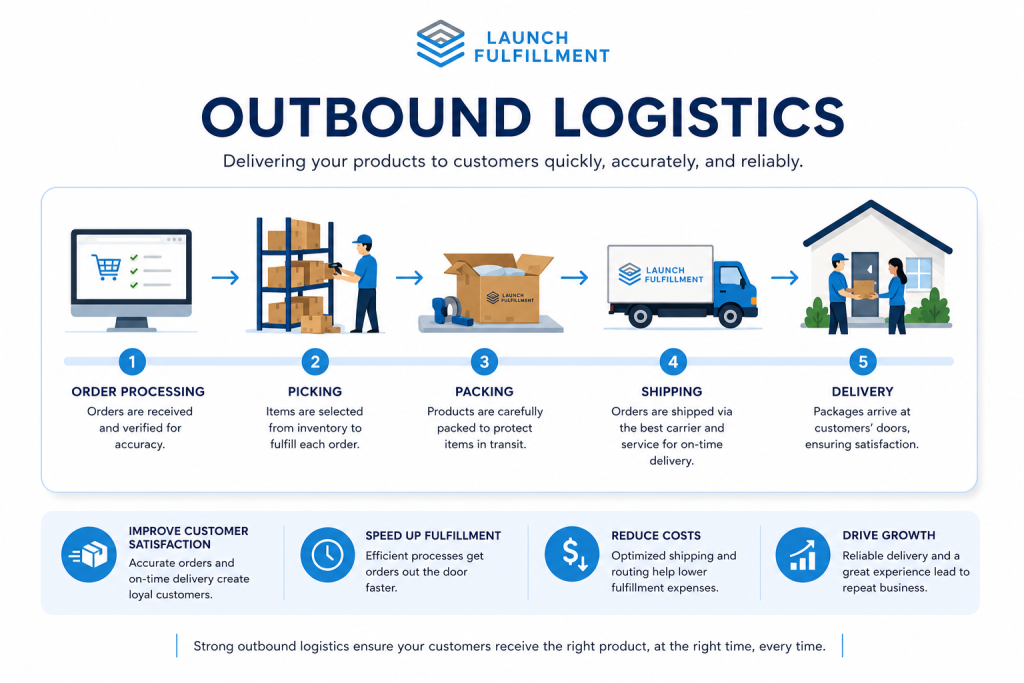
Outbound logistics involves transporting and delivering goods to customers, focusing on the demand side of supply and demand. Key activities include:
- Order Processing: Managing customer orders from receipt to fulfillment.
- Picking and Packing: Selecting items for customer orders, packaging them, and preparing for shipment.
- Warehousing and Storage: Planning and organizing storage to fulfill orders quickly and accurately.
- Outbound Transportation: Delivering orders to customers, including distribution channels, route optimization, and last-mile delivery.
Businesses need to excel in outbound logistics to ensure customers receive their orders promptly and in excellent condition. This will help increase customer satisfaction and loyalty.
Inbound vs. Outbound Logistics
Here is a clear comparison between inbound and outbound logistics:
Inbound Logistics:
-
- Focus: Receiving and storing goods from suppliers.
- Activities:
- Sourcing and procurement
- Transportation from suppliers
- Receiving and quality checks
- Warehousing and storage
- Inventory management
- Goal: Ensure raw materials and goods are available for production and fulfillment.
Outbound Logistics:
-
- Focus: Delivering finished products to customers.
- Activities:
- Order processing
- Picking and packing
- Outbound transportation
- Route optimization and last-mile delivery
- Customer delivery and satisfaction
- Goal: Ensure timely and accurate delivery of customer orders.
If you want an even clearer picture of inbound vs. outbound logistics, here’s a brief video to explain the two.
(video credit: Green Supply Chain)
Reverse Logistics
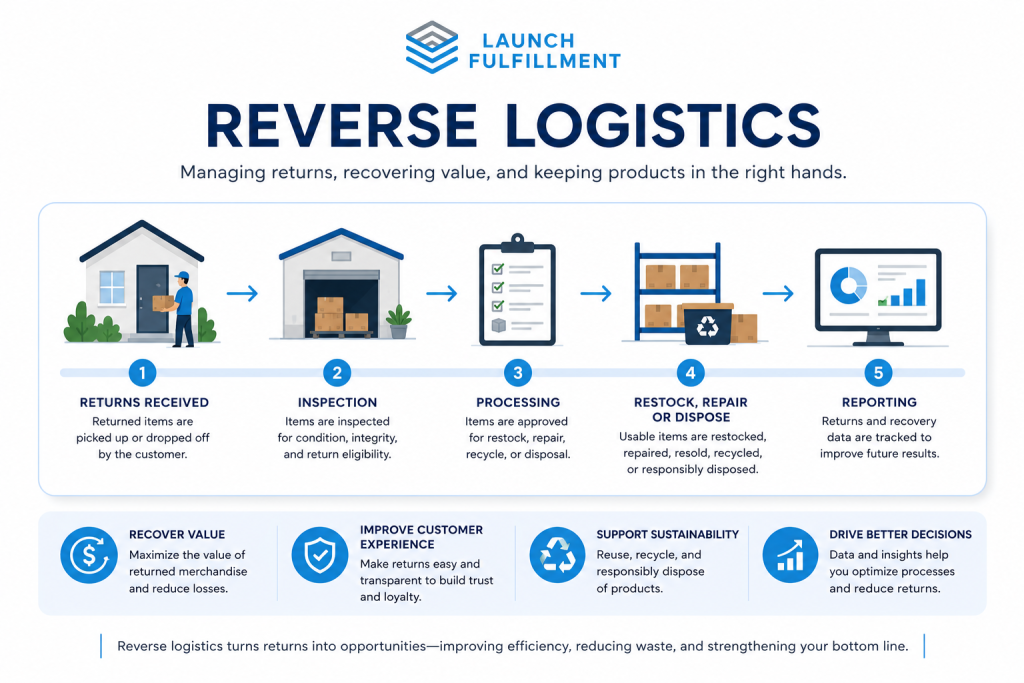
Reverse logistics manages products moving from the customer or final destination back through the supply chain. It can include customer returns, inspections, exchanges, repairs, refurbishment, restocking, recycling, liquidation, and responsible disposal.
Although returned products may physically arrive at a warehouse through an inbound receiving process, reverse logistics is considered a distinct logistics flow because its purpose is to recover value, complete a return, or properly dispose of the product.
Key components of reverse logistics include:
- Product Inspection: Evaluating returned items for quality and condition.
- Repair and Replacement: Fixing or replacing products as needed.
- Cost Reduction: Minimizing expenses related to returns.
According to the National Retail Federation’s 2025 Retail Returns Landscape, approximately 19.3% of online sales were expected to be returned in 2025. That return volume makes reverse logistics a core ecommerce operation rather than an occasional customer-service task.
These and many more reasons are why all 3 types of logistics- inbound, outbound, and reverse are all equally important.
Managing More Inventory Than Your Team Can Handle?
Launch Fulfillment helps growing ecommerce brands coordinate receiving, inventory storage, order fulfillment, shipping, and returns through one scalable 3PL operation.
Launch Fulfillment for All Three Types of Logistics
A 3PL provider is important for managing logistics for eCommerce businesses. Here are all of the services a third-party provider can offer in relation to all three types of logistics:
- Inbound Logistics:
- Coordination: Oversees the conveyance of products from producers, manufacturers, and sellers to storage facilities and distribution hubs.
- Storage: Receives products and components, ensuring they are stored efficiently.
- Outbound Logistics:
- Transportation: Transports goods from warehouses to customers.
- Order Fulfillment: Handles picking, packing, and shipping products to ensure timely delivery.
- Reverse Logistics:
- Returns Management: Manages the return of goods from customers to suppliers or warehouses.
- Processing: Inspects, repairs, and replaces returned items.
Additional Benefits:
- Inventory Management: Helps maintain optimal inventory levels.
- Tracking and Reporting: Provides real-time tracking and detailed reporting services.
A qualified 3PL fulfillment provider can coordinate receiving, storage, order fulfillment, shipping, inventory visibility, and returns within one operating system.
By leveraging a 3PL’s expertise, companies can streamline their supply chain operations, reduce costs, and enhance customer service. These processes ensure timely, cost-effective delivery of products and services, leading to improved customer satisfaction. Consider partnering with Launch Fulfillment to improve all types of logistics.
Conclusion for Different Types of Logistics
Effective logistics management is crucial for the success of eCommerce businesses. Launch Fulfillment excels in handling the three key types of logistics:
- Inbound
- Outbound
- Reverse logistics
They ensure that goods are transported smoothly from suppliers to their modern warehouses.
For outbound logistics, Launch Fulfillment expertly manages order processing, picking, packing, and shipping, guaranteeing timely and accurate deliveries to customers.
For ecommerce brands, these activities form the foundation of scalable ecommerce fulfillment services.
Our expert knowledge in reverse logistics helps us implement key elements of reverse logistics such as:
- Returns processing
- Inspecting
- Repairing
- And replacing goods as needed.
Additionally, Launch Fulfillment offers comprehensive inventory management, real-time tracking, and detailed reporting services.
By partnering with Launch Fulfillment, businesses can optimize their supply chain operations and reduce their costs. As a result, companies that use these services end up with satisfied customers.
Bring Your Logistics Processes Together
Reduce the operational gaps between receiving inventory, shipping customer orders, and processing returns with a fulfillment partner built for growing ecommerce brands.
FAQs related to Logistics Meaning & Different Kinds of Logistics
What is the difference between logistics and supply chain management?
Logistics focuses specifically on the movement, storage, and flow of goods and materials within the broader supply chain. Supply chain management involves planning, obtaining materials, manufacturing, and delivering products or services to customers. (Source)
What are the main components of logistics?
The main components of logistics typically include:
- Transportation
- Warehousing,
- Inventory management
- Packaging and materials handling
- Information systems
What are the key performance indicators (KPIs) used to measure inbound and outbound logistics?
Some common KPIs include:
- On-time delivery rate
- Order fulfillment cycle time
- Inventory turnover ratio
- Transportation costs as a percentage of sales
- Customer return rate (for reverse logistics)
How can technology improve inbound, outbound, and reverse logistics?
Implementing technology solutions like:
- Transportation management systems (TMS) to optimize routes and modes
- Warehouse management systems (WMS) for inventory visibility
- Order management systems to streamline fulfillment
- Analytics tools to gain insights from data
References
Ameliakling. (2024, March 28). Is logistics the same as supply chain management?. Michigan State University. https://www.michiganstateuniversityonline.com/resources/supply-chain/is-logistics-the-same-as-supply-chain-management/
Cavoulacos, M., says:, P., says:, issack A. dan A., says:, Subbanaidu. the mba.m com, says:, P. S., says:, T. V., Says:, S. M., says:, J. A., says:, R. M., says:, P. F., Says:, J. S. B., says:, B. sahoo, says:, K. R., says:, M. S., says:, V. W., says:, S., says:, K., says:, K. M., says:, A. lenin, … says:, C. (2024, June 1). Top 45 logistics interview questions and answers (2024). Career Guru99. https://career.guru99.com/top-20-logistician-interview-questions/
Definition, examples, and process. Inbound Logistics. (n.d.). https://www.inboundlogistics.com/articles/what-is-inbound-logistics/
Logistics, iDrive. (2022, February 9). Answering top google-searched transportation and Logistics questions. LinkedIn. https://www.linkedin.com/pulse/answering-top-google-searched-transportation-logistics-/
The Problems & Opportunities of E-commerce returns. ecrloss.com. (n.d.). https://www.ecrloss.com/research/buy-online-return-in-store
YouTube. (2023, September 25). What is inbound and outbound logistics?. YouTube. https://www.youtube.com/watch?v=2lichQyEvgs
The Ultimate Supplement Fulfillment Checklist: Essential Steps for DTC Brands
Key Takeaways Supplement fulfillment checklist is more than logistics, it’s compliance. FDA...
Master the Safety Stock Formula: Calculate Your Ideal Inventory Levels
Key Takeaways “Just right” inventory is a competitive advantage. Too much stock drains cash, while...
![Top 10 Best Reverse Logistics Companies in Utah [2025]](https://www.launchfulfillment.com/wp-content/uploads/2024/06/10-best-reverse-logistics-companies-in-utah-400x250.jpg)
Top 10 Best Reverse Logistics Companies in Utah [2025]
At Launch Fulfillment, we view each part of the supply chain as an opportunity to earn customer...

Jake Tripp
Lead Content Strategist
I’m a content strategist and copywriter who specializes in 3PL content and other business services. I help brands nationwide to communicate their values and build loyal audiences.
