

You’ve likely heard the term “3PL” tossed around in business conversations, but the logistics universe extends far beyond just third-party logistics providers.
While large enterprises have long partnered with logistics companies, we’re seeing small and medium-sized brands increasingly joining the 3PL movement – especially as e-commerce fulfillment reaches new heights.
Here’s the truth: running your own warehousing, fulfillment, and distribution operations often costs significantly more than finding the right logistics partner.
Though 3PLs represent the most common logistics solution, you might encounter other acronyms like 1PL, 2PL, 4PL, and 5PL during your research.
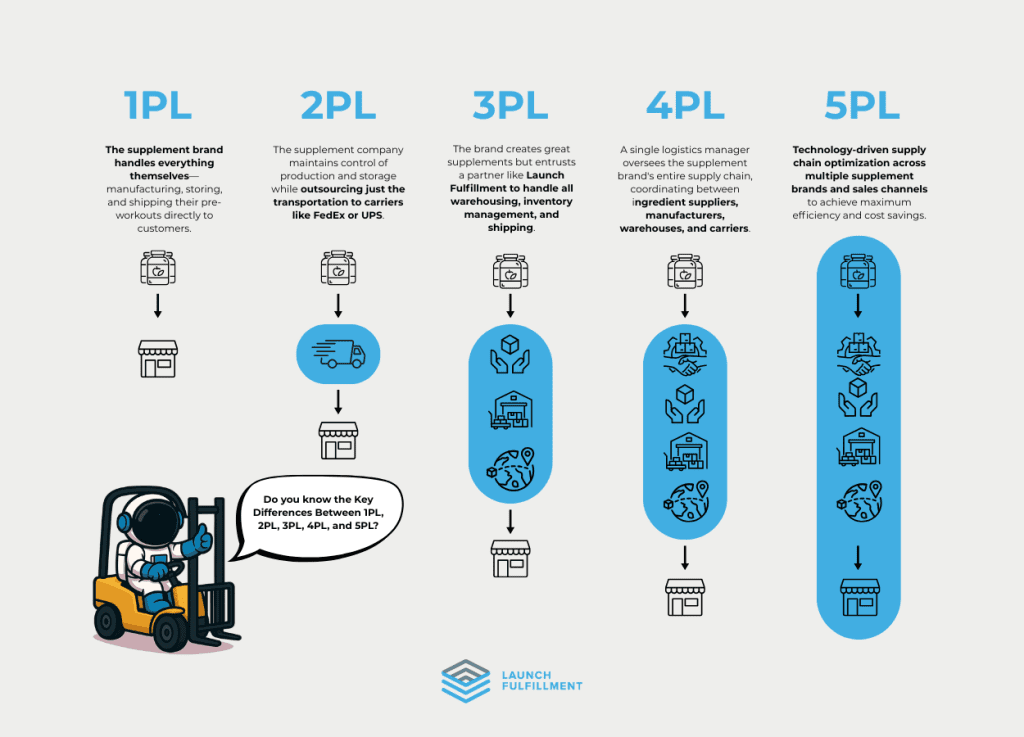
Key Takeaways for Modes of Logistics Management
- PL stands for “party logistics,” referring to different outsourcing models in supply chain management
- 1PL (first party logistics) involves companies handling their own logistics operations internally
- 2PL (second party logistics) focuses primarily on transportation
- 3PL (third party logistics) offers comprehensive services including warehousing, fulfillment, and transportation
- 4PL (fourth party logistics) that manage entire supply chains without owning physical assets
- 5PL (fifth party logistics) leverages advanced technology to optimize multiple supply chains
- Choosing the right logistics model depends on your business size, complexity, and growth stage
Let’s break down each type of logistics company and spotlight what makes them different, so you can identify which partner might be the perfect match for your growing brand.
The term 3PL takes up a lot of space in the industry – but there are so many other providers out there that make up the supply chain. They deserve the spotlight just as much as we do. All logistics providers work extremely difficult to make this whole thing work.
What Does 1PL, 2PL, 3PL, 4PL and 5PL Mean?
If you’re here, you’ve probably heard of the term 3PL – but what about all the other logistics providers out there?
The world of supply chain management is filled with acronyms and specialized terms that can be confusing for newcomers and veterans alike.
This comprehensive guide will explain the key differences between the various logistics models, from 1PL to 5PL, helping you determine which approach best aligns with your business goals.
What Does PL Stand for?
First, PL stands for “party logistics.” This term refers to the party or entity responsible for handling operations within a supply chain.
The number preceding “PL” indicates the level of service and the degree of outsourcing involved:
- 1PL: The company handles its own backend logistics processes
- 2PL: Transportation specialists move goods from point A to point B
- 3PL: External providers handle multiple logistics functions
- 4PL: Oversight and management of the entire supply chain
- 5PL: Technology-driven optimization across multiple supply chains
Logistics providers offer various services, including transportation, warehousing, and inventory management, to support companies in managing their supply chains effectively.
Each logistics level offers varying degrees of control, complexity, and integration, allowing companies to choose the best fit for their supply chain needs and logistics requirements.

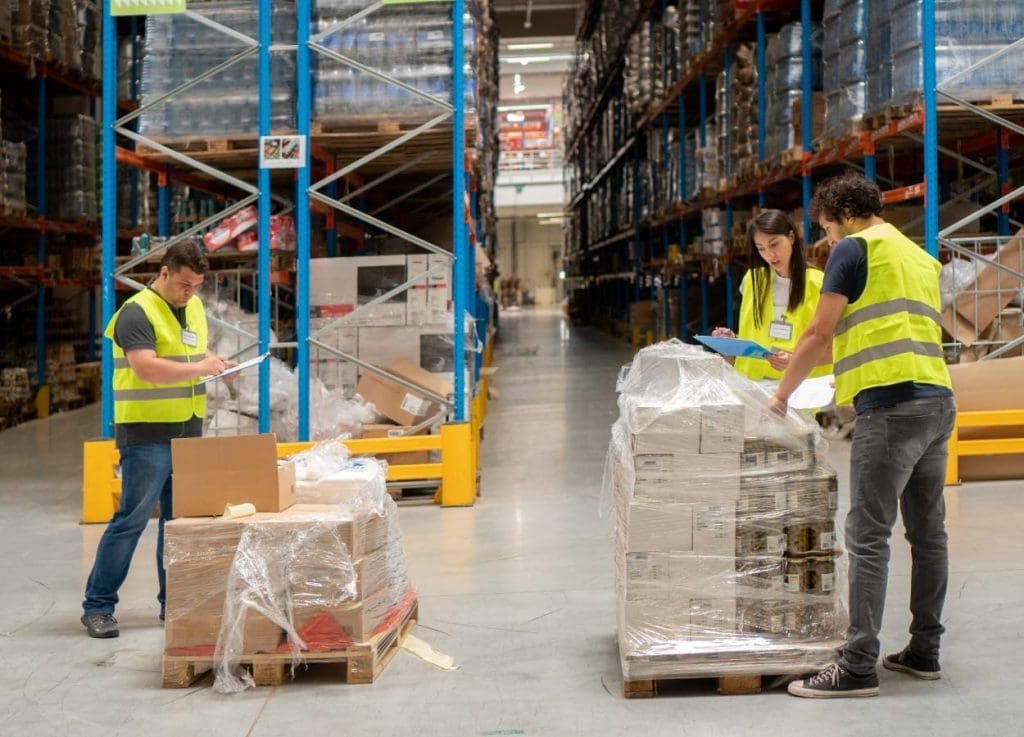
2nd Party Logistics (2PL or Second Party Logistics)
2PL involves outsourcing specific transportation to external carriers while maintaining control over other aspects of the supply chain.
In this model, companies partner with specialized transportation providers—such as shipping companies, trucking companies, or freight forwarders—to move goods from one location to another.
Unlike 1PL, where companies own their transportation assets, 2PL allows businesses to leverage the expertise and resources of dedicated transportation providers without making significant capital investments in vehicles and related infrastructure.
Examples of 2PL Logistics:
- A manufacturer contracting with a trucking company to transport finished products to distributors
- An e-commerce business using UPS, FedEx, or other carriers for package delivery
- A retailer partnering with ocean freight carriers for international shipping
- A company hiring a specialized trucking firm for hazardous material transport
- A business using rail transportation for bulk shipments
2PL Logistics: Experts in Transportation management systems
The 2PL model focuses primarily on transportation services, offering companies more flexibility and potentially lower costs compared to maintaining an in-house fleet.
By outsourcing transportation to specialists, businesses can benefit from carriers’ established networks, economies of scale, and expertise in specific transportation modes or regions.
This approach works well for companies that:
- Need reliable transportation without investing in their own fleet
- Have straightforward shipping requirements
- Want to focus on core business activities rather than transportation management
Different ways to express this type of logistics service provider include:
- Asset-based carriers
- Transportation providers
- Shipping company
- Freight carriers
- Shipping service providers
- Logistics transportation companies
(video credit: CSCP LEARNING https://www.youtube.com/watch?v=jnIhLh7GREc)
Get in Touch to Find Out More
3rd Party Logistics (3PL or Third Party Logistics)
3PL takes outsourcing a step further by providing comprehensive logistics services beyond just transportation.
The relationship between a business and its 3PL partner is typically collaborative and ongoing, with the 3PL provider tailoring its services to meet the specific needs of the client.
Key services offered by 3PL providers include:
-
Warehousing and storage
-
Inventory management
-
Order processing and fulfillment
-
Transportation management
-
Freight forwarding
-
Returns management
-
Supply chain consulting
-
Value-added services (kitting, packaging, labeling)
Examples of 3PL Logistics:
-
Launch Fulfillment providing warehousing, order fulfillment, and shipping services for e-commerce businesses
-
A 3PL managing the entire distribution process for a consumer goods manufacturer
-
A fulfillment company handling storage, picking, packing, and shipping for online retailers
-
A logistics company managing retail distribution for a clothing brand
-
A 3PL operating dedicated warehouse space for a tech company’s inventory
3PL Logistics: The One-stop-shop for Ecommerce Businesses
The 3PL model has become particularly valuable for e-commerce businesses that need efficient, scalable logistics solutions without the capital investment required to build their own infrastructure.
This approach works well for companies that:
-
Want to focus on their core business activities rather than operations
-
Need to scale operations up or down quickly based on demand
-
Require expertise in specific logistics areas (like international shipping)
-
Seek to reduce fixed costs associated with warehousing and transportation
-
Need to improve order accuracy and delivery times
-
Want to expand into new markets without establishing their own infrastructure
Different ways to express this type of logistics provider include:
-
3rd party logistics provider
-
Fulfillment service provider
-
Logistics outsourcing partner
-
Supply chain services company
-
Warehousing and distribution partner
-
Logistics solutions provider

4th Party Logistics (4PL or Fourth Party Logistics)
4PL represents a more advanced level of outsourcing where the provider takes responsibility for managing the entire supply chain.
Unlike 3PLs, which primarily execute logistics functions, 4PLs act more as consultants and integrators, overseeing and optimizing the complete supply chain ecosystem.
A 4PL provider typically doesn’t own physical assets like trucks or warehouses.
Instead, they leverage their expertise, technology, and relationships with various service providers (including 3PLs) to design and manage comprehensive supply chain solutions.
How 4PLs Manage Entire Supply Chains
4PL logistics providers manage the entire supply chain, including operations, transportation, and inventory management, without owning physical assets.
The 4PL assumes responsibility for:
- Supply chain strategy and design
- Selection and management of service providers (including 3PLs)
- Integration of various logistics elements
- Technology implementation and management
- Performance monitoring and optimization
- Continuous improvement initiatives
- Risk management and contingency planning
- Negotiation logistics strategy
4PLs as Strategic Partners
4PLs act as strategic partners, providing expertise and technology to optimize logistics processes and improve supply chain efficiency.
They offer a consultative approach, working closely with clients to understand their business objectives and develop supply chain solutions that support those goals.
This strategic partnership offers several key benefits:
- High level of control and integration
- Streamlined management (single point of contact)
- Access to specialized expertise and advanced technology
- Objective decision-making (not tied to specific assets)
- Ability to leverage multiple 3PLs for best-in-class service
4PLs are ideal for large companies with complex supply chains that require advanced logistics solutions and strategic oversight.
They’re particularly valuable for large companies and global organizations operating across multiple regions with diverse supply chain requirements.
Examples of 4PL Logistics:
- A 4PL designing and managing the global supply chain for a multinational manufacturer
- A logistics integrator coordinating multiple 3PLs for a retailer’s omnichannel distribution
- A supply chain management firm overseeing both inbound and outbound logistics for a consumer goods company
- A 4PL implementing and managing supply chain technology solutions across a client’s operations
- A logistics consultant redesigning a company’s entire distribution network for greater efficiency
4PL Logistics: The Orchestrator & Integrator
The 4PL model focuses on orchestration and integration of various supply chain elements rather than direct execution. By taking a holistic view of the supply chain, 4PLs can identify inefficiencies and opportunities for improvement that might not be visible when looking at individual logistics functions in isolation.
Different ways to express this type of service provider include:
- Supply chain integrator
- Lead logistics provider (LLP)
- Supply chain manager
- Logistics orchestrator
- Supply chain solution architect
- Fourth-party logistics integrator
Ready to Ship?
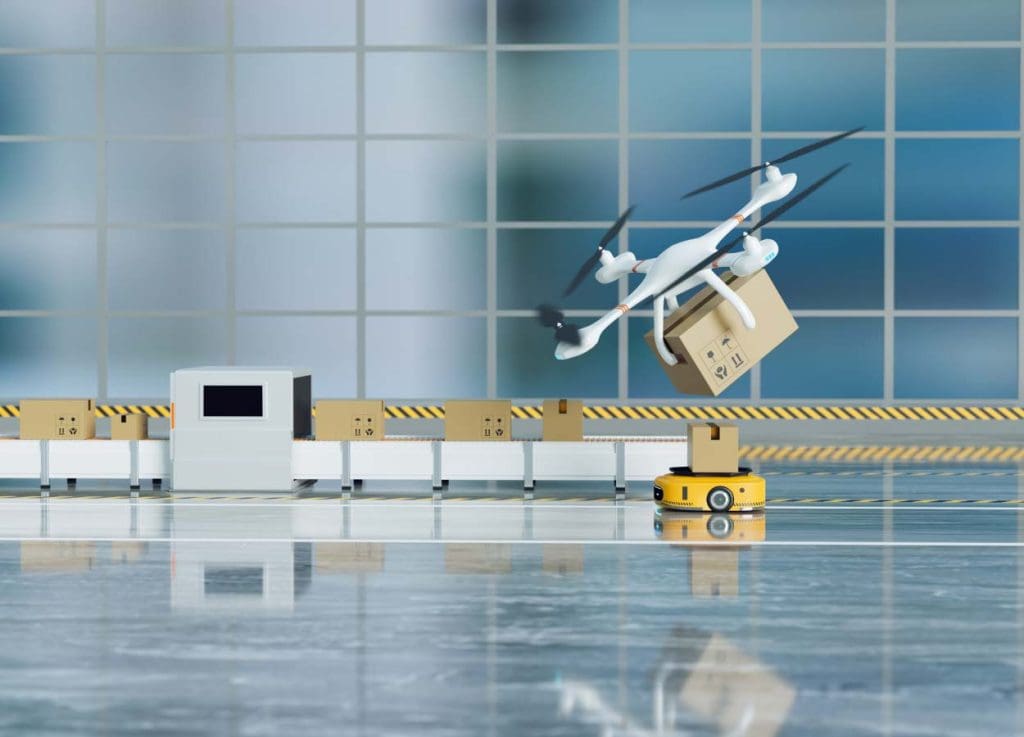
5th Party Logistics (5PL or Fifth Party Logistics)
5PL represents the most advanced evolution of logistics outsourcing, focusing on technology-driven supply chain optimization across multiple networks.
While 4PLs focus on managing a single organization’s supply chain, 5PLs often operate at an industry or network level, seeking to optimize logistics across multiple companies and supply chains.
This approach enables economies of scale and network efficiencies that wouldn’t be possible when optimizing individual supply chains in isolation.
How 5PLs Integrate Advanced Technology
5PL providers integrate advanced technology, such as data analytics and artificial intelligence, to optimize logistics processes and improve supply chain efficiency. They leverage big data, predictive analytics, IoT sensors, blockchain, and other emerging technologies to:
- Create real-time visibility across your supply chain
- Predict potential disruptions before they occur
- Optimize transportation routes and modes
- Match supply with demand more accurately
- Identify opportunities for consolidation and collaboration
- Reduce carbon footprint and enhance sustainability
- Automate routine decisions and processes
5PLs offer a comprehensive range of logistics, including inventory and transportation management, as well as warehousing, to support companies in managing their supply chains. However, what distinguishes them from other logistics models is their emphasis on technology-driven optimization and their broader, network-level perspective.
Benefits of 5PL Logistics Services
They provide real-time visibility and control, enabling companies to respond quickly to changes in demand and maintain high levels of customer satisfaction.
Other key benefits include:
- Enhanced supply chain resilience and risk management
- Greater cost efficiency through network optimization
- Improved sustainability and reduced environmental impact
- Access to cutting-edge supply chain technologies
- Data-driven decision making
- Continuous innovation and improvement
5PLs are ideal for e-commerce brands and companies with complex supply chains that require advanced logistics solutions and high levels of scalability. They’re particularly well-suited for industries with volatile demand patterns, complex distribution requirements, or strict delivery timeframes.
Examples of 5PL Logistics:
- A logistics technology company optimizing shipping routes across multiple carriers and clients
- A supply chain platform connecting manufacturers, distributors, and retailers in a specific industry
- A logistics network operator managing shared warehouse space for multiple companies
- A digital freight matching platform using AI to optimize carrier selection
- A technology provider using blockchain for supply chain tracking across multiple parties
Different ways to express this type of logistic provider include:
- Supply chain network optimizer
- Logistics technology integrator
- Digital supply chain platform
- Network-based logistics provider
- Collaborative logistics network
- E-logistics provider
- Logistics aggregator
How Do I Know Which Logistics Provider is Best for My Business?
Selecting the appropriate logistics model for your business is a critical decision that can significantly impact your operational efficiency, customer satisfaction, and bottom line. The best approach depends on your company’s specific needs, resources, and growth stage.
Evaluate Based on Challenges You Face
Start by identifying the specific logistics challenges your business is currently facing:
Limited Resources and Expertise
If your company lacks the resources or expertise to manage logistics effectively in-house, partnering with a 3PL like Launch Fulfillment can provide access to professional services without a significant capital investment.
Scaling Difficulties
For growing businesses struggling to scale their operations to meet increasing demand, 3PLs offer flexible solutions that can expand with your business without requiring substantial infrastructure investments.
Geographic Expansion Challenges
Companies looking to enter new markets without establishing their own infrastructure can leverage 3PLs with existing networks in those regions to facilitate expansion.
Supply Chain Complexity
Businesses with highly complex supply chains involving multiple suppliers, channels, and markets might benefit from 4PL or 5PL providers that can manage and optimize the entire ecosystem.
By addressing these specific challenges, you can ensure a smooth transition to a new logistics model and achieve your business goals.
Choosing the Right Logistics Provider
Once you’ve identified your specific challenges and determined which logistics model aligns with your needs, the next step is selecting the right provider within that category. Consider these factors when evaluating potential logistics partners:
Service Offerings and Capabilities
Ensure the provider offers all the services you need, whether that’s warehousing, fulfillment, transportation, returns management, or specialized services like kitting or custom packaging.
Technology and Systems
Evaluate the provider’s technology platform and how it will integrate with your existing systems. Look for features like real-time inventory visibility, order tracking, reporting capabilities, and API connections.
Scalability and Flexibility
Choose a provider that can accommodate your business growth and adapt to seasonal fluctuations or changing requirements. Ask about their capacity limits and how they handle volume increases.
Pricing Structure and Contract Terms
Understand the provider’s pricing model (per order, per SKU, storage fees, etc.) and ensure it aligns with your business model. Review contract terms carefully, particularly regarding service level agreements and termination conditions.
Choosing the right provider is critical for companies looking to outsource their logistics operations. By selecting the right logistics provider, companies can ensure successful implementation and achieve their business goals.
Why is Launch Fulfillment a Top-Rated 3PL?
In the crowded 3PL industry, Launch Fulfillment stands out as a top-rated 3PL partner for several key reasons:
Specialized E-commerce Expertise
Launch Fulfillment has built its services around the unique needs of e-commerce brands, providing tailored fulfillment solutions that enhance the online shopping experience and drive customer satisfaction.
Transparent Pricing
Launch Fulfillment maintains a straightforward pricing structure without hidden fees, making it easier to predict and manage your fulfillment costs as your business grows.
FAQs for 1PL, 2PL, 3PL, 4PL, and 5PL Meaning
What is 1PL, 2PL, 3PL, 4PL, and 5PL?
-
1PL (First-Party Logistics) is when a company handles all its logistics operations internally, using its own transportation, warehousing, and staff to move products directly to customers. (See: 1PL Definition)
2PL (Second-Party Logistics) refers to a model where a company directly contracts with transportation providers like trucking companies or shipping lines to move goods without additional logistics services.
3PL (Third-Party Logistics) involves outsourcing logistics functions to external providers who handle warehousing, inventory management, order fulfillment, and transportation services.
4PL (Fourth-Party Logistics) providers manage the entire supply chain, acting as a single point of contact between a company and multiple logistics providers, offering a more holistic approach than 3PL.
5PL (Fifth-Party Logistics) integrates technology with supply chain operations to optimize end-to-end processes for multiple businesses on a global scale, focusing on network efficiency.
What is the difference between 3PL and 4PL and 5PL?
What is 6 party logistics?
6PL (Sixth-Party Logistics) is an emerging concept that incorporates artificial intelligence and automation throughout the supply chain, creating semi-automated solutions that can proactively manage production, delivery, and identify anomalies.
What are the types of logistics?
All The answers

Conclusion for 1PL, 2PL, 3PL, 4PL, and 5PL Meaning
Each logistics model offers distinct advantages and limitations that should be carefully considered based on your specific business needs:
-
First-Party Logistics (1PL) gives you full control but requires significant investment and expertise.
-
Second-Party Logistics provides specialized transportation services while you manage other logistics aspects.
-
Third-Party Logistics offers comprehensive logistics including warehousing, fulfillment, and transportation.
-
Fourth-Party Logistics provides strategic oversight and management of your whole supply chain.
-
Fifth-Party Logistics) leverages advanced technology to optimize logistics networks across multiple supply chains.
For many e-commerce brands and growing companies, partnering with a reputable 3PL like Launch Fulfillment offers the ideal balance of professional logistics expertise, advanced technology, and scalable solutions without requiring massive investments in infrastructure and personnel.
Ready to transform your logistics operations?
Visit Launch Fulfillment’s website to learn more about how their third-party logistics solutions can help your business overcome logistics challenges and achieve sustainable growth.
References
-
“What Is Second Party Logistics (2PL)? The Function It Plays.” Vector, 10 Apr. 2025, www.withvector.com/blog/what-is-second-party-logistics-2pl-the-function-it-plays/.
-
“How 4PL Solutions Are Revolutionizing Peak Period Logistics.” Supply Chain World Magazine, 17 July 2024, scw-mag.com/news/how-4pl-solutions-are-revolutionizing-peak-period-logistics/.
-
“5PL Logistics: Everything You Need To Know About.” Dropoff, 10 Oct. 2023, www.dropoff.com/blog/5pl-logistics/.
-
“What Is First Party Logistics (1PL)? A Simple Introduction.” Vector, 16 Apr. 2025, www.withvector.com/blog/what-is-first-party-logistics-1pl-a-simple-introduction/.
-
“1PL, 2PL, 3PL, and 4PL: Choosing the Right Logistics Model.” Maersk, 24 Apr. 2024, www.maersk.com/logistics-explained/supply-chain-management/2024/04/24/navigate-the-world-of-party-logistics-with-our-guide-to-1pl-2pl-3pl-4pl-models.
- video credit: CSCP LEARNING https://www.youtube.com/watch?v=jnIhLh7GREc
Switching 3PLs: How to Know It’s Time to Replace Fulfillment Providers & What to Look for in a New 3PL Fulfillment Service Provider
Ecommerce enterprises regularly switch fulfillment providers, but the current moment is making it...
How Does the 3PL Fulfillment Process Work?
Are you trying to figure out what sort of fulfillment approach is best for your company? Are you...
In-House vs. Outsourcing Fulfillment
Knowing how you are going to fulfill orders is one of the most important aspects to starting an...

Jake Tripp
Lead Content Strategist
I’m a content strategist and copywriter who specializes in 3PL content and other business services. I help brands nationwide to communicate their values and build loyal audiences.
