
Key Takeaways
- Split shipments ecommerce strategies can help brands deliver faster, but they also create higher shipping costs, more packaging, and a more fragmented customer experience.
- A split shipment happens when one customer order is fulfilled from multiple warehouses, fulfillment centers, or inventory nodes instead of being shipped in one consolidated package.
- The biggest tradeoff with split shipments is speed versus margin. Shipping items separately can reduce delivery time, but it often increases carrier fees, DIM-weight costs, packaging materials, and pick-and-pack labor.
- Customer communication is critical. When shoppers receive only part of an order without clear tracking updates, split shipments can lead to WISMO tickets, support strain, and lower customer satisfaction.
- Inventory accuracy and distributed fulfillment planning help reduce unnecessary split shipments by positioning products closer to demand and improving order routing decisions.
- Brands should use rules around customer value, shipping method, margin thresholds, and delivery promises to decide when splitting an order makes sense and when consolidation is better.
- The best fulfillment strategy does not eliminate every split shipment. It manages them intentionally so delivery speed, customer experience, sustainability, and profitability stay aligned.
Introduction: The Rise of the Fragmented Order
The modern customer experience is defined by speed, yet it is frequently undermined by fragmentation. When a user clicks “place order,” they visualize a single, cohesive delivery. However, the operational reality of modern e-commerce often forces a different outcome: the split shipment. Driven by the need for rapid fulfillment, retailers are increasingly utilizing multi-node distribution, which transforms a single transaction into multiple packages. While this strategy aims to satisfy the “Amazon Effect,” it introduces friction into the customer journey. If not managed with precision, this fragmentation can erode brand loyalty and complicate your bottom line. To thrive in 2025, retailers must stop treating split shipments ecommerce as a mere logistical nuisance and instead view them as a critical CX strategy challenge that directly impacts their Net Promoter Score (NPS).
At Launch Fulfillment, we see split shipments as one of the clearest examples of where fulfillment strategy, customer experience, inventory accuracy, packaging, and shipping costs all collide. The right fulfillment partner helps brands decide when to split, when to consolidate, and how to communicate both options without damaging customer trust.
The Shift Toward Multi-Node Fulfillment and Omnichannel Retail
Retailers are aggressively abandoning centralized warehousing in favor of distributed, multi-node fulfillment models. By leveraging regional distribution centers, urban micro-fulfillment hubs, and even brick-and-mortar stores as shipping points, brands can drastically reduce transit times. While this transition to omnichannel retail effectively lowers “time-to-door,” it mathematically increases the probability of order fragmentation. Matching your ecommerce fulfillment services to modern user expectations turns this complex logistical problem into a competitive advantage, ensuring that speed remains a pillar of your value proposition.
For growing DTC brands, this is why fulfillment design cannot be limited to storage and carrier labels. It has to include inventory placement, order routing, technology integrations, packaging logic, and customer communication. Launch Fulfillment’s 3PL fulfillment services are built to support brands that need both operational speed and a clean customer experience.
Defining the Split Shipment: Why One Order Becomes Three Packages
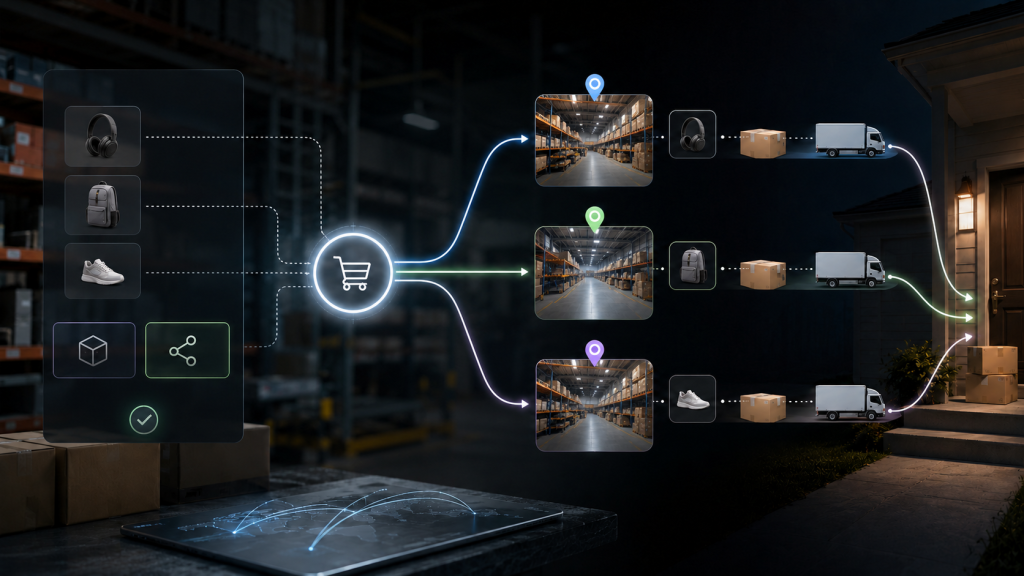
Split shipments happen when one ecommerce order is fulfilled from multiple inventory nodes, creating separate packages for the customer.
How multi-node fulfillment creates split shipments: A single order is routed to different warehouses based on inventory, resulting in multiple deliveries.
A split shipment occurs when a single customer order is fulfilled from multiple inventory nodes due to local stock availability. Multi-node fulfillment causes split shipments; a single order goes to different warehouses based on stock, resulting in multiple packages for the customer. If a user purchases three items, and those items are housed in three different geographic locations, the brand must choose between waiting to consolidate, delaying delivery, or shipping immediately and fragmenting the order. This choice is a defining moment of truth that shapes the user’s perception of your brand’s operational competence.
When brands work with a partner that understands order fulfillment, this decision becomes less reactive. The best systems use real-time inventory, customer promise dates, margin thresholds, carrier options, and fulfillment node availability to decide the smartest path for each order.
The Conflict: Balancing Operational Efficiency with Consumer Expectations
The central challenge for operations teams is balancing the desire to keep shipping costs low with the need to satisfy Customer Needs. If you hold an order to consolidate it, you sacrifice speed and potentially fail a “promise date.” If you ship immediately, you sacrifice margin. Achieving the right balance requires a deep understanding of your Customer Satisfaction metrics and the willingness to sacrifice minor operational efficiencies for long-term customer retention. It is about aligning your logistics with the specific expectations of your high-value shoppers.
That balance is also why pick, pack, and ship services need to be accurate, flexible, and connected to the bigger fulfillment strategy. A split shipment might be worth it for a VIP customer, a time-sensitive item, or a subscription product that needs to arrive on schedule. It may not be worth it for a low-margin order where the added shipping and packaging costs erase the profit.
Need a Fulfillment Strategy That Balances Speed and Margin?
Split shipments can help you deliver faster, but only when your fulfillment logic, inventory data, packaging, and carrier strategy are aligned. Launch Fulfillment helps growing ecommerce brands simplify fulfillment while protecting customer experience and profitability.
Exponential Shipping Costs and Dimensional Weight Surcharges
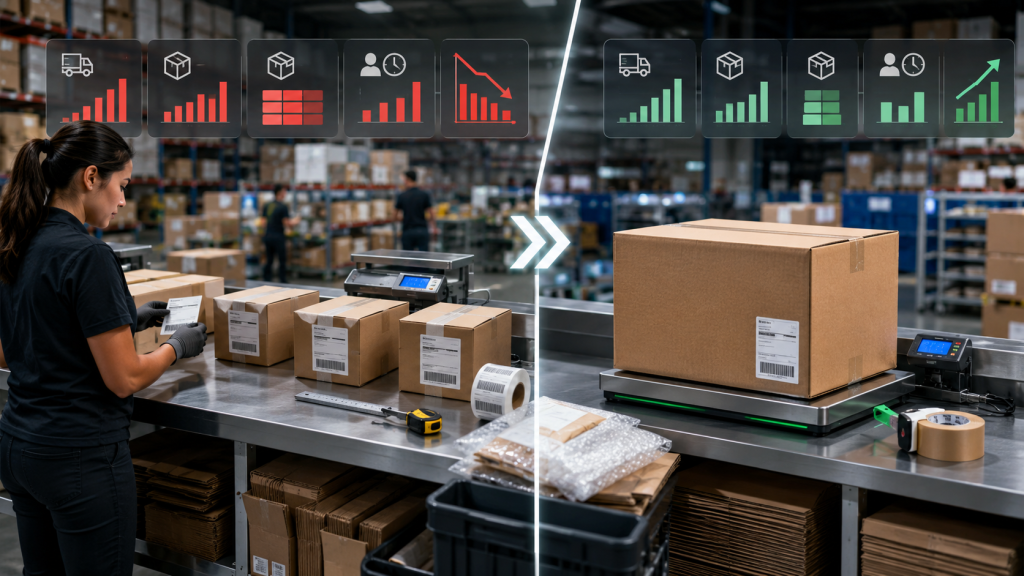
Split shipments can increase carrier fees, dimensional weight charges, packaging materials, and fulfillment labor compared to a consolidated order.
Every individual package incurs distinct carrier fees, handling charges, and often, hidden surcharges. When you split an order, you often pay more than double the shipping costs compared to a consolidated delivery. Moreover, carriers charge based on dimensional (DIM) weight; shipping three small boxes is almost always more expensive than one large, optimized carton. These costs erode the profit margin of every item, forcing businesses to consider the financial viability of every split against their total Customer Lifetime Value.UPS advises shippers to use accurate package dimensions to avoid dimensional weight shipping charge corrections, which is especially important when split shipments create multiple packages from one order. Brands that do not understand DIM weight should review how dimensional weight changes shipping costs before choosing a split shipment strategy.
The Hidden Cost of Packaging Waste and Labor Inefficiencies
Beyond shipping fees, split shipments multiply the labor required for pick-and-pack operations. Warehouse staff process many shipments, use more packaging materials, and handle extra logistics paperwork. This inefficiency creates a “hidden tax” on your operations. Furthermore, the reliance on excessive cardboard and plastic padding harms your sustainability rating, which is increasingly factored into brand perception by eco-conscious consumers.The EPA explains that sustainable packaging decisions affect both environmental and economic outcomes, which matters when split shipments multiply the number of boxes, labels, inserts, and packing materials used for one customer order. Extra packaging does not only increase freight cost. It can also affect the unboxing experience, sustainability perception, storage needs, and customer loyalty.
Impact on Customer Lifetime Value (CLV) and Long-term Churn Rate
Frequent, unexplained split shipments directly correlate with higher customer churn. When customers receive fragmented deliveries, they perceive the brand as disorganized. This friction degrades the Customer Effort Score (CES), making the shopping process feel harder than it should be. Over time, this dissatisfaction lowers your Customer Lifetime Value (CLV), as frustrated buyers are less likely to return for future purchases.
For brands in verticals like beauty, wellness, supplements, and subscription commerce, that risk is even higher because the customer relationship depends on consistency. Launch Fulfillment’s fulfillment services by industry help brands design workflows around the expectations of their actual buyers, not a generic shipping model.
Accounts Receivable and Billing Complexities in Fragmented Deliveries
Splitting shipments introduces significant complexity to your finance department. Matching invoices and payment authorizations to multiple tracking numbers across various nodes complicates reconciliation. This friction in back-end services often leads to billing errors, which can further strain customer relationships and force your support teams to mediate financial discrepancies, ultimately increasing the cost of customer service.
This is where fulfillment data quality matters. When your warehouse management system, order management workflows, carrier data, and customer service records are aligned, teams can explain partial shipments clearly and avoid unnecessary confusion.
Reducing “Time-to-Door” Through Distributed Inventory Management
Sometimes, splitting is the only way to deliver on a promise of next-day or two-day shipping. By routing products from the closest nodes, you shave days off the transit time. For the end user, this faster arrival often outweighs the minor annoyance of receiving multiple packages, provided the customer communication is clear and proactive.
USPS provides a domestic zone chart that shows how origin and destination affect shipping zones, while Launch Fulfillment’s guide to shipping zones explained breaks down why distance affects transit time, cost, and fulfillment planning. When brands understand zone-based shipping, they can make smarter decisions about inventory placement and split shipment thresholds.
Managing Out-of-Stock Scenarios Without Losing the Sale
Distributed inventory allows you to save sales that would otherwise be lost to “out of stock” notifications. If a flagship item is unavailable at your primary distribution center, you can fulfill it from a regional hub. This strategic splitting ensures the user receives their full order, preventing the immediate abandonment of the sale and keeping your customer engagement metrics high.
Inventory placement is especially important for fast-growing brands with seasonal demand, product launches, bundles, or subscription inventory. Strong inventory management helps reduce preventable splits by keeping stock counts clean and making it easier to position products where demand is most likely to occur.
The Trade-off: Priority Shipping vs. Order Consolidation
Retailers must weigh the cost of a split against the benefit of speed. High-impact customers who pay for priority shipping expect their items immediately, making splits an acceptable and often expected trade-off. Conversely, for standard economy shipping, consolidation is usually the preferred path. Creating tiered policies for these different segments is essential for an effective CX strategy.
This is one reason Launch Fulfillment approaches fulfillment as a strategy, not just a warehouse task. Brands need defined rules for when to split, when to hold, when to consolidate, and when to communicate proactively. Those rules should support both customer experience and margin health.
Using Predictive Analytics to Pre-position Stock and Minimize Splits
Advanced retailers use predictive analytics and AI tools to ensure stock is positioned where it is most likely to sell. By analyzing historical data, you can move products to the correct nodes before an order is placed. This proactive inventory placement reduces the need for split shipments, keeping the order journey consolidated and efficient. Focus on keeping inventory accurate; your customer’s experience depends on the product and the delivery’s reliability and transparency.
Launch Fulfillment’s fulfillment warehousing facilities support growing brands with secure storage, real-time tracking, and technology-driven workflows so inventory decisions are not made blindly.
Turn Inventory Placement Into a Customer Experience Advantage
Split shipments often start with inventory gaps. Launch Fulfillment helps ecommerce brands improve order accuracy, inventory visibility, shipping speed, and fulfillment consistency across growing operations.
The “Unboxing Anxiety” and Fragmented Customer Journey Mapping
The “unboxing” experience is a vital touchpoint in the customer journey. When a customer receives half their order, they experience “unboxing anxiety,” wondering where the rest of their items are. Utilizing customer journey mapping allows brands to see that each package arrival is an opportunity for either frustration or delight. If the arrival is unexpected, it becomes a friction point; if it is expected, it becomes a fulfillment success.
For subscription brands, this is even more sensitive. A missing item, delayed component, or unexplained partial delivery can make the full experience feel broken. Launch Fulfillment’s subscription box fulfillment services are designed around accurate assembly, careful packing, and customer-ready presentation.
The Surge in “Where Is My Order?” (WISMO) Support Tickets
Split shipments are the leading driver of “Where Is My Order” (WISMO) inquiries. When a user sees one package marked as “delivered” but missing half their order, they immediately contact customer support. This puts massive, unnecessary strain on your support teams and significantly decreases your Customer Satisfaction Score (CSAT).
Gorgias reports that WISMO requests are among the most common ecommerce support questions and that self-service resources and automation can reduce support strain. The operational takeaway is simple: if you split the shipment, you need tracking communication that makes the split obvious before the customer has to ask.
Brand Perception: How Excess Packaging Affects Sustainability Scores
Today’s consumers are increasingly eco-conscious. Receiving three separate boxes, often with excessive padding, leaves a negative impression. Brands that ignore the environmental impact of their logistics strategy risk losing trust. By optimizing for fewer shipments, you improve both your bottom line and your standing among environmentally conscious buyers.
Packaging decisions are part of the fulfillment strategy. A brand may decide that faster delivery justifies a split, but that choice should be weighed against added cartons, filler, labels, labor, carrier charges, and customer perception. Launch Fulfillment’s pick and pack workflows help brands protect presentation while avoiding unnecessary waste where possible.
“Moments of Truth”: When a Split Shipment Becomes a Broken Promise
The “moment of truth” is the moment of arrival. If a split isn’t clearly communicated, it feels like a failure. Transparency here is vital. Providing clear, early information turns a potential complaint into a simple, understood logistics process. If the brand communicates the split clearly, the “broken promise” disappears.
That communication should start at checkout and continue through post-purchase updates. Brands can reduce friction by explaining that items may ship separately, showing all tracking numbers in one view, and setting expectations before the first box arrives.
The Unified Tracking Experience: Consolidating Information in the Digital Layer

Unified tracking helps customers understand split shipments by showing every package from one order in a single view.
This is where order fulfillment operations need to connect directly with customer-facing systems. If warehouse activity, inventory allocation, carrier labels, tracking updates, and customer notifications live in separate silos, split shipments become harder to explain and harder to trust.
Proactive Communication: Using Automated Alerts to Set Expectations
Don’t wait for the customer to ask where their package is. If an order must be split, send a proactive email or SMS explaining why. A simple message, “We’ve split your shipment to get your items to you faster”, transforms a potential grievance into an example of proactive customer service.
The language matters. Instead of framing a split as a problem, frame it as a speed or availability decision: “Your items are shipping from separate fulfillment centers so we can get them to you faster.” That one sentence can turn confusion into confidence.
Leveraging AI Chatbots and Self-Service Portals for Real-Time Updates
Use AI chatbots to handle common WISMO queries. By allowing users to check their shipping status instantly, you free up your human agents for higher-level interactions. This maintains a high standard of customer support without overloading your staff. Empowering the user to find their own answers is a key component of modern customer experience management.
Still, automation only works when the underlying fulfillment data is clean. A chatbot cannot solve a split shipment issue if the warehouse, carrier, and order systems disagree. That is why ecommerce brands should treat fulfillment integrations as part of the customer experience stack.
The Role of Sentiment Analysis in Identifying Fulfillment Friction Points
Sentiment analysis tools help find regions or product types where fulfillment often fails to meet user expectations. By analyzing social media mentions and customer feedback, you can identify when split shipments are causing genuine anger. This data is essential for refining your routing rules and improving the overall Customer Experience.
Brands should also review returns feedback, customer service tags, delivery complaints, and product reviews. If a specific SKU, region, or promotion consistently creates fulfillment friction, the fix may be inventory placement, carrier selection, packaging design, or customer communication.
Determining the “Margin Threshold” for Splitting an Order
Every business needs a defined “margin threshold.” If the cost of splitting an order exceeds a certain percentage of the item’s margin, the system should hold the order for consolidation. This math-based method removes feelings from logistics decisions and ensures that every split is economically justified.
Launch Fulfillment often encourages brands to think through these thresholds before peak season, product launches, or subscription drops. A clear split-shipment rule gives your team the confidence to protect customer experience without letting preventable shipping costs eat into margin.
High-Impact Customers vs. Standard Transactions: Tiered Fulfillment Strategies
Treat your most loyal customers differently. For VIP members, the cost of an occasional, expedited split shipment is a necessary investment in Customer loyalty. For low-margin, one-time shoppers, prioritize consolidation to protect your bottom line. Segmenting your fulfillment strategy based on customer data is a hallmark of sophisticated customer experience management.
This is especially valuable for brands with loyalty programs, subscription customers, influencer campaigns, or high-AOV buyers. A strong ecommerce operations model connects customer value with fulfillment decisions instead of applying one flat shipping rule to every order.
Environmental Impact: When to Offer “Sustainable Shipping” Incentives
Offer your customers a choice at checkout: “Would you prefer your items all at once, or as they become available?” Many users are willing to wait for a consolidated shipment if it means less cardboard waste, turning a logistical constraint into a brand-building gesture that increases customer advocacy.
This choice can also reduce unnecessary packaging, lower support confusion, and give customers more control over the delivery experience. For eco-conscious brands, consolidated shipping can become part of the brand promise instead of a hidden logistics compromise.
Using Voice of the Customer (VoC) Feedback Loops to Refine Routing Rules
Use Voice of Customer (VoC) feedback loops to continuously update your routing logic. If your customer feedback indicates that shoppers in a specific region are consistently annoyed by split shipments, adjust your inventory rules to favor consolidation for that segment. This iterative process ensures your logistics strategy evolves alongside your customer needs.
The best fulfillment strategies are not static. They improve as brands learn which customers value speed, which value sustainability, which are most sensitive to packaging, and which are most likely to contact support after partial deliveries.
Build a Fulfillment Operation Customers Can Trust
Launch Fulfillment helps ecommerce brands improve inventory visibility, reduce fulfillment friction, optimize shipping decisions, and create a delivery experience that protects both margins and customer satisfaction.
Final Thoughts
Managing Split Shipments to Enhance Customer Satisfaction requires a fundamental shift in perspective. Retailers must stop viewing split shipments as mere failures and start managing them as a strategic variable in the broader customer journey. By prioritizing transparency, leveraging AI tools for predictive inventory placement, and using real-time data to communicate with customers, you can turn a logistical hurdle into a demonstration of service excellence.
Ultimately, the goal is to protect your Customer Satisfaction Score while maintaining the agility that modern retail demands. To future-proof your business, audit your current CX strategy, integrate your CRM software with your logistics engine, and ensure that every delivery split or consolidated reinforces your commitment to the customer. The winners in the 2025 landscape will be those who treat every package not just as a unit of inventory, but as a critical touchpoint in a long-term customer relationship.
For growing brands, the real opportunity is not to eliminate every split shipment. It is to build a fulfillment system that knows when splitting helps, when it hurts, and how to communicate the decision clearly. With the right 3PL partner advantage, brands can turn fulfillment complexity into a better customer experience.
Related Posts
FAQ: Split Shipments Ecommerce
What does split shipment mean?
A split shipment happens when one customer order is shipped in multiple packages instead of one consolidated delivery. In ecommerce, this usually happens when items from the same order are stored in different warehouses, fulfillment centers, or inventory nodes. The customer still placed one order, but they may receive two or more tracking numbers and delivery dates.
What is split order shipping?
Split order shipping is the process of fulfilling different parts of the same order separately. For example, if a customer buys three items and only two are available in one fulfillment center, the third item may ship from another location. This can help brands deliver faster, but it can also increase shipping costs, packaging use, and customer communication needs.
Why do ecommerce brands use split shipments?
Ecommerce brands use split shipments to avoid stockouts, reduce delivery times, and fulfill orders from the closest available inventory location. Split shipments can help brands save the sale when one item is unavailable at the primary warehouse. However, they need to be managed carefully so the added shipping cost and customer confusion do not outweigh the speed benefit.
How do split shipments ecommerce strategies affect shipping costs?
Split shipments ecommerce strategies can increase shipping costs because each package may create its own carrier fee, label, handling cost, packaging cost, and dimensional weight charge. Three small boxes are often more expensive to ship than one optimized carton. Brands should use margin thresholds to decide when splitting an order makes financial sense.
Can split shipments improve delivery speed?
Yes. Split shipments can improve delivery speed when items are shipped from the fulfillment center closest to the customer or when one product is ready to ship before the rest of the order. This can help brands meet faster delivery promises, but the customer should receive clear tracking updates so they understand why the order is arriving in separate packages.
How do split shipments affect customer satisfaction?
Split shipments can either improve or hurt customer satisfaction. They can improve the experience when they help customers receive items faster and the brand communicates clearly. They can hurt the experience when the customer receives only part of the order without explanation, leading to confusion, WISMO tickets, and frustration.
How can ecommerce brands reduce unnecessary split shipments?
Ecommerce brands can reduce unnecessary split shipments by improving inventory accuracy, using smarter order routing, pre-positioning stock closer to demand, setting rules for when to consolidate orders, and offering customers a choice between faster separate deliveries or fewer consolidated packages. A strong 3PL partner can help brands balance speed, cost, packaging waste, and customer experience.
