
Key Takeaways
- Cheapest Overnight shipping is driven by more than speed, it’s driven by system efficiency. Costs are heavily influenced by packaging, zones, and fulfillment execution.
- The cheapest overnight option isn’t always the lowest rate. Surcharges, dimensional weight, and operational inefficiencies can quietly increase total cost.
- Shipping zones have a major impact on pricing. The farther a package travels, the more expensive overnight delivery becomes location strategy matters.
- Dimensional weight can inflate costs fast. Large, lightweight packages often cost more than expected if packaging isn’t optimized.
- Cutoff times are just as important as carrier speed. Missing processing windows can delay delivery, even with overnight services.
- Carrier selection should be strategic, not default. USPS, FedEx, and UPS all offer different strengths depending on package size, destination, and urgency.
- The best way to lower overnight costs is improving fulfillment, not just switching carriers. Better inventory placement, faster processing, and smarter routing reduce both cost and delivery time.
Unlocking Affordable Overnight Delivery
In today’s fast-paced world, the expectation for speed in delivery has never been higher. For businesses, especially those in e-commerce, offering rapid shipping can be a powerful differentiator, driving customer satisfaction and loyalty. However, the allure of overnight shipping often comes with a significant price tag, potentially impacting profit margins. Navigating the complexities of shipping costs while ensuring swift delivery can feel like a balancing act. This guide is designed to demystify overnight shipping, providing you with the knowledge and strategies to find the fastest and most affordable options available, ensuring you meet customer demands without breaking the bank.
At Launch Fulfillment, we see overnight shipping as part of a bigger fulfillment strategy. The goal is not just to ship faster. It is to build an operation where inventory placement, order processing, packaging, carrier selection, and shipping zones work together to protect both delivery speed and profit margin.
Overnight shipping shouldn’t destroy your margins.
If next-day delivery feels expensive, the issue usually isn’t just the carrier—it’s how your fulfillment system is set up.
The Urgency of Next-Day: Why Speed Matters
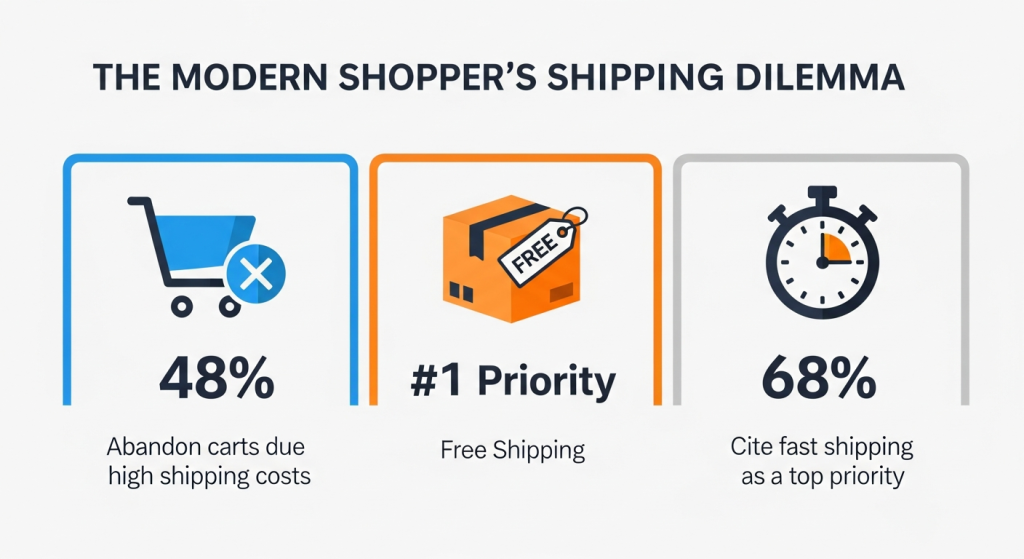
Consumer data highlights the critical balance between shipping speed and cost in eCommerce.
The digital marketplace has fundamentally reshaped consumer expectations. Consumers increasingly value not just the product they purchase, but the speed and convenience of its arrival. This shift is particularly evident in the eCommerce landscape, where next-day delivery is evolving from a premium service to a near-necessity for competitive businesses. Online shoppers increasingly define fast shipping in terms of days, not weeks, and speed has become a major factor in whether a customer completes a purchase. For businesses, failing to offer competitive delivery speeds can lead to cart abandonment, damaged trust, and weaker repeat purchase behavior. Therefore, understanding and optimizing overnight shipping is not just about logistics; it’s a strategic imperative for business growth and customer retention.
That expectation is exactly why Launch Fulfillment’s ecommerce fulfillment services focus on fast order processing, flexible shipping, and software-supported operations. Speed only works when the back end is built to support it. Launch’s ecommerce fulfillment services include platform integrations, pick and pack, flexible shipping, real-time inventory tracking, and returns support for growing brands. Launch Fulfillment ecommerce fulfillment services
The Cost Challenge: Balancing Speed and Budget
While the demand for speed is clear, the cost associated with overnight shipping is a significant barrier for many. The inherent nature of expedited services means carriers must prioritize these packages, often involving dedicated resources, optimized routing, and strict timelines. This urgency translates directly into higher shipping costs.
Navigating this market requires a keen eye for detail, a strategic approach to carrier selection, and a thorough understanding of what influences the final price of rapid shipping. The goal is to achieve the fastest possible delivery without incurring unnecessary expenses, finding that sweet spot that benefits both the business and its customers.
For ecommerce brands, the cheapest overnight option is rarely just the lowest published carrier rate. It is usually the result of smarter packaging, fewer shipping zones, better warehouse placement, and stronger carrier-rate leverage. Launch Fulfillment’s ecommerce fulfillment pricing guide explains how shipping zones, carrier rates, product size, SKU complexity, packaging, and order volume all shape total fulfillment cost. Launch Fulfillment ecommerce fulfillment pricing
What This Guide Will Cover: Your Roadmap to Cheaper Overnight Shipping
This guide will serve as your comprehensive roadmap to understanding and securing the most affordable overnight shipping options. We will begin by demystifying the fundamentals of overnight shipping, including what “overnight” truly means and the guarantees associated with it. Subsequently, we will delve into the intricate details of what drives shipping costs, with a particular focus on factors like dimensional weight and shipping zones. A detailed comparison of major carrier services from USPS, FedEx, and UPS will highlight their respective next-day delivery offerings. Furthermore, we will explore advanced strategies designed to secure the absolute cheapest rates, including leveraging technology, negotiation, and optimization. Finally, we will address common pitfalls and hidden fees to watch out for, empowering you to avoid unexpected charges and make informed decisions for cost-effective, rapid shipping.
Understanding the Fundamentals of Overnight Shipping
Before diving into cost-saving strategies, it’s crucial to grasp the core principles of overnight shipping. This foundational knowledge will help set realistic expectations and identify the services that best fit your needs.
Defining “Overnight”: Expectations vs. Reality
When a carrier advertises overnight shipping or next-day delivery, it generally implies that a package will arrive at its destination within 24 hours of being shipped. However, the reality can be more nuanced. The term “overnight” often refers to a delivery by the end of the next business day. Some services guarantee delivery by a specific time in the morning, while others offer delivery by the close of business. It’s essential to understand the specific service level agreement for any overnight shipping option you consider, as precise delivery times can vary. The guarantee itself is also critical; while carriers aim for 100% on-time performance, exceptions can occur due to weather, logistical issues, or other unforeseen circumstances.
For brands trying to operationalize speed, the definition of overnight also depends on internal execution. Orders must be received, synced, picked, packed, labeled, and handed off before carrier cutoff times. Launch Fulfillment’s pick, pack, and ship services are designed around accurate picking, same-day order processing, fast shipping, and real-time tracking. Launch Fulfillment pick, pack, and ship services
Key Service Levels: What Each Carrier Offers
Major carriers like USPS, FedEx, and UPS offer a spectrum of next-day delivery services, each with different speed guarantees, price points, and delivery windows. USPS typically offers USPS Priority Mail Express, which provides a 1- or 2-day delivery guarantee to most U.S. addresses, often at a competitive price, especially with flat-rate options. FedEx provides services such as FedEx First Overnight, FedEx Priority Overnight, and FedEx Standard Overnight. UPS offers a similar tiered approach with services like UPS Next Day Air Early, UPS Next Day Air, and UPS Next Day Air Saver. Understanding these distinctions is key to selecting the service that balances speed requirements with shipping costs.
For current carrier-specific service details, review the official pages for USPS Priority Mail Express, FedEx overnight shipping services, and UPS domestic shipping services.
The Critical Role of Cutoff Times for Next-Day Delivery
A paramount factor in ensuring next-day delivery is adhering to carrier cutoff times. These are the deadlines by which a package must be dropped off or picked up to be processed for overnight transit. If a package misses its cutoff time, it will typically be processed the following business day, pushing the delivery back by 24 hours. For businesses, establishing an efficient workflow that accounts for these cutoff times is crucial. This might involve optimizing order processing, packing, and drop-off procedures to ensure packages are ready well in advance. Missing a cutoff time can negate the entire purpose of overnight shipping and lead to disappointed customers and potential service failures.
This is where fulfillment operations become the hidden driver of shipping performance. Launch Fulfillment’s order management and order processing resources explain how order receiving, processing, and fulfillment connect before a package ever reaches the carrier.
The Guarantee Factor: When “Overnight” is Truly Guaranteed
While carriers aim for punctuality, the guarantee associated with overnight shipping is not always absolute. Most major carriers offer money-back guarantees for their expedited services if the package does not arrive by the promised time, barring specific exceptions like severe weather, natural disasters, or public holidays. It’s essential to review the specific terms and conditions of the carrier’s guarantee. Understanding what constitutes a valid reason for a refund or credit in case of delay is vital for managing expectations and for potential claims.
Decoding Overnight Shipping Costs: What Drives the Price
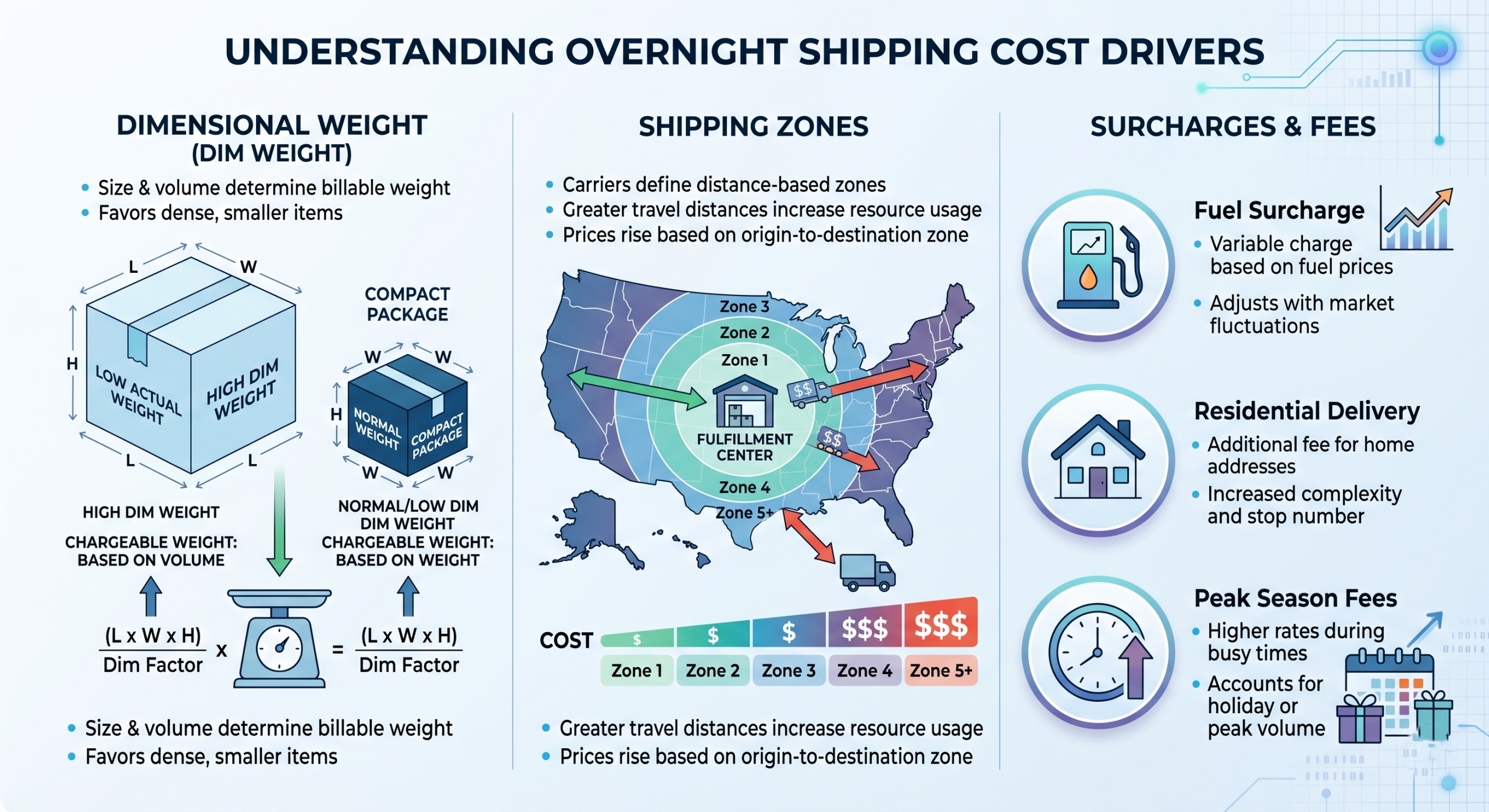
The price of overnight shipping is influenced by a multitude of factors beyond simply the distance a package travels. Understanding these elements is key to identifying opportunities for cost savings.
Shipping costs aren’t just about speed.
Dimensional weight, zones, and surcharges can quietly inflate every order. Fixing the system behind shipping is where real savings happen.
Package Dimensions and Weight: The Impact of Dimensional Weight
One of the most significant drivers of shipping costs, particularly for lighter but bulky items, is dimensional weight, commonly referred to as DIM weight. Carriers calculate DIM weight based on a package’s volume. If the DIM weight is greater than the package’s actual weight, the carrier will charge based on the DIM weight. This means that inefficient packaging, using boxes that are too large for the contents, can significantly increase your shipping costs, even if the package feels light. Optimizing packaging to use the smallest box that safely fits the item is a critical strategy for reducing overall expenses.
Launch Fulfillment’s ecommerce fulfillment services for beauty, wellness, and DTC brands include custom packing solutions and cost-conscious shipping support, which matter when dimensional weight starts turning oversized packaging into a margin problem. Launch’s ecommerce fulfillment services also emphasize optimized shipping routes, real-time inventory tracking, and cost-efficient operations for brands scaling from 2,500 to 50,000+ orders per month. Launch Fulfillment ecommerce fulfillment services
Shipping Zones and Distance: How Far Your Package Travels
Shipping zones are geographical areas defined by carriers that represent different distances from the origin of the shipment. The further a package needs to travel, the higher the shipping cost. This is a fundamental principle in shipping. For overnight shipping, the impact of shipping zones is amplified because the carrier must complete the delivery within a very short timeframe. Strategic placement of inventory in fulfillment centers closer to major customer populations can significantly reduce the number of shipping zones a package travels, thereby lowering shipping costs and potentially improving delivery times.
Launch Fulfillment’s guide to how distance affects ecommerce fulfillment costs and time in transit explains how shipping zones are calculated and why distance from origin to destination directly affects cost. Launch’s homepage also highlights strategically located U.S. fulfillment centers in Springville, Utah, and Shepherdsville, Kentucky, supporting faster regional coverage. Launch Fulfillment homepage
Fuel Surcharges and Other Carrier Fees: Hidden Costs to Watch For
Beyond the base rate, carriers often apply various surcharges that can substantially increase the final price of overnight shipping. Fuel surcharges are a common example, fluctuating based on market fuel prices and directly impacting the total cost. Other typical surcharges include residential delivery fees, remote area surcharges, and peak-season surcharges, which are often implemented during high-demand periods like holidays. Understanding these potential add-ons is crucial for accurate cost estimation and for avoiding unexpected expenses.
For official surcharge details, review the current carrier resources for UPS fuel surcharges and FedEx shipping surcharges and fees. These pages are worth checking regularly because surcharge rates and fee structures can change.
Time-Definite vs. End-of-Day Delivery: Paying for Precision
The level of precision required for delivery directly impacts shipping costs. Services that guarantee delivery by a specific time in the morning are typically more expensive than those that guarantee delivery by the end of the business day. For example, UPS Next Day Air Early will cost more than UPS Next Day Air Saver. Evaluate whether your needs genuinely require a precise morning delivery or if an end-of-day guarantee suffices. Often, choosing a slightly less precise, but still rapid, delivery option can lead to considerable savings on overnight shipping.
Package Insurance: When to Buy and When to Skip
While not directly a cost of the service itself, package insurance is an additional expense to consider. For high-value items, purchasing insurance is often a wise investment to protect against loss or damage. However, for lower-value goods, the cost of insurance may outweigh the risk, especially if the carrier already offers some level of declared value protection. Many businesses also opt for third-party insurance providers, which can sometimes offer more competitive rates than carrier-offered insurance. Assess the value of your shipment and the carrier’s liability policies to determine if purchasing extra insurance is necessary and cost-effective for your overnight shipping needs.
Major Carriers Compared: Finding the Cheapest Overnight Options
Choosing the right carrier is fundamental to securing the cheapest overnight shipping. Each major provider offers distinct advantages and pricing structures for their expedited services.
USPS Priority Mail Express: Your Go-To for Budget Overnight
For many individuals and small businesses, USPS Priority Mail Express stands out as a highly cost-effective option for overnight or 1-2 day delivery. It offers a money-back guarantee for packages arriving late, and its flat-rate boxes can be particularly economical for shipping multiple items or heavier objects, as they eliminate the concern over weight-based pricing within the flat-rate constraints. While its network might not reach every remote area as quickly as some private carriers, it provides excellent value and reliability for a vast majority of domestic shipments, making it a strong contender for the cheapest overnight shipping.
FedEx Overnight Services: Speed and Reliability for Business & Personal Needs
FedEx is renowned for its robust express shipping network, offering a suite of overnight shipping options designed for speed and reliability. Services like FedEx Priority Overnight and FedEx First Overnight cater to urgent business needs where precise delivery times are critical. While generally priced higher than USPS, FedEx often provides competitive rates for specific weight and zone combinations, especially for businesses that can leverage negotiated rates. Their extensive network ensures widespread coverage and a high degree of service consistency for next-day delivery requirements.
UPS Next Day Air Services: Comprehensive Solutions for Urgent Shipments
UPS is another titan in the expedited shipping market, offering a comprehensive range of next-day delivery services under its UPS Next Day Air umbrella. UPS Next Day Air Saver is frequently cited as one of the most competitive overnight shipping options for end-of-day delivery, often providing a strong balance between speed and cost. For even greater speed, UPS Next Day Air Early and UPS Next Day Air guarantee earlier morning deliveries. Similar to FedEx, UPS offers significant advantages for businesses with high shipping volumes through negotiated rates and volume discounts, making their services potentially very affordable when structured correctly.
Advanced Strategies for the Absolute Cheapest Overnight Shipping
Beyond understanding carrier options, several advanced strategies can significantly reduce your shipping costs for overnight delivery.
Leverage Carrier Comparison Tools and Shipping Rate Calculators
The most straightforward way to find competitive rates is by using online shipping rate calculators and comparison tools. These platforms allow you to input package details and instantly compare quotes across multiple carriers, including USPS, FedEx, and UPS. By leveraging these tools regularly, you can identify the cheapest option for each specific shipment. Many eCommerce platforms also integrate with these tools, streamlining the process for businesses.
Negotiated Rates and Volume Discounts
For businesses that ship frequently, negotiating directly with carriers can unlock substantial savings. Carriers offer volume discounts and customized rate plans for high-volume shippers. If your eCommerce business meets certain shipping thresholds, engaging with carrier sales representatives can lead to significantly lower shipping costs per package. Understanding your average monthly shipment volume and destinations is key to negotiating favorable terms.
A 3PL can often help here because it aggregates volume and builds carrier relationships across multiple brands. Launch Fulfillment’s third-party logistics services help connect warehousing, shipping, order fulfillment, and logistics support into one scalable system.
Consolidating Shipments and Optimizing Packaging
Efficient packaging is paramount for overnight shipping. Whenever possible, consolidate multiple items into a single shipment. This reduces the number of individual packages and associated fees. Furthermore, meticulously optimize your packaging to use the smallest possible box that safely contains the items. This minimizes DIM weight, a crucial factor in shipping costs. Proper void fill and secure packing also prevent damage, avoiding costly returns or reshipments.
This is especially important for product categories where presentation and product protection both matter. Launch Fulfillment’s subscription box fulfillment services include kitting, custom branding options, and fast, accurate order fulfillment for brands that need both operational precision and a strong unboxing experience.
Strategic Use of Regional Carriers and Third-Party Logistics Providers
While national carriers offer broad coverage, regional carriers can sometimes provide more affordable and faster shipping within specific geographic areas. For eCommerce businesses, partnering with a Third-Party Logistics provider can also yield savings. 3PLs often have established relationships with multiple carriers, allowing them to leverage aggregated volume discounts and optimized distribution networks. Strategic placement of inventory within a 3PL’s network of fulfillment centers can significantly reduce shipping zones and, consequently, shipping costs for overnight delivery.
Launch Fulfillment’s 3PL fulfillment services are built around scalable storage, inventory tracking, reliable order fulfillment, shipping support, and returns management. The right 3PL setup can make overnight shipping less reactive by positioning products closer to demand and automating the steps between order placement and carrier handoff.
Printing Your Own Shipping Labels Online: Cost Savings and Convenience
Printing your own shipping labels online through carrier websites or third-party shipping software offers both cost savings and convenience. These platforms often provide discounted rates compared to retail prices at the carrier’s counter. They also streamline the label creation process, reduce errors, and facilitate tracking. Integrating this with your eCommerce platform can automate much of the shipping workflow, saving time and improving accuracy.
For ecommerce brands scaling past basic manual shipping, Launch Fulfillment’s ecommerce shipping services and solutions guide outlines shipping methods such as 2-day shipping, same-day delivery, overnight shipping, expedited shipping, freight shipping, dimensional weight, and shipping integrations.
A Better Fulfillment Setup Makes Fast Shipping Easier
If overnight shipping costs are cutting into margins, the issue may not be the carrier alone. It may be where inventory is stored, how orders are processed, and how quickly packages are packed and handed off. Talk to Launch Fulfillment about building a fulfillment setup designed for faster, more cost-effective delivery.
Avoiding Hidden Fees and Common Overnight Shipping Pitfalls
Even with the best intentions, unexpected fees and common shipping errors can inflate your overnight shipping costs. Being aware of these pitfalls is crucial for comprehensive cost management.
Address Correction Fees: Why Accurate Addresses Are Crucial
Inaccurate or incomplete addresses are a frequent cause of shipping issues and can result in significant address correction fees. When a package cannot be delivered due to an incorrect address, the carrier will attempt to correct it, and a fee is typically applied for this service. This not only adds to the cost but also delays delivery. Implementing address validation tools in your checkout process or during label creation can help mitigate this risk and ensure your packages reach their intended recipients efficiently.
Residential Delivery Surcharges: Knowing When They Apply
Most national carriers charge an additional fee for shipments destined for residential addresses, as opposed to commercial or business addresses. This surcharge is standard for services like FedEx and UPS next-day delivery. While often unavoidable for eCommerce businesses, understanding that this fee is built into the overall shipping cost for most consumer orders is important for accurate pricing and margin calculation.
Fuel Surcharges: Understanding Fluctuations and Impact on Shipping Costs
Fuel surcharges are a dynamic component of shipping costs that can change weekly. These surcharges are tied to the national average price of fuel and are applied as a percentage to the base shipping rate. While they are a standard practice, their fluctuating nature means that the total cost of overnight shipping can vary even for identical shipments over different weeks. Staying informed about the current carrier fuel surcharge rates can help in budget forecasting.
Delivery Exceptions and Their Financial Impact
Delivery exceptions, such as weather delays, missed pickups, or package damage, can lead to significant issues. While some exceptions are outside of a business’s control, understanding the carrier’s policies regarding these events is important. If a delivery is guaranteed and an exception occurs, you may be eligible for a refund of shipping costs. Proactively communicating with customers about delays and tracking package status can mitigate negative feedback and maintain customer satisfaction, even when unforeseen problems arise.
Real-time visibility helps reduce the fallout from exceptions. Launch Fulfillment’s homepage highlights real-time tracking, data-driven fulfillment, unlimited integrations, and smart warehousing locations that support better delivery visibility from the warehouse to the customer. Launch Fulfillment
Final thoughts
Mastering the art of affordable overnight shipping is a critical skill in today’s competitive marketplace. By understanding the fundamentals of next-day delivery, the intricate factors that drive shipping costs like DIM weight and shipping zones, and the specific offerings of major carriers such as USPS Priority Mail Express, FedEx, and UPS Next Day Air, businesses and individuals can make more informed decisions. Leveraging advanced strategies such as comparison tools, negotiated rates, optimized packaging, and the potential of fulfillment centers and 3PLs can unlock significant savings. Crucially, avoiding hidden fees and common pitfalls related to inaccurate addresses and surcharges ensures that the perceived cost of speed aligns with the actual expenditure. In the end, the most effective approach to achieving cheap overnight shipping is a proactive, strategic one that balances speed, cost, and reliability, ultimately contributing to higher customer satisfaction and a healthier bottom line.
If your brand is trying to offer faster shipping without letting overnight costs eat into margin, Launch Fulfillment can help you build the fulfillment foundation behind it. From warehousing and real-time inventory tracking to order processing, carrier strategy, and shipping-zone optimization, the right partner can make fast delivery more predictable and more profitable.
Ready to offer faster shipping without margin shock?
Overnight delivery should help your brand convert, not quietly drain profit. Get in touch with Launch Fulfillment to build a smarter fulfillment strategy around speed, cost, and customer experience.
Ready to ship faster without overpaying?
Build a fulfillment setup that supports overnight delivery, reduces zone costs, and keeps your margins intact.
