

Key Takeaways
- Diversification is key: Moving away from a single-carrier model allows brands to build a stronger shipping network that balances cost, speed, and reliability.
- Regionalization can lower shipping costs: Using regional carriers near fulfillment centers can reduce zone-based costs and improve last-mile delivery performance.
- National carriers still matter: UPS, FedEx, and USPS provide broad nationwide reach, making them essential for coast-to-coast ecommerce fulfillment.
- Technology makes multi-carrier shipping possible: Shipping software, carrier integrations, and real-time order routing help brands manage complexity without slowing operations.
- The cheapest label is not always the lowest-cost option: Surcharges, delivery delays, customer service tickets, and manual work can quietly increase total shipping costs.
- A hybrid carrier strategy is often the strongest choice: The right mix of regional and national carriers helps ecommerce brands reduce cost without sacrificing delivery experience.
Regional carriers vs National Carriers
What Are National Carriers?
National carriers, such as UPS, FedEx, and USPS, are the backbone of the American logistics landscape. These shipping companies deliver packages across the whole country, providing standardized service levels and massive infrastructure. They are the go-to choice for most ecommerce brands because their footprint allows for predictable, coast-to-coast reach.
However, relying solely on national providers can be a bottleneck. Because these carriers operate on a complex hub-and-spoke model, they often incur significant costs for residential and rural deliveries. For high-volume brands, the lack of flexibility in national networks can lead to ballooning delivery costs and performance dips during peak seasons.
At Launch Fulfillment, we see carrier strategy as part of the broader fulfillment equation. The carrier you choose matters, but so does where your inventory sits, how orders are routed, how packages are packed, and whether your fulfillment partner has the technology to make better shipping decisions automatically.
What Are Regional Carriers?
Regional carriers work in certain geographic areas. They usually cover a few states or metro areas, functioning as specialized nodes within the broader logistics ecosystem. Providers like OnTrac, LaserShip, Spee-Dee, and LSO have transformed parcel shipping by focusing on high-density lanes.
Because these carriers operate in confined zones, they excel in short-haul deliveries. They are not burdened by the same long-haul transport costs as national firms, allowing them to offer more competitive pricing and faster ground-based delivery speeds. For brands seeking to improve their customer experience, regional carriers provide an agility that is difficult to replicate with national networks.
That agility becomes even more powerful when paired with the right ecommerce fulfillment services. If inventory is stored closer to the customer and routed intelligently, a regional carrier can help deliver the kind of fast, affordable shipping experience customers now expect.
Your shipping strategy is probably costing you more than you think.
If you’re relying on one carrier, you’re likely overpaying on zones, surcharges, and delivery inefficiencies. The right fulfillment setup fixes that.
Coverage

National carriers utilize a nationwide hub-and-spoke model, while regional carriers focus on high-density, short-haul lanes within specific geographic zones.
National carriers deliver nationwide, providing consistent, standardized reach across all 50 states. In contrast, regional carriers are limited to specific zones. While this geographic limitation sounds restrictive, it is actually their primary strategic strength: by mastering specific shipping lanes, they achieve higher reliability in their defined territories.
Coverage strategy should also connect to warehouse placement. Launch Fulfillment’s fulfillment warehousing facilities are designed to help brands store products strategically, shorten transit distances, and make shipping decisions with more context than a single-carrier setup can provide.
Cost Structure

Regional carriers usually have lower base rates. They also have fewer extra fees for short-distance deliveries. National carriers have more complex pricing. This is especially true for deliveries to homes and rural areas, where zone-based surcharges can inflate a simple shipment by 20% or more.
Shipping zones matter because the farther a package travels from the fulfillment center, the more expensive it usually becomes. USPS provides a public domestic zone chart that shows how zones are calculated based on origin and destination. For ecommerce brands, those zones are not just technical details. They directly affect margins, delivery promises, and the customer experience.
For a deeper cost breakdown, Launch Fulfillment’s ecommerce fulfillment pricing guide explains how shipping zones, carrier rates, storage, packaging, and fulfillment expenses all contribute to the final cost of getting an order to the customer.
Delivery Speed
Regional carriers often provide 1–2 day ground delivery within their zones without the need for expensive air services. National carriers may require expedited air services to match these same delivery times, which drastically increases the cost per order.
This is where fulfillment location and carrier mix work together. Launch Fulfillment’s ground shipping for ecommerce stores resource explains how distributed fulfillment can support 2-day ground delivery when inventory is placed correctly across the network.
Surcharges and Fees
National carriers depend a lot on extra charges, including residential delivery fees, delivery area surcharges, and fluctuating peak season surcharges. These fees often catch growing brands off guard. Regional carriers generally offer a more transparent and predictable fee structure, which helps in maintaining stable shipping rates.
The key is to look beyond the base rate. A shipping label may look affordable until residential fees, delivery area surcharges, fuel adjustments, dimensional weight rules, and peak charges are applied. For heavier or bulkier shipments, brands may also need to evaluate freight options. The National Motor Freight Traffic Association is a useful external resource for understanding freight classification and standards that can affect LTL shipping costs.
Why National Carriers Dominate But Aren’t Always Cheapest
National carriers win on reach and reliability. If your shipping needs require nationwide coverage, they are functionally unavoidable. However, they are built for massive, standardized scale, not for micro-level efficiency. When your shipping volume spikes, national carriers often prioritize their biggest contracts, leaving mid-market brands to pay premium surcharges for the same level of service.
This does not mean national carriers are bad. It means they should be used strategically. A strong 3PL fulfillment services partner can help brands decide when national coverage is necessary and when regional delivery options create a better cost-performance balance.
Where Regional Carriers Win on Cost and Speed
Regional carriers are the secret weapon for brands looking to lower their shipping costs while maintaining rapid delivery times. By utilizing regional distribution centers, these carriers bypass the costly intermediate sorting hubs that national carriers use. This direct, high-density approach often results in same-day delivery possibilities or consistently fast ground-based arrivals that significantly boost customer satisfaction.
Regional carriers are especially useful when customer density is concentrated in specific metros, states, or coastal regions. If a brand knows that a large share of orders ships into the same region, relying only on national carriers can leave savings on the table. Launch Fulfillment’s shipping zones guide explains why distance, zone movement, and fulfillment location can dramatically influence shipping costs and time in transit.
The Hidden Costs Most Brands Miss
Many brands overlook the true cost of their shipping operation. Beyond the label price, consider the operational cost of manual entry or the customer service tickets generated by poor visibility. When a brand lacks unified tracking and visibility capabilities, they end up spending hours of administrative time manually checking statuses a silent killer of profit margins.
Carrier choice is only one part of the problem. If your team has to manually compare rates, generate labels, track orders, or troubleshoot delivery issues, the “cheap” carrier may not actually be cheap. Launch Fulfillment’s pick, pack, and ship services are built to reduce that friction by combining accurate order handling, fast processing, and real-time tracking.
For brands selling through multiple channels, visibility becomes even more important. Launch Fulfillment’s order management and order processing resources show how connected workflows help reduce manual errors before orders ever reach the carrier decision point.
Shipping costs aren’t just in the label price.
Manual work, delays, and poor routing quietly eat into your margins. A better fulfillment system eliminates those hidden costs.
The Case for a Hybrid Shipping Strategy
Successful brands use both types of carriers. This lowers costs, speeds up delivery, and creates a more scalable fulfillment system. By adopting a distributed fulfillment model, you can position inventory closer to the customer, allowing you to use the most cost-effective carrier for the final leg of the journey.
A hybrid shipping strategy gives ecommerce brands options. National carriers provide reach. Regional carriers provide efficiency in targeted lanes. Freight and LTL solutions support larger shipments. The right mix depends on order volume, product size, customer location, delivery expectations, and the flexibility of your fulfillment infrastructure.
Launch Fulfillment supports this kind of decision-making through third-party logistics services that connect warehousing, order fulfillment, shipping, and returns into a more scalable system.
How to Build the Right Carrier Mix for Your Business
1. Order Density
Where are most of your customers located? If you have high concentration in the Northeast or West Coast, integrating a regional player into your carrier mix can drop your average cost per parcel significantly.
Order density is not just a shipping metric. It should influence inventory placement, warehouse strategy, and whether a regional carrier makes sense at all. Brands with recurring orders, bundles, or subscription programs may also benefit from Launch Fulfillment’s subscription box fulfillment services, where predictable shipping patterns can make carrier optimization easier.
2. Shipping Zones
The distance a package travels is the biggest factor in pricing. By strategically utilizing distribution hubs and regional players, you avoid zone jumping, which is where most national carrier costs spiral out of control.
The U.S. Postal Service explains that shipping zones are based on the distance between origin and destination. Ecommerce brands that ignore this reality often pay more than they need to because inventory is stored too far from customers. A better fulfillment footprint can reduce the distance packages travel and improve delivery economics.
3. Volume
Regional carriers often require consistent shipping volume to negotiate the best rates. You must analyze your historical data to ensure you can meet the minimums required to secure preferential pricing.
This is where a 3PL can give growing brands more leverage. Launch Fulfillment’s 3PL fulfillment services are designed around scalable warehousing, shipping, and returns management, helping brands access stronger fulfillment infrastructure without having to build it all in-house.
4. Customer Expectations
In the age of Amazon, customer expectations for fast delivery are non-negotiable. Using a mix of carriers allows you to meet these demands through ground transit rather than paying for premium air shipping every time.
Fast delivery also protects repeat purchase behavior. When customers know they can rely on your delivery experience, they are more likely to trust your brand again. For premium product categories, that expectation gets even sharper. Launch Fulfillment’s supplement fulfillment services and beauty supply fulfillment center pages show how category-specific fulfillment can support product integrity, speed, and customer trust.
When to Use Regional Carriers vs National Carriers
Use regional carriers when you have high, consistent volume in a specific region and wish to minimize costs on the last mile. Use national carriers as your reliable backup and for nationwide fulfillment where your volume is too sparse to justify regional setups.
Use national carriers when you need predictable nationwide reach, rural coverage, or a standardized service level across all 50 states. Use regional carriers when you have enough density in a specific geography to take advantage of shorter delivery lanes, lower base rates, and faster ground transit.
For many ecommerce brands, the smartest approach is not choosing one over the other. It is building rules for when each carrier should be used. That is why fulfillment strategy should be tied to your broader order fulfillment process, not treated as an isolated shipping decision.
How 3PLs Like Launch Fulfillment Optimize Carrier Mixes
Managing many carriers inside a company is difficult. This method increases efficiency. It does not reduce delivery reach. A 3PL uses shipping software and a multi-carrier shipping platform to automate label generation and route optimization. By leveraging a high-powered shipping API, a 3PL ensures that every order is routed via the most cost-effective and fastest path available, integrating services like liftgate delivery or white glove delivery as needed for complex freight.
At Launch Fulfillment, carrier optimization is not just about picking the cheapest option on a screen. It is about combining warehouse location, inventory visibility, customer geography, package profile, service expectations, and shipping cost into one practical decision. Our ecommerce fulfillment services for beauty, wellness, and DTC brands include flexible shipping, real-time inventory tracking, platform integrations, and technology-forward fulfillment designed to help brands scale without losing control.
That matters because shipping is often where operational problems become customer-facing problems. If the wrong carrier is selected, the package is delayed. If tracking is unclear, the customer contacts support. If the shipping cost is too high, the margin disappears. A strong 3PL helps prevent those issues before they become expensive.
Ready to lower shipping costs without sacrificing delivery experience?
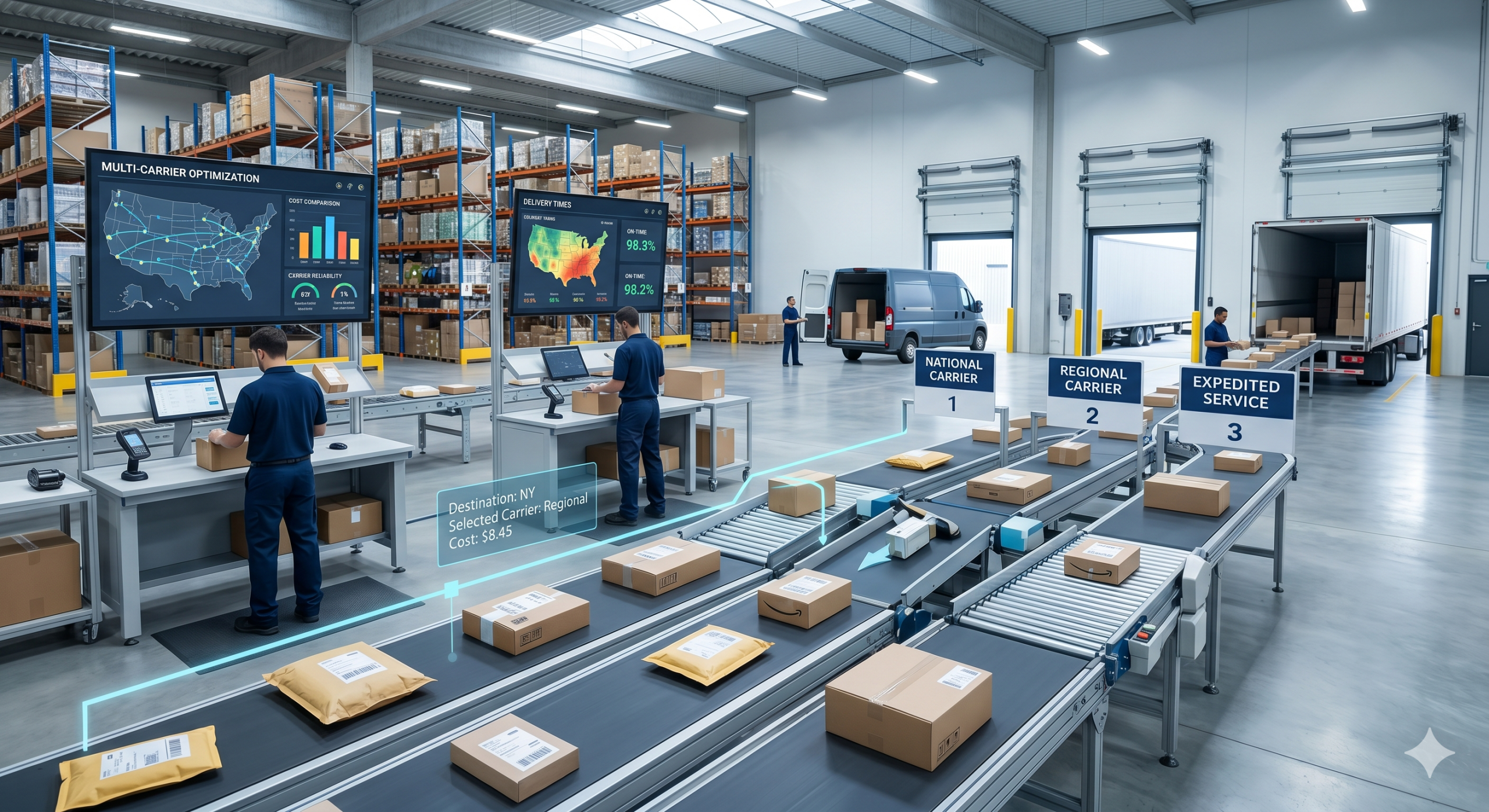
If carrier mix, shipping zones, and fulfillment costs are getting harder to manage, Launch Fulfillment can help you build a smarter shipping strategy around your customer base. Talk to Launch Fulfillment about a fulfillment setup built for speed, visibility, and cost control.
Ready to lower shipping costs without slowing delivery?
Build a smarter carrier mix, reduce zone costs, and improve delivery speed with a fulfillment strategy designed to scale.
Final Verdict: It’s Not Either/Or, It’s Strategy
The modern ecommerce platform requires more than a single-carrier dependency. Volatility in the logistics market is the new normal. To stay competitive, brands must build a flexible shipping network that integrates national scale with regional efficiency. By diversifying your carrier mix, you aren’t just saving money — you are building a more resilient, customer-centric business that can thrive regardless of market conditions.
National carriers are essential. Regional carriers are powerful. But the real advantage comes from knowing when to use each one. With the right fulfillment partner, ecommerce brands can move beyond single-carrier dependency and build a carrier strategy that lowers cost, protects delivery speed, and supports long-term growth.
If your shipping costs keep rising and your current setup feels too rigid, get in touch with Launch Fulfillment. A better fulfillment strategy can help you reduce cost, improve delivery performance, and give customers the shipping experience they expect.
