

Key Takeaways
- Bonded warehouses and free trade zones (FTZs) both help importers manage duties and taxes through duty deferral, VAT suspension, and customs-approved workflows.
- A bonded warehouse is a Customs Bonded Warehouse regulated by customs authorities (HMRC in the UK); FTZs are international foreign trade zone regimes used in global trade hubs.
- Bonded warehousing focuses on storage, inventory management, and supply chain control for imported goods; FTZs enable manufacturing, assembly, export processing and broader international trade logistics.
- Ecommerce brands selling in the UK usually prefer bonded warehouses; multinational exporters and manufacturers often benefit more from FTZ warehouse operations.
- The right choice strengthens cash flow, reduces duty payments at the duty rate in force at release, and simplifies compliance across your supply chain.
Managing import duties, customs duties, tariffs, and VAT is where margins are won or lost in international trade. If you handle foreign goods at volume, you need a customs solution that keeps duty payments off your balance sheet until the right tax point, without breaking compliance or your inventory management process. Two proven options are bonded warehousing and free trade zones (FTZs)—both designed for trade facilitation and smoother international commerce.
At Launch Fulfilment, our Bonded Warehousing in the UK service gives brands a compliant way to store imported goods under customs control, improve cash flow, and keep the warehouse fulfilment engine running.
For a detailed guide on how to Establish a bonded warehouse step by step, including requirements, application processes, and compliance tips, check out our comprehensive guide on how to start a bonded warehouse.
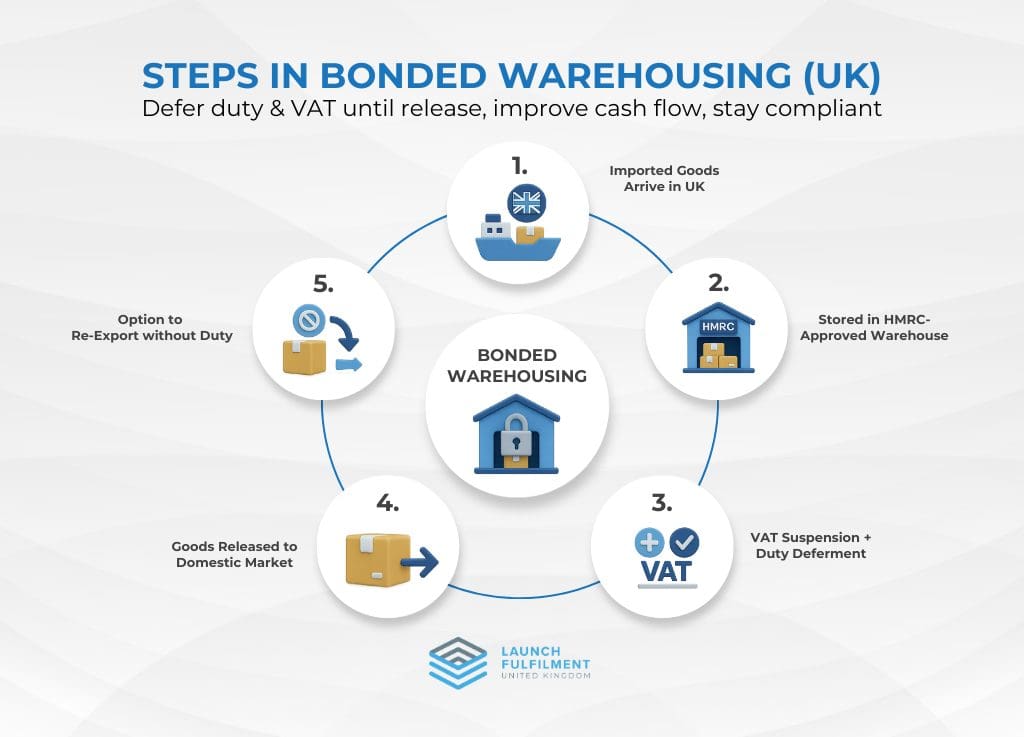
A bonded warehouse (often called a Customs Bonded Warehouse) is a secure facility where imported goods can be stored under customs authorities’ supervision with duty deferral and VAT suspension until those goods are transferred, re-exported goods are shipped, or stock is released to the UK market.
Why brands use bonded warehousing
- Duty deferral / VAT suspension: delay duties and taxes until sale or transferring goods to free circulation.
- Unlimited dwell: long-term storage (subject to compliance) to smooth supply chain peaks.
- Inventory management: integrated IT / TMS / WMS systems for traceability, batch/lot control, and vendor managed inventory options.
- Logistics stack: easy handoff with freight forwarding, customs brokerage, and cargo insurance.
- Re-export: ship re-exported goods without UK duty.
For ecommerce and DTC, a bonded site is a cash-flow-friendly extension of warehouse fulfilment—you hold imported goods without immediate duty payments.
What is a Free Trade Zone (FTZ)?
A Free Trade Zone (aka foreign trade zone, FTZ warehouse, export processing zone, or free port) is a designated area—often around ports/airports—where businesses can import, store, assemble, and manufacture with duties postponed until domestic entry.
Typical FTZ features
- Export processing and value-add (kitting, light manufacturing, assembly, processing).
- Duty deferral and potential tariff advantages (e.g., tariff inversion rules in some regimes).
- Used across free port countries (US, EU, Asia). In the US, think of CBP Service Port jurisdictions serving FTZs (e.g., Long Beach, Miami, Florida) supporting trade with Latin America and beyond.
FTZs are purpose-built for international trade logistics and large-scale global trade operations.
External primer: U.S. Foreign Trade Zones Program
Similarities: Where bonded warehousing and FTZs overlap
- Trade facilitation under strict customs regulation and customs clearance controls.
- Customs duty/import duties postponed until domestic release at the prevailing duty rate.
- Seamless with freight forwarding, customs brokerage, cargo care services (inspection, damage prevention), and cargo insurance.
- Both help align international trade logistics with finance (less upfront cash burn).
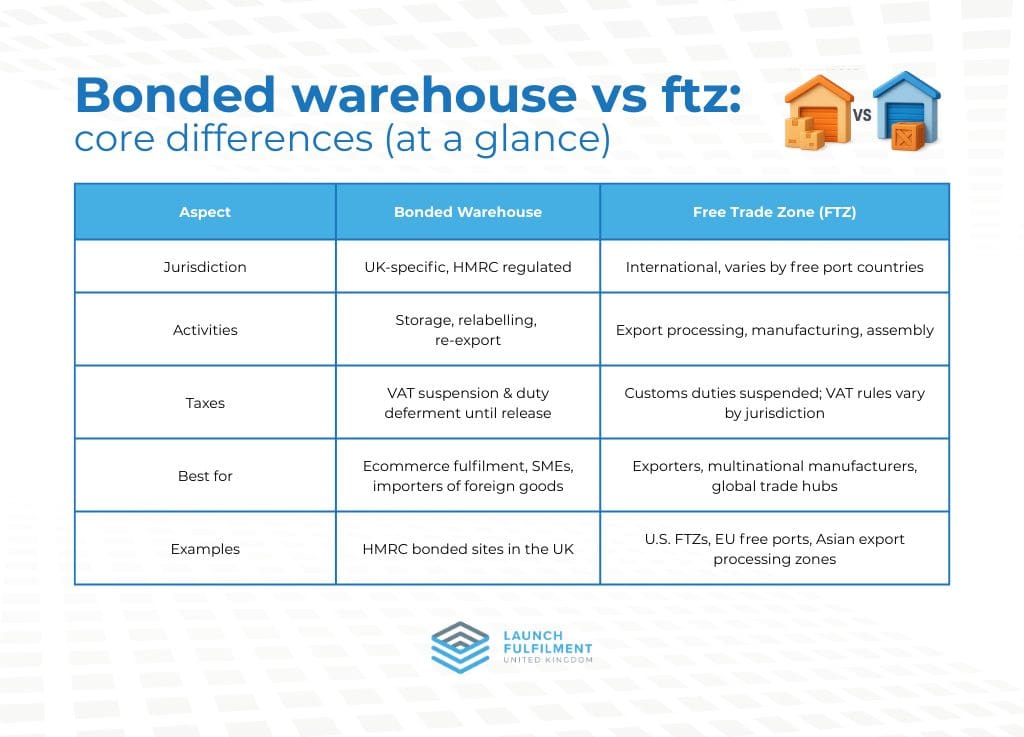
Bonded Warehouse vs FTZ: Core differences (at a glance)
Unlock the Benefits of Bonded Warehousing
Which option fits ecommerce brands best?
For UK-focused ecommerce and DTC, bonded warehousing usually wins. You keep imported goods under customs control, make duty payments only when units actually move, and plug the site into your IT / TMS / WMS systems for clean inventory management. If you’re a manufacturer or exporter doing heavy export processing, an FTZ can unlock more value.
👉 Also see our Ecommerce Fulfilment Services.
“Launch Fulfilment is the perfect partner for our growing business… excellent communication and responsiveness from dedicated managers enables us to focus on other parts of our operation.” — Aged & Ore
Costs, rates, and compliance nuances
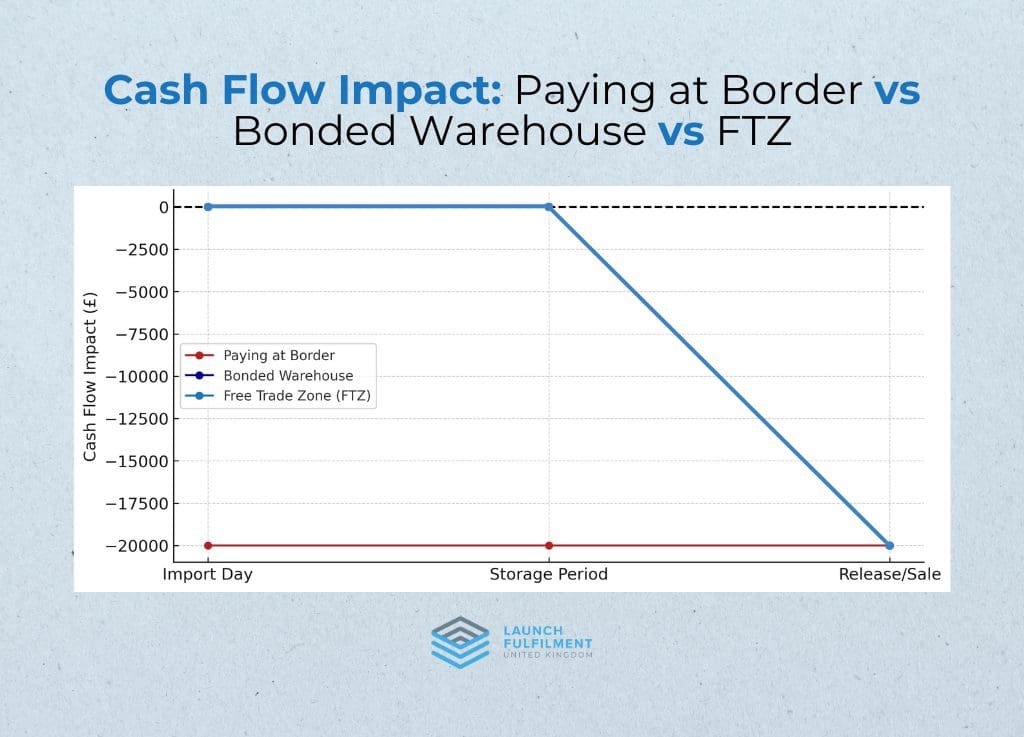
- Duties and taxes: With both regimes, import duties are calculated at the duty rate in force at the tax point (domestic entry).
- Fees: Some geographies levy admin/processing fees (e.g., the US Merchandise Processing Fee in certain cases), zone usage charges, or handling fees—model these into landed cost.
- Controls: Expect robust customs regulation on records, audits, and customs clearance accuracy; your customs authorities will expect clean stock trails.
- Risk management: Keep cargo insurance appropriate to your goods and lanes.
- People & partners: Choose experienced freight forwarding and customs brokerage partners used to bonded/FTZ regimes.
Trade examples and flows (how goods move)

- Entrepôt trade/transferring goods through hubs: stage foreign goods inbound, perform light work (labelling/repacking), and re-export to final markets.
- FTZ bonded warehouse transit: in some countries, goods flow from an FTZ into a bonded site (or vice-versa) under control before final release—handy for multi-node international trade logistics.
Closing Thoughts
Both bonded warehousing and FTZs exist to make international commerce simpler and more competitive. If you sell into the UK and want predictable cash flow with solid inventory management, a bonded warehouse is the straightforward answer. If you’re a manufacturer/exporter pursuing export processing and value-add in global trade hubs, an FTZ is often the right move.
Explore how Launch Fulfilment’s Bonded Warehousing in the UK gives you the control and compliance of a Customs Bonded Warehouse with the speed your supply chain demands.
👉 Understanding the Differences and Choosing the Best Option for You. Discover Launch Fulfilment’s exceptional bonded warehouse services.
Get Expert Guidance on FTZs & VAT
FAQ: Bonded Warehouses and Free Trade Zones (FTZs)
What is the main difference between a bonded warehouse and a free trade zone?
A bonded warehouse is a UK Customs Bonded Warehouse focused on storage, duty deferral, and VAT suspension for imported goods; an FTZ (foreign trade zone) is an international export processing zone that allows manufacturing, assembly, and broader value-add before domestic entry.
Is a bonded warehouse part of a free trade zone?
Not in the UK. Bonded sites are separate HMRC regimes. Some free port countries co-locate bonded operations within FTZ complexes, but compliance rules remain distinct.
Which is better for ecommerce?
Bonded warehousing—clean inventory management, deferred duty payments, and tight integration with IT / TMS / WMS systems and vendor managed inventory practices.
Do FTZs reduce tariffs more than bonded warehouses?
Often, yes—FTZs can support tariff engineering and component-based benefits for manufacturers, whereas bonded warehouses primarily defer duties and taxes until the tax point at domestic entry.
How do brokerage and forwarding fit in?
You’ll still use customs brokerage and freight forwarding for declarations, gate moves, and customs clearance. Add cargo care services and cargo insurance to protect high-value lanes.
Can I re-export from either regime?
Yes. Re-exported goods can move out without UK domestic charges from a bonded site; FTZs are built for export flows.
Where do FTZs operate?
Globally—think US zones under CBP Service Port oversight (e.g., Long Beach, Miami, Florida) with strong links to Latin America, plus EU and Asian free port networks.

Jake Tripp
Lead Content Strategist
I’m a content strategist and copywriter who specializes in 3PL content and other business services. I help brands nationwide to communicate their values and build loyal audiences.
