

Key Takeaways
- Postponed VAT Accounting (PVA) lets importers defer import VAT and declare it on their VAT return instead of paying at the UK border.
- It applies to imported goods from both EU and non-EU countries, including goods affected by the Northern Ireland Protocol.
- VAT-registered businesses benefit from improved cash flow, simplified VAT reporting, and smoother customs clearance.
- To use PVA, businesses must file accurate customs declarations with the correct customs procedure code (CPC).
- Launch Fulfilment supports ecommerce brands with bonded warehousing, postponed accounting, and customs compliance.
Importing goods can be complicated and quite expensive. Many ecommerce brands face large bills for import VAT and customs duties as soon as shipments land in Great Britain. These upfront charges can damage cash flow and slow down supply chains.
To resolve this issue, HMRC introduced Postponed VAT Accounting (PVA) in January 2021. This postponed accounting scheme allows VAT-registered businesses to shift the tax point so import VAT is included on the import VAT return, not paid at customs. Alongside special procedures such as bonded warehousing, PVA has become one of the most important customs reliefs for UK importers.
What is Postponed VAT Accounting?
Postponed VAT Accounting is a customs procedure that lets UK importers account for Value Added Tax (VAT) on their VAT return rather than paying it at the border.
Here’s how it works:
- Imported goods arrive at the UK border.
- Instead of paying import VAT immediately, it is postponed and declared on the VAT return.
- The same VAT is reclaimed as input tax if eligible, often resulting in a neutral cash flow effect.
For many VAT-registered businesses, postponed accounting means no cash leaves the business during importation, while VAT reporting remains compliant with HMRC and customs authorities.
👉 HMRC – Check when you can account for import VAT on your VAT Return
Why Was PVA Introduced?
Before Brexit, UK businesses importing from EU countries used the reverse charge mechanism for VAT. No tax was paid at the border; instead, VAT was accounted for on the VAT return.
After Brexit, goods from the European Union became imports, creating an immediate liability for import VAT and import duties. This caused an administrative burden and cash flow pressure.
To reduce disruption, HMRC introduced postponed import VAT accounting. It restored many of the advantages of the reverse charge system and helped VAT-registered businesses continue trading smoothly with EU suppliers.
Goods moving under the Northern Ireland Protocol may have different VAT rules, but in most cases, postponed accounting can still be applied.
How Does Postponed VAT Accounting Work?
Using PVA requires the right customs procedure code on your import declaration. Here’s the process:
- Imported goods arrive in Great Britain.
- You or your freight forwarder / customs agent submit a customs declaration form in the Customs Declaration Service (CDS).
- You select postponed accounting on the declaration.
- HMRC records the VAT due but does not require upfront payment.
- A monthly statement of postponed import VAT (sometimes called a PIVA statement) is generated in CDS.
- Businesses access this statement using their government gateway account.
- VAT is included on the import VAT return for the relevant accounting period.
This system ensures compliance with customs processes while protecting cash flow.

Who Can Use Postponed VAT Accounting?
PVA is available to most businesses that:
- Are VAT-registered businesses in the UK.
- Import goods from both EU and non-EU countries.
- Use CDS to file import declarations with the correct customs procedure.
There is no separate registration process. Any VAT-registered business can adopt the postponed accounting scheme if they file customs declarations correctly.
If you are an international business selling to UK customers, managing import VAT requirements is crucial. For detailed compliance rules, threshold limits, and registration steps, check out our comprehensive UK VAT guide for overseas sellers.
Benefits of Postponed VAT Accounting for Ecommerce Brands
1. Cash Flow Relief
By moving the tax point to the VAT return, businesses avoid large upfront VAT bills when importing goods.
2. Faster Customs Clearance
Goods clear customs without waiting for VAT settlement, reducing delays in the supply chain.
3. Simplified VAT Process
Monthly postponed import VAT statements make VAT reporting more efficient and provide a clear audit trail for HMRC.
4. Flexibility with Special Procedures
PVA can be used alongside other customs reliefs such as bonded warehousing, duty deferment, and delayed declaration. This gives ecommerce brands more tools to manage costs.
5. Growth Potential
In industries like supplements, skincare, and DTC health, controlling customs duties and import VAT is crucial for expansion.
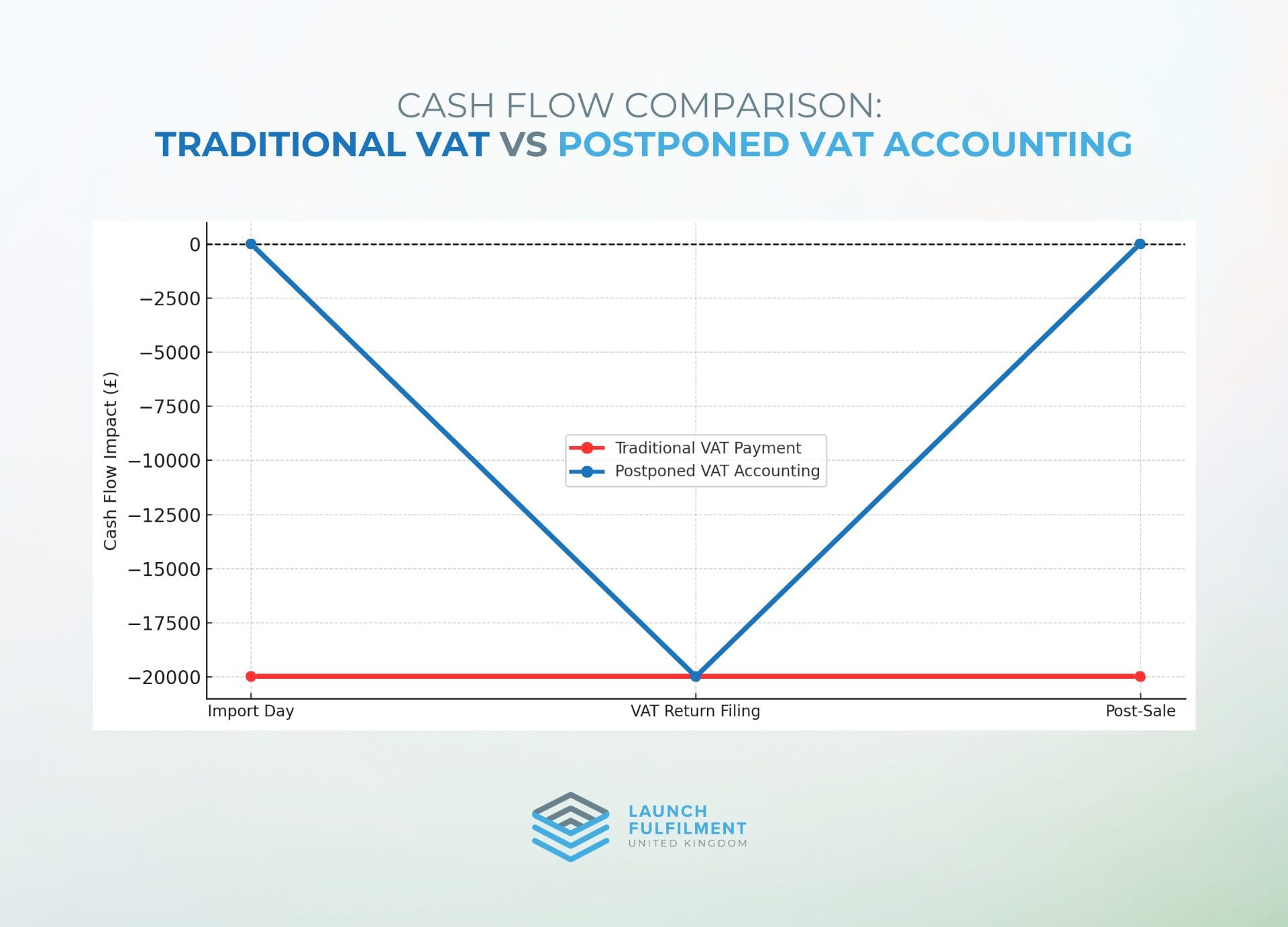
Example: VAT at the Border vs Postponed VAT
Get in Touch to Find Out More
Example: Importing £100,000 worth of goods.
- Without PVA: £20,000 import VAT paid immediately at the UK border.
- With PVA: £20,000 declared on the VAT return and reclaimed in the same return, meaning no upfront cash outflow.
This is why postponed accounting is now essential for VAT-registered importers.
Compliance and Reporting Requirements
Using PVA doesn’t remove obligations. Businesses must:
- Keep accurate C79 certificates or C79 reports for evidence of VAT paid outside PVA.
- Download their postponed import VAT statement each month.
- File VAT returns on time for each accounting period.
- Maintain correct VAT reporting and records for audits.
- Ensure trader responsibilities are met under HMRC rules.
Failure to comply may lead to VAT debt or VAT late payment penalties. In some cases, businesses may also lose eligibility for certain customs reliefs.
How to Apply for Postponed VAT Accounting
There is no formal application. To use PVA:
- Tick the postponed VAT option on your customs declaration form.
- Work with a freight forwarder or customs agent to ensure accuracy.
- Access the PIVA statement via your government gateway account.
This evidence supports VAT reclaim during the relevant accounting period.
Postponed VAT Accounting vs Duty Deferment Account
Though often compared, these are separate customs procedures:
- PVA (Postponed VAT Accounting): Defers import VAT.
- Duty Deferment Account (DDA): Defers customs duties and excise duties, not VAT.
- Together: Many businesses use both to manage import duties and VAT effectively.
📌 Related reading: Deferring or Postponing Important VAT

Closing Thoughts
Postponed VAT Accounting has become an essential customs relief for VAT-registered businesses in the UK. By deferring import VAT to the VAT return, businesses gain cash flow flexibility, reduce administrative burden, and keep supply chains moving.
For ecommerce brands, combining postponed VAT accounting with bonded warehousing services, ecommerce fulfilment solutions, and other special procedures offers complete control over customs processes.
👉 Launch Fulfilment helps importers manage import duties, VAT reporting, and customs declarations, freeing capital for growth. Contact us now to find out how.
All The answers
FAQs About Postponed VAT Accounting
Q: Do I need to register for Postponed VAT Accounting?
A: No. Any VAT-registered business can use postponed accounting by selecting it on their customs declaration.
Q: Can postponed VAT accounting be used for EU imports?
A: Yes. PVA applies to imported goods from both EU countries and non-EU countries, though the Northern Ireland Protocol may apply.
Q: How do I access my postponed import VAT statement?
A: Log into the Customs Declaration Service using your government gateway account to download your monthly statement.
Q: What is a C79 certificate?
A: A C79 certificate is an HMRC document showing import VAT paid outside of postponed accounting. Businesses should keep these for VAT reporting and audits.
Q: What’s the difference between postponed VAT and delayed declaration?
A: PVA is about import VAT return timing, while a delayed declaration is a separate customs relief allowing extra time to file import documentation.
Q: What is the tax point under PVA?
A: The tax point is when the postponed import VAT is declared on your VAT return, not when goods arrive at the UK border.

Jake Tripp
Lead Content Strategist
I’m a content strategist and copywriter who specializes in 3PL content and other business services. I help brands nationwide to communicate their values and build loyal audiences.
