

Key Takeaways
- A customs warehouse (also called a bonded warehouse) is an HMRC-authorised facility where bonded goods are stored with duty suspension and VAT suspension under customs control.
- Importers use customs warehousing to delay import duties and import VAT until goods are released for free circulation (UK sale) or re-exported.
- Goods can remain in a customs warehouse indefinitely (subject to customs authorities supervision), whereas temporary storage is limited to 90 days.
- Removal options include free circulation, re-export, or transfer to another customs procedure such as Inward Processing.
- Only HMRC-authorised facilities (run by an approved warehouse keeper) can operate as customs warehouses; importers may use a public customs warehouse (third-party) rather than obtaining their own approval.
If you import goods into the UK, you’ve likely come across the term customs warehouse—also known as a bonded warehouse. Both describe the same system: a secure, HMRC-authorised facility operating under customs supervision where imported goods can be held with duty and VAT deferred until they are released into the market.
For e-commerce brands in sectors like supplements, beauty, and personal care, customs warehousing is not just about compliance. It’s a financial strategy. By storing stock in bond, you can defer customs duty, excise duties (for excise goods), and import VAT until items are sold. That protects working capital, reduces exposure to tariff changes, and can eliminate charges entirely when stock is re-exported.
👉 Learn more about our UK bonded warehousing service at Launch Fulfilment.
What is a Customs Warehouse?
A customs warehouse, commonly called a bonded warehouse, is an HMRC-approved facility where imported goods are stored under customs control with duty suspension and VAT suspension.
There are two types of customs warehouse recognised by HMRC:
- Public customs warehouse (operated by a third-party warehouse keeper for multiple traders).
- Private customs warehouse (authorised for a single trader’s goods).
Instead of paying charges at the border, businesses hold goods until they are released for free circulation in the UK. At that point, customs duty and VAT become payable. If the goods are re-exported, no UK duty or VAT is due.
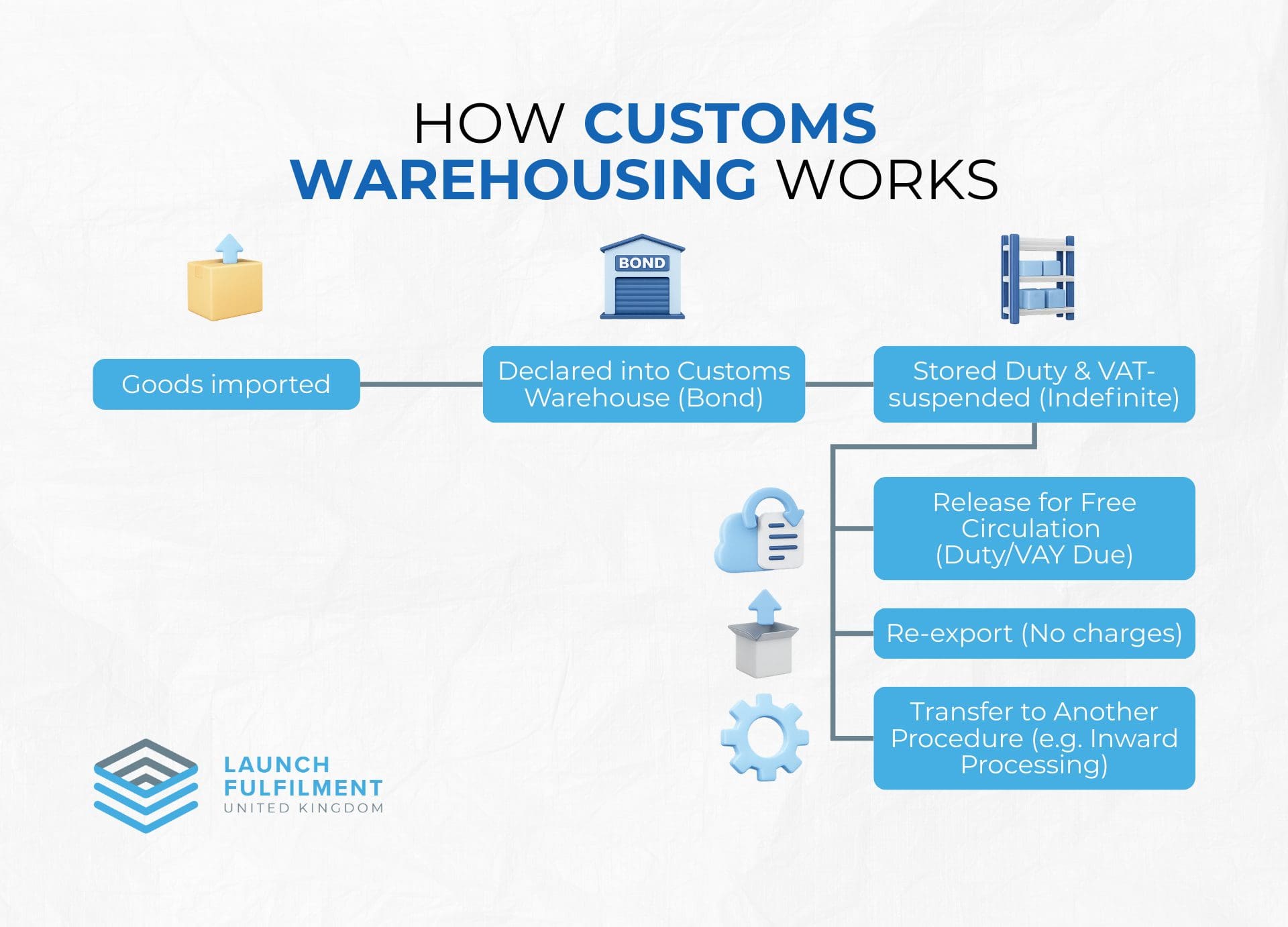
How Goods Move Into a Customs Warehouse
To place goods under the customs warehousing procedure, traders must follow the correct customs procedure code (CPC) and submit an import declaration via HMRC’s Customs Declaration Service (CDS). There are two common routes:
- Full customs declaration (complete data at import), or
- Simplified Customs Declaration Procedures (SCDP) with a simplified entry followed by a supplementary declaration.
Your warehouse keeper (or customs broker) ensures compliance, maintains stock control records, and keeps an auditable inventory system for customs authorities. Good practice also includes accurate commodity codes (tariff classification), customs valuation, and origin documentation to ensure the correct duty rates (HMRC valuation rules).
How to Remove Goods from a Customs Warehouse
When goods leave a customs warehouse, they must be declared for one of three outcomes:
- Released for UK sale (free circulation) → customs duty, import VAT, and any excise duties become payable.
- Re-exported outside the UK → no UK charges.
- Transferred to another special procedure (for example Inward Processing, which allows further manufacturing or repair under suspension of duty HMRC: inward processing).
This flexibility lets importers phase duty liability in line with demand rather than paying everything upfront. Many traders pair warehousing with Postponed VAT Accounting (PVA) and a Duty Deferment Account (DDA) (HMRC duty deferment) for smoother settlement.
How Long Can Goods Stay in a Customs Warehouse?
Unlike temporary storage, which allows goods to remain for up to 90 days, the customs warehousing special procedure does not impose a fixed time limit. As long as the warehouse maintains HMRC authorisation, customs supervision, and accurate stock control and audit trail records, goods can be stored indefinitely.
This makes customs warehousing especially valuable for seasonal stock, bulk imports, slow-moving SKUs, or high-value items.
Understanding storage timelines is just one part of trade compliance. For a step-by-step breakdown of duty declarations and import regulations, see our full guide on UK customs clearance.
Get in Touch to Find Out More
Temporary Storage vs Customs Warehousing
Although both are overseen by customs authorities, there are key differences:
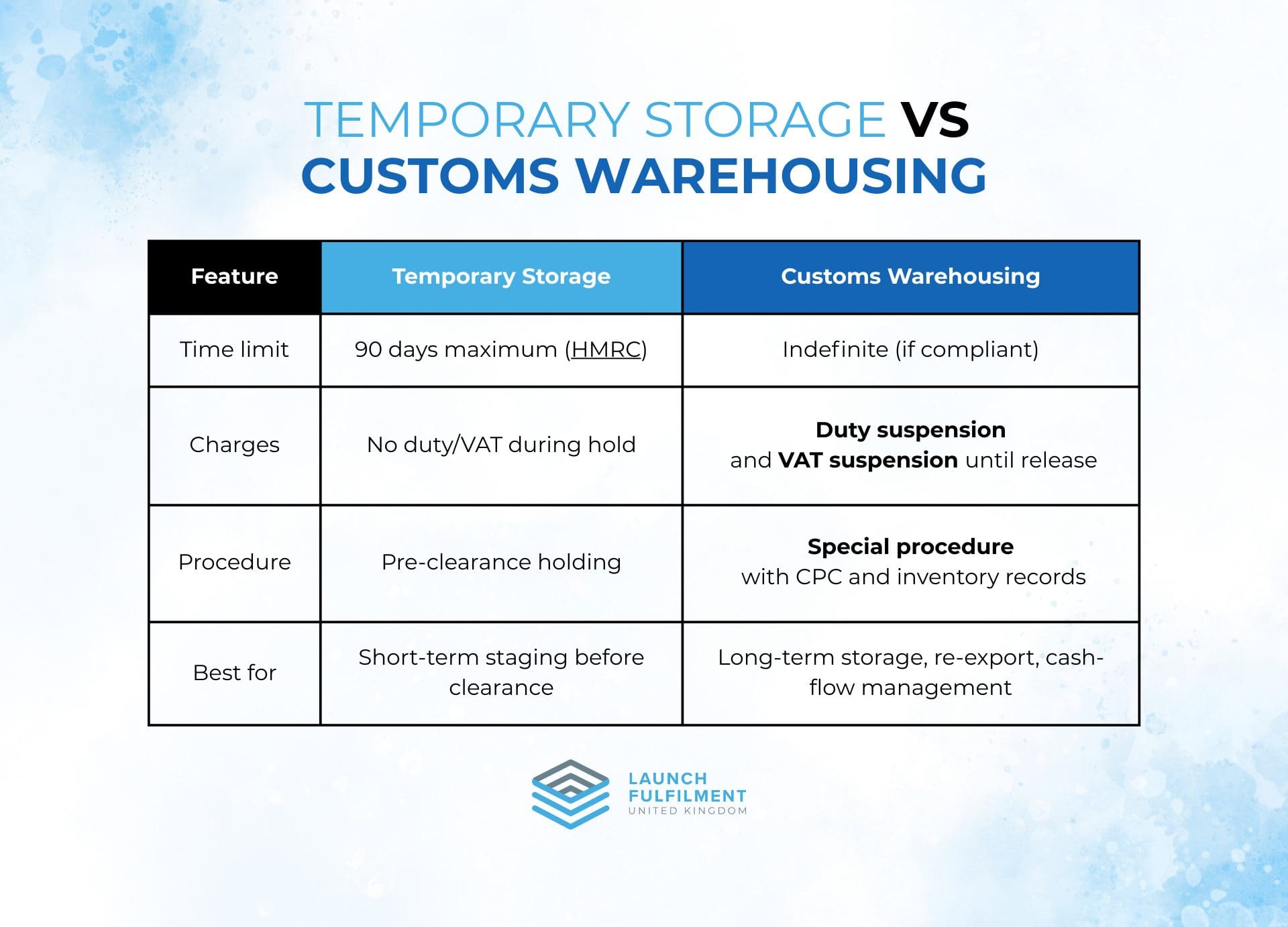
For most importers, customs warehousing offers more flexibility and stronger financial control than temporary storage or a general tax warehouse.
Advantages of Customs Warehousing
Customs warehousing provides several advantages for UK importers and e-commerce brands:
- Improved cash flow → pay import duties and import VAT only when goods are sold (HMRC PVA).
- Tariff risk management → avoid exposure to sudden rate changes before release for free circulation.
- Re-export options → ship abroad with no UK duty or VAT.
- Operational efficiency → accurate stock control and integrated inventory systems under customs control.
- Compliance with customs authorities → structured records for HMRC audits and clear alignment with defined customs procedures.

Compliance Checklist for Importers
To use customs warehousing in the UK, businesses typically need:
- An EORI number (apply here).
- Access to CDS to lodge import declarations.
- Either their own HMRC authorisation or use of a public customs warehouse run by an authorised warehouse keeper.
- Robust stock control and inventory records (commodity codes, quantities, movements, and CPC used), ready for HMRC inspection.
Final Thoughts
Customs warehousing is a special procedure that builds financial resilience. By keeping goods under duty suspension until they’re sold or exported, UK brands gain cash-flow flexibility, reduce risk, and simplify trade compliance.
👉 Ready to protect your margins and grow sustainably? Explore Launch Fulfilment’s bonded warehouse services.
“With Launch handling all the product kitting and fulfilment, I’m able to focus my time and energy on scaling. Good communication, easy to work with, I highly recommend them.”
All The answers
FAQ about Customs Warehousing
What is the difference between customs warehousing and bonded warehousing?
There is no difference. “Bonded warehousing” is the common industry term, while HMRC refers to the customs warehousing special procedure. Both involve storing goods under customs control with duty and VAT suspended.
How do I move goods into a customs warehouse?
Submit an import declaration in CDS using the correct customs procedure code (CPC). This can be a full declaration or an SCDP with supplementary documentation.
How do I remove goods from a customs warehouse?
Goods are removed either into free circulation (duties/VAT payable), re-exported (no charges), or transferred into another special procedure like Inward Processing.
What is the difference between temporary storage and customs warehousing?
Temporary storage is a short-term hold (max 90 days), while customs warehousing allows indefinite storage with duties and VAT deferred under HMRC supervision.
Do I need HMRC approval to operate a customs warehouse?
Yes. Only HMRC-authorised facilities can operate as customs warehouses. Importers can use public warehouses run by authorised warehouse keepers.

Jake Tripp
Lead Content Strategist
I’m a content strategist and copywriter who specializes in 3PL content and other business services. I help brands nationwide to communicate their values and build loyal audiences.
