
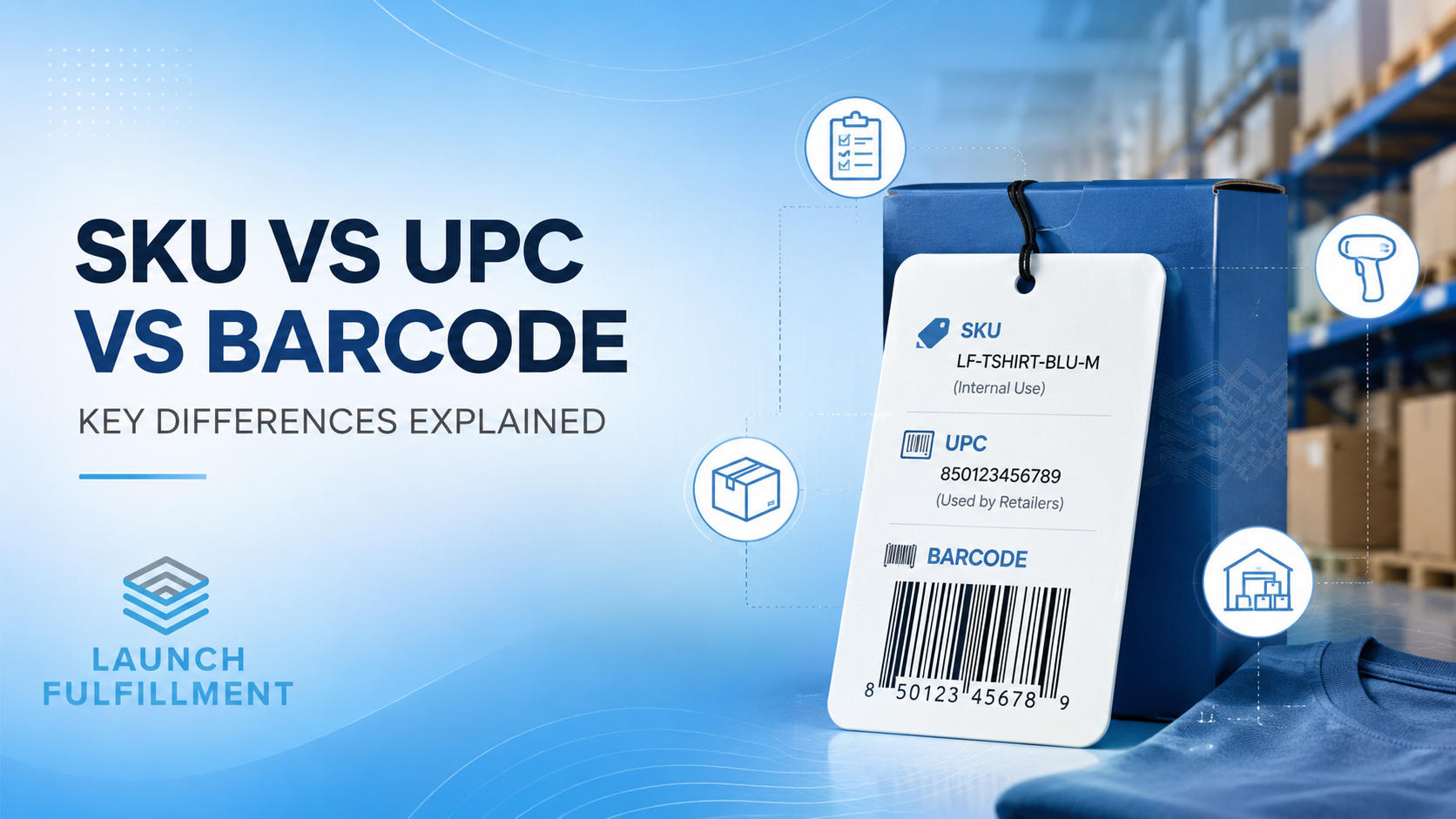
A SKU is an internal product identifier created by a business for inventory management. A UPC is a standardized 12-digit product identifier used across retailers and sales channels. A barcode is the machine-readable visual pattern that can encode a UPC, SKU, or another type of product data.
SKU vs UPC vs Barcode at a Glance
| Feature | SKU | UPC | Barcode |
|---|---|---|---|
| What it is | An internal product code | A standardized retail product identifier | A machine-readable symbol |
| Created by | The individual business | The brand owner using GS1 identification standards | Generated from the data being encoded |
| Typical format | Letters, numbers, or both | Commonly a 12-digit UPC-A identifier | Lines, spaces, squares, or other scannable patterns |
| Primary use | Internal inventory tracking | External product identification and retail sales | Fast, accurate data capture |
| Unique across businesses? | No | Yes, when properly assigned | Depends on the data encoded |
| Can it identify variants? | Yes | Yes; distinct trade-item variants normally need distinct identifiers | Yes, when linked to the correct product identifier |
| Required for every product? | Not legally required, but highly useful | Depends on the retailer, marketplace, or distribution channel | Depends on the operational workflow |
Technical nuance: in GS1 terminology, the GTIN identifies the product, while a UPC barcode is one common symbol used to carry that identifier. A UPC-A barcode contains 12 digits.
How Does a GTIN Relate to a UPC?
A Global Trade Item Number, or GTIN, is the standardized number used to identify a trade item. A UPC commonly contains a 12-digit GTIN, also called a GTIN-12. The UPC is the identifier, while the barcode is the scannable visual representation used to carry that number.
What Is a Stock Keeping Unit (SKU)?
A Stock Keeping Unit (SKU) is an alphanumeric code that a business assigns to a product for internal inventory management and tracking purposes. Unlike standardized codes, SKUs are customizable and created by individual businesses to organize their inventory effectively. Their alphanumeric nature allows for rich descriptive detail, enabling businesses to encode vital product attributes such as color, size, material, style, and even supplier information. For example, an SKU like “TSHIRT-BLU-MED-STR” clearly indicates a blue, medium-sized t-shirt from a specific collection.
The primary function of an SKU is to facilitate detailed inventory tracking and management of inventories. Businesses use SKUs within their inventory management systems and inventory management software to monitor stock levels, identify product variations, and analyze sales performance. A well-designed SKU system provides granular insights into which products are selling well, which are low in stock, and how to manage inventory levels efficiently. This is particularly crucial for businesses with extensive product lines or numerous product variations, as it allows for precise differentiation between even minor changes in a product’s attributes. By meticulously tracking SKUs, businesses can enhance operational efficiency, reduce errors in order fulfillment, and gain a clearer understanding of the performance of your SKUs.
For more context on stock visibility, replenishment, and inventory health, see inventory position, formula of inventory, and inventory management for e-commerce.
What Is a Universal Product Code (UPC)?
The Universal Product Code (UPC) is a standardized, 12-digit numeric barcode symbology commonly used in North America and other regions for product identification. Unlike SKUs, UPCs are issued by GS1, a global organization that manages supply chain standards. This ensures that every UPC assigned is unique worldwide, preventing duplication and enabling seamless identification of products across different businesses and markets.
A typical UPC structure consists of two main parts: a company prefix and a product code. The final digit of the UPC is a check digit, calculated using a specific algorithm. This check digit acts as a safeguard against scanning errors; if the barcode is read incorrectly, the check digit will likely not match, flagging a potential issue. UPCs are essential for physical products sold through major retailers, online platforms, and the broader retail supply chain. They are a requirement for manufacturers looking to distribute their products widely, ensuring consistency and traceability from the point of origin through to the checkout counter. While European markets primarily use the related EAN system, the principle of standardized external identification remains the same.
What Is a Barcode?
A barcode is the visual, machine-readable representation of data. It’s the familiar pattern of parallel lines of varying widths and the spaces between them that you see on almost every product. This pattern is designed to be quickly and accurately interpreted by a barcode scanner or barcode reader. While SKUs are alphanumeric and UPCs are strictly numeric, the barcode itself is the visual representation that translates this underlying data into a format that scanning systems can process.
There are various barcode formats, such as UPC-A, Code 128, and QR codes. Each format is optimized for specific types of data and applications. The barcode image is printed on product labels, packaging, or shipping labels. When scanned, the barcode reader deciphers the pattern and transmits the associated data—either an SKU or a UPC—to a computer system, such as inventory management software or a point-of-sale system. This enables rapid data capture, significantly improving efficiency and accuracy in processes ranging from inventory tracking in fulfillment centers to sales transactions at the checkout counter.
For shipping-side barcode standards, USPS’s Intelligent Mail Package Barcode resources are also worth bookmarking.
Key Differences: SKU vs. UPC vs. Barcode
The key differences between SKUs, UPCs, and barcodes can be summarized by their origin, purpose, format, and scope.
- Origin: SKUs are created internally by individual businesses, while UPCs are issued externally by GS1. Barcodes are generated as a visual representation of either an SKU or a UPC.
- Purpose: SKUs are primarily for internal inventory management and inventory tracking, helping businesses manage their stock, analyze product performance, and optimize inventory levels. UPCs are for external, global product identification, enabling sales, distribution, and tracking across the supply chain and with major retailers. Barcodes are tools that enable rapid scanning and data entry for both SKUs and UPCs.
- Format: SKUs are alphanumeric and can vary in length, allowing for descriptive detail. UPCs are strictly 12-digit numeric codes. Barcodes are visual patterns that encode either alphanumeric or numeric data depending on what they represent.
- Scope: SKUs are specific to a single business’s internal operations. UPCs are universal, intended for use across all markets and retailers globally. Barcodes are the common visual interface for accessing both types of data via scanning systems.
The biggest difference lies in their application: SKUs are about internal control and specific product attributes, while UPCs are about external recognition and standardized product identity. A barcode is simply the technological enabler for reading this information quickly.
How SKUs, UPCs, and Barcodes Work Together
While SKUs and UPCs serve different primary functions, they often coexist on the same physical products and work in synergy to provide comprehensive product identification. A manufacturer will typically assign a unique UPC to each product variation they produce. This UPC is then printed on the product packaging, often represented by a barcode image. Internally, the retailer or distributor will then assign its own SKU to that same product.
This creates a dual identification system: the UPC for external, universal recognition, and the SKU for internal, granular tracking. When a barcode scanner reads the barcode on a product, it can retrieve either the UPC or the SKU, depending on the system’s configuration. For example, a fulfillment center might use the barcode to identify an item by its SKU to pick the correct product for an order. Later, when that order is shipped and its contents are scanned at a different point, the UPC might be used for external tracking. Inventory management software can often link an SKU to its corresponding UPC, allowing businesses to leverage the benefits of both systems—internal control and external standardization—seamlessly. This integrated approach is vital for accurate inventory tracking, efficient order fulfillment, and overall operational efficiency.
It’s also why brands evaluating a 3PL should look beyond storage alone and evaluate broader third-party logistics services and their 3PL partner advantage.
Does Your Business Need SKUs, UPCs, or Both?
Understanding which identifiers your business needs depends on your operational scope and sales channels.
- For Small E-commerce Businesses Selling Directly: Primarily, you will need SKUs for robust inventory management and inventory tracking within your own online store. You can create your own descriptive SKUs to manage product variations and monitor inventory levels.
- For Businesses Selling on Major Marketplaces: These online platforms typically require UPCs for product listings to ensure standardization and discoverability. While you’ll still use SKUs internally, you’ll need UPCs for marketplace integration.
- For Brick-and-Mortar Retailers: UPCs are generally mandatory for point-of-sale systems and inventory management. Major retailers will almost always require products to have UPCs. You will also use SKUs for your internal stock management.
- For Manufacturers and Wholesalers: Obtaining UPCs is a fundamental requirement. You must assign a unique UPC to each product variation you produce for distribution to retailers. Your internal operations might also benefit from SKUs for managing raw materials or finished goods before they are assigned a UPC.
- For Fulfillment Centers and Shipping Carriers: These entities work with both SKUs and UPCs. They rely on accurate barcode labeling and scanning systems to manage inventory for their clients, process orders, and track shipments efficiently.
In North America, the Universal Product Code is the standard, while businesses in other regions might encounter related systems. Regardless of the specific code, the principle of standardized identification is crucial for smooth supply chain operations.
| Business Need | Recommended Identifier |
|---|---|
| Internal inventory organization | SKU |
| Selling through retailers or marketplaces | UPC |
| Warehouse scanning and automation | Barcode |
| Managing product variants | Separate SKU for each variant |
| Retail identification plus internal tracking | UPC and SKU |
Common SKU and Barcode Mistakes That Cause Inventory Errors
Even a well-designed product identification system can break down when codes, labels, and inventory records are not managed consistently. These mistakes often lead to stock discrepancies, picking errors, shipping delays, and unreliable reporting.
Duplicate SKUs Within the Same Inventory System
Each distinct sellable product or variation should have its own SKU within your inventory system. Assigning the same SKU to two different products makes it difficult for software and warehouse teams to determine which item was received, sold, picked, or returned.
For example, a blue medium T-shirt and a red medium T-shirt should not share the same SKU. Each variation needs a unique code so inventory quantities and sales performance can be tracked accurately.
Different companies may use the same internal SKU without conflict, but duplicate SKUs should not exist inside one company’s active product catalog.
Inconsistent SKU Naming Conventions
SKU formats should follow a clear and repeatable structure. If one product category uses abbreviations, another uses full words, and another uses unrelated numbers, the system becomes difficult to maintain.
A consistent SKU format helps teams quickly recognize important product details such as:
- Product category
- Style or model
- Color
- Size
- Pack quantity
- Product variation
Keep SKU formats short, readable, and consistent. Avoid special characters or unnecessarily complicated codes that warehouse teams may struggle to interpret.
Unreadable or Poorly Positioned Barcode Labels
Barcode labels must be clear enough for scanners to read quickly and accurately. Smudged printing, low contrast, damaged labels, curved placement, or labels positioned over packaging seams can cause scanning failures.
When a barcode cannot be scanned, warehouse staff may need to enter information manually. That slows receiving and fulfillment while increasing the risk of human error.
Labels should be printed clearly, placed on a flat and accessible surface, and tested with the same scanners used in the warehouse.
Applying the Wrong Label to a Product
A perfectly printed barcode is still useless when it is attached to the wrong item.
Incorrect labeling can cause the warehouse management system to associate one physical product with another product’s SKU or UPC. This may result in incorrect inventory counts, wrong-item shipments, return-processing problems, and customer complaints.
Barcode accuracy should be verified during receiving, relabeling, kitting, and product preparation.
Reusing One Identifier Across Different Product Variants
Different sizes, colors, flavors, materials, quantities, and bundles should be tracked separately when they are sold as distinct items.
For example, a 30-count supplement bottle and a 60-count bottle should not share the same SKU. The same principle applies to apparel sizes, cosmetic shades, fragrance variations, and multipacks.
Assigning unique identifiers to each variation gives the business accurate visibility into which products are selling, which are running low, and which need replenishment.
Disconnected Inventory, Storefront, and Warehouse Systems
Product identifiers only work when every connected system recognizes the same product record.
If the ecommerce storefront, order management system, warehouse management system, and fulfillment provider use different SKUs or mismatched product data, the business may experience:
- Overselling
- Incorrect stock quantities
- Delayed orders
- Duplicate product records
- Picking and packing errors
- Confusing returns data
Product data should remain synchronized across every platform involved in inventory and order fulfillment.
How Product Identification Affects Ecommerce Fulfillment
Clean product identification directly affects receiving, inventory visibility, picking, packing, shipping, and returns.
When inventory arrives at a warehouse, the SKU and barcode help the receiving team confirm that the correct product and quantity were delivered. The item can then be connected to the proper inventory record and assigned to an accurate storage location.
During order fulfillment, warehouse staff use SKUs and scannable labels to identify the correct product variation. Accurate product records reduce the risk of selecting the wrong size, color, flavor, or pack quantity.
Product identification also supports:
- Faster receiving and putaway
- More accurate inventory counts
- Efficient warehouse picking
- Better lot and batch tracking
- Fewer wrong-item shipments
- Cleaner returns processing
- More reliable operational reporting
A strong SKU system cannot prevent errors by itself. Product records, barcode labels, physical inventory, and warehouse workflows must all remain aligned.
For growing ecommerce brands, this connection becomes even more important as order volume, sales channels, warehouse locations, and product variations increase. A scalable fulfillment operation uses consistent product data from the moment inventory arrives until the order reaches the customer.
Turn Clean Product Data Into Accurate Fulfillment
A strong SKU and barcode system only works when receiving, storage, picking, packing, and shipping follow the same product data.
Clean product data is great. Clean fulfillment is better.
If your ecommerce operation is tracking inventory correctly but still dealing with warehouse inefficiencies, pick errors, delayed shipments, or disconnected systems, talk to Launch Fulfillment. You can also explore ecommerce fulfillment services, review how fulfillment works, or see how industry-specific fulfillment solutions support brands as they scale.
Related Posts
FAQs About SKUs, UPCs, and Barcodes
Can a SKU and UPC be the same?
A SKU and UPC serve different purposes and generally should not be the same. A SKU is an internal identifier created by a business to organize and track inventory. A UPC-A barcode typically carries a standardized 12-digit GTIN-12 used to identify a retail product across businesses and sales channels. Although inventory software may technically allow matching values, keeping the identifiers separate prevents confusion and supports cleaner product data.
Is a SKU the same as a barcode?
No. A SKU is the internal code a business assigns to a product, while a barcode is a machine-readable symbol that carries encoded data. A business may generate a barcode that encodes its SKU for internal warehouse scanning, but the SKU and barcode are not the same thing. Barcodes can also carry standardized identifiers such as GTINs.
What is the difference between a barcode and a UPC code?
A barcode is the visual, machine-readable symbol scanned by a barcode reader. A UPC-A barcode is a specific barcode type commonly used for retail products in North America, and it carries a 12-digit GTIN-12. In everyday language, people often use “UPC” to refer to both the identification number and the barcode symbol, which is why the terms are frequently confused.
Does every product need a different SKU?
Every distinct product or sellable variant should generally have its own SKU so inventory can be tracked accurately. For example, the same shirt offered in three sizes and two colors would normally require six separate SKUs. Businesses create their own SKU structure, so the format can reflect useful details such as style, size, color, or product category. A SKU may be alphanumeric and can be updated as internal systems change.
Can two products have the same UPC?
Two distinct retail products should not share the same GTIN or UPC. Each product that must be separately priced, ordered, or invoiced needs a unique identifier. Important variations such as different sizes or colors commonly require separate GTINs because retailers and supply-chain systems must distinguish them as unique products.
How do I create a good SKU number for a product?
Create a consistent SKU format that is easy for your team to understand and scalable as your catalog grows. Use short combinations of letters and numbers to represent details such as category, style, color, size, or version. Avoid ambiguous characters, spaces, overly long codes, and formats that depend entirely on supplier numbers. Each SKU should be unique within your inventory system and remain consistent across sales and fulfillment workflows.
