
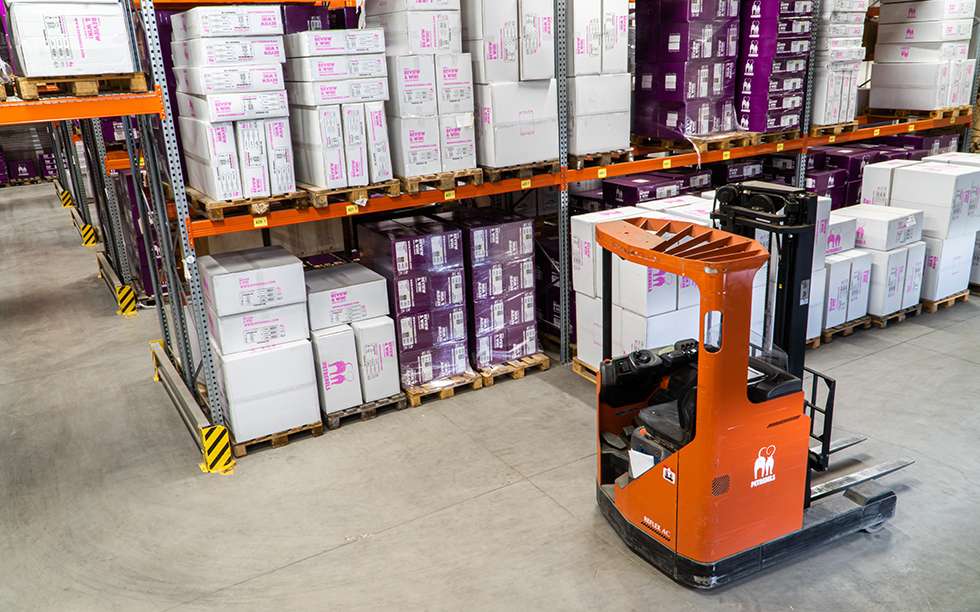
Once we’ve received your inventory, we keep it in our fulfillment centers. Each SKU has its own storage space, which may be on a shelf, in a bin, or on a pallet.
Different 3PLs have different storage capacities; not all 3PL warehouse space is created equal. It’s important to work with a 3PL that can offer more than enough storage space for your current inventory — as your product line and order volume grow, your 3PL storage must be able to scale with you.
A 3PL is a third-party logistics (3PL) provider that manages your storage, picking, and distribution.
Picking
When a consumer places an order, the 3PL fulfillment process begins. (You may have heard the term “pick-and-pack fulfillment” before — this is the first half of that.)
Many 3PLs want you to upload orders manually into their system. This might include order information spreadsheets, client shipping documentation, and more. This can be a time-consuming and laborious approach to manage orders.
Other 3PLs have sophisticated technology that is integrated directly into your ecommerce platform or marketplace. These 3PL fulfillment software integration make it easier to manage the fulfillment process by bringing orders, shipments, inventory monitoring, and stock levels together in one location.
When a customer places an order with your 3PL, the program immediately sends it to their designated fulfillment provider.
An order is sent to your 3PL, and it is assigned to the warehouse picking crew. To collect the ordered products from their specific places, the picker receives a picking list of the items, quantities, and storage locations at the facility.
Packing
After all items in a purchase have been picked, it’s time to pack them for shipping securely. The packing supplies employed will be determined by your 3PL’s capabilities, brand preferences, and the goods being transported.
The following are the most frequent packing materials:
Some 3PLs charge for packing supplies as a stand-alone item, while others include them into their fulfillment management services.
The 3PL will choose the best packing materials to both protect your products and minimize their dimensional weight, as skilled shippers. They’ll also streamline packages so that you don’t have to split them up.
Dimensional weight is a shipping pricing strategy that takes into account package dimensions in order to determine rates. Using the appropriate packing supplies might help keep transportation costs low.
If you want your brand to stand out during delivery, work with a 3PL that allows you to design your own packaging, such as bespoke boxes and inserts. When it comes to shipping a present, there are few things that make the consumer feel more connected to your brand than seeing its distinctive packaging. Branded packaging is effective at making a big impact because it’s often the first in-person encounter a customer has with your business.
Shipping
The next stage is to ship your purchase. Most 3PLs will take care of purchasing and printing shipping labels for you. Some 3PLs have chosen preferred carrier partners, while others evaluate shipping charges from a range of carriers. The latter aids 3PLs in providing the lowest possible price for delivery speed to clients according to their demands.
3PL warehouses take orders from carriers like DHL, USPS, and UPS to send. The carrier and delivery speed for each order are determined by the 3PL’s relationships and rules, as well as the ship options chosen by the client and picked by the end customer.
When the order is delivered, 3PLs with the integrated technology described above will immediately send tracking information to merchants’ online storefronts.
Returns
Return processing is another common service offered by 3PLs. If a customer returns an order via shipping it back to your 3PL, your 3PL will process the return and restock or dispose of the product, depending on their policies and your preferences.
You may have your 3PL print return shipping labels for your clients. This saves you time and money by allowing you to avoid in-house returns. Customers can simply follow the progress of their return order by using these labels.
