

Key Takeaways
- “Just right” inventory is a competitive advantage. Too much stock drains cash, while too little leads to lost sales and frustrated customers.
- Safety stock protects against uncertainty. It acts as a buffer for demand spikes and supplier delays, helping you maintain consistent fulfillment.
- Demand and lead time variability drive inventory risk. The more unpredictable these factors are, the more strategic your safety stock planning needs to be.
- Basic formulas are a starting point—not the finish line. More advanced, data-driven methods provide better accuracy and reduce unnecessary overstock.
- Inventory decisions should be tied to service levels. Higher service levels improve customer experience but increase carrying costs—balance is key.
- Safety stock works best as part of a system. Forecasting, reorder points, and fulfillment operations all need to work together—not in silos.
- Strong operations reduce the need for excess inventory. Better visibility, faster fulfillment, and smarter replenishment help you carry less while staying in stock.
Why “Just Right” Inventory Is Your Competitive Edge
In today’s dynamic business environment, striking the perfect balance in inventory management isn’t just a best practice — it’s a critical competitive differentiator. Holding too much stock ties up valuable capital and increases costs, while too little leads to frustrating stockouts, lost sales, and damaged customer relationships. The key to achieving this delicate equilibrium lies in understanding and mastering the safety stock formula. This isn’t about guesswork; it’s about strategic calculation to ensure you have just enough buffer to weather the inevitable fluctuations in demand and supply chain lead times. This article will guide you through the essential concepts, formulas, and strategic considerations for calculating and maintaining your ideal inventory levels, turning potential liabilities into powerful assets for your business.
At Launch Fulfillment, we’ve seen firsthand that inventory discipline is one of the clearest separators between brands that scale smoothly and brands that constantly feel reactive. The goal is not to carry the most inventory. The goal is to carry the right inventory, supported by better ecommerce fulfillment systems, cleaner forecasting, and stronger operational visibility.
The Peril of Stockouts: Lost Sales and Damaged Reputation
The most immediate and often visceral consequence of inadequate inventory is the stockout. When a customer wants a product, and it’s unavailable, the immediate impact is a lost sale. However, the damage often extends far beyond that single transaction. In an era of abundant choices and instant gratification, a customer encountering a stockout may simply turn to a competitor, potentially permanently. This erosion of customer loyalty can have long-term, cascading effects on revenue and market share. Furthermore, a reputation for unreliability can be incredibly difficult to rebuild, impacting brand perception and future sales opportunities across your entire product line.
That’s why strong order management and order processing matters so much. If inventory visibility breaks down, the customer doesn’t care whether the problem started in forecasting, receiving, or replenishment. They just know the item wasn’t available when they wanted it.
Inventory problems aren’t just a math issue
If stockouts and overstock keep showing up, the problem usually runs deeper than formulas. It’s about visibility, timing, and fulfillment execution.
The Burden of Excess Inventory: Tied-Up Capital and Obsolete Stock
On the flip side, holding too much inventory presents its own set of significant challenges. Excess stock represents capital that could be invested elsewhere — in marketing, research and development, or operational improvements. This tied-up capital limits financial flexibility and can hinder growth. Beyond the financial burden, excess inventory incurs ongoing costs. These include storage space in your warehouse, insurance, security, and the risk of obsolescence. Products can become outdated, damaged, or simply expire, leading to write-offs and significant financial losses. Furthermore, the need to discount or liquidate excess stock can devalue your brand and erode profit margins.
For brands trying to scale cleanly, this is where “more inventory” stops being a safety net and starts becoming a drag. Launch Fulfillment’s approach to order fulfillment and inventory flow is built around reducing that drag while still protecting availability.
What Is Safety Stock? Your Strategic Buffer
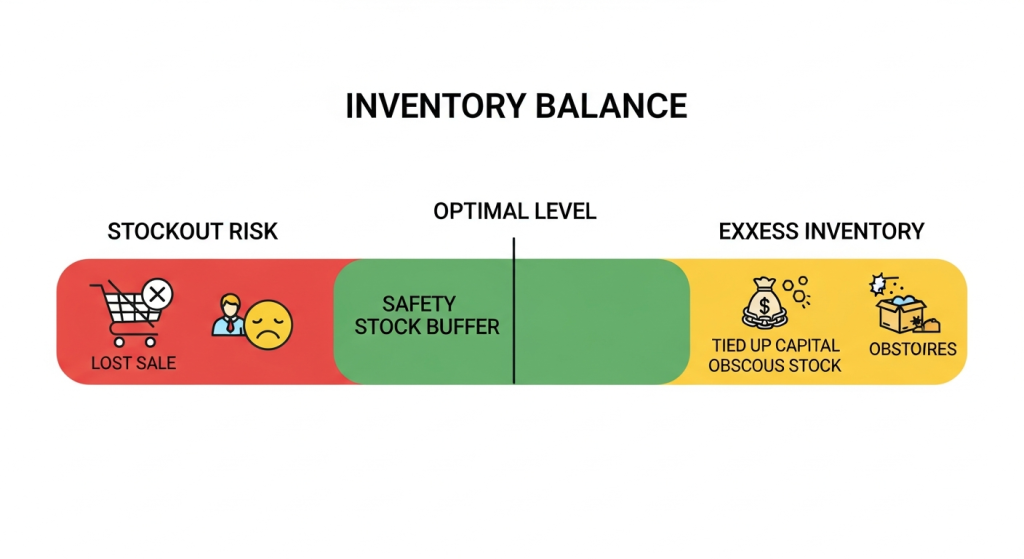
Safety stock provides a strategic buffer, helping businesses find the optimal balance between the risk of stockouts and the costs of excess inventory.
Safety stock, also known as buffer stock or “just in case” inventory, is the extra inventory a company holds to mitigate the risk of stockouts. It acts as a strategic reserve to cover unexpected increases in demand or delays in replenishment lead times. It’s not the inventory you expect to sell in your normal cycle; rather, it’s the contingency plan for when demand surges beyond forecasts or when your suppliers experience delays. Properly managed safety stock ensures that you can continue to meet customer demand even when the unpredictable occurs, safeguarding sales and customer satisfaction.
This is closely connected to broader inventory management for ecommerce. Safety stock is not a standalone tactic. It works best when it is tied to stronger forecasting, clearer replenishment logic, and real-time awareness of what inventory is actually available to sell.
Achieving Inventory Mastery: Beyond Guesswork
Effective inventory management, including the precise calculation of safety stock, moves beyond intuition and gut feelings. It requires a data-driven approach that leverages historical information and predictive capabilities. This means understanding the key variables that influence your inventory needs — primarily demand and lead time — and developing robust methods to forecast them. By moving from guesswork to calculation, businesses can optimize their inventory, reduce costs associated with both stockouts and excess, and build a more resilient and responsive supply chain.
ASCM defines inventory control as the systems and procedures used to optimize inventory levels and reduce costly problems like stockouts, waste, and obsolescence. That framing is useful here because “just right” inventory is not luck; it is a control system. ASCM’s inventory control overview is a solid outside reference.
Too much inventory is just as risky as too little.
Carrying excess stock ties up cash and slows growth. The right fulfillment setup helps you move faster without overcommitting inventory.
Understanding the Pillars of Safety Stock: Demand and Lead Time

The calculation of safety stock is fundamentally built upon two critical pillars: demand for your products and the lead time it takes to receive them. Fluctuations in either of these can disrupt your supply chain and lead to stockouts if not adequately buffered.
Demand: More Than Just “Average Sales”
When we talk about demand in the context of safety stock, we’re not just referring to the average daily or weekly sales figures. While averages provide a baseline, they often mask crucial variations. Demand variability refers to the unpredictable swings in how much of a product customers purchase over a given period. This can be influenced by seasonality, promotions, competitor actions, economic trends, or even external events. High demand variability means your sales can fluctuate significantly, requiring a larger safety stock to cover potential spikes. Accurately understanding and quantifying this variability is key to setting appropriate safety stock levels.
One of the clearest ways to improve this is with better forecasting discipline. Launch Fulfillment’s guide to naive forecasting in inventory management is a good example of how even simple forecasting frameworks can sharpen reorder timing, safety stock planning, and lead-time decisions.
Lead Time: The Journey from Order to Arrival
Lead time is the total duration from the moment an order is placed with a supplier until the goods are received and available for use or sale in your warehouse. This period typically includes order processing time, manufacturing or assembly time, shipping time, and receiving and put-away time at your facility. Like demand, lead time is also subject to variability. Factors such as supplier production issues, transportation delays, customs holds, or even weather events can cause lead times to fluctuate. Understanding both the average lead time and, critically, the maximum lead time you might experience is essential for safety stock calculations.
Lead time becomes even more important when multiple systems are involved. If your receiving, storage, and replenishment workflows are disconnected, lead-time assumptions get weaker fast. That is one reason brands often lean on a stronger ecommerce fulfillment partner once order volume starts climbing.
The Crucial Role of Forecasting: Estimating Demand and Lead Time
Accurate forecasting is the bedrock upon which effective safety stock calculations are built. Without reliable estimates for future demand and lead times, any calculation will be flawed. Sophisticated forecasting techniques can help predict both average values and the expected range of variability for demand and lead time. This involves analyzing historical sales data, market trends, promotional calendars, and supplier performance. The better your forecasts, the more precisely you can calculate the necessary safety stock to cover potential deviations, leading to a more efficient and cost-effective inventory management strategy.
The Core Safety Stock Formula: Your Foundation for Calculation
While various methods exist, understanding the foundational formulas for safety stock calculation is crucial. These formulas provide a quantitative approach to determining the optimal buffer needed.
Unpacking the Basic Formula: Maximum Usage Method
A common and straightforward method for calculating safety stock is the “Maximum Usage” or “Maximum Demand” method. This approach is relatively simple to implement and provides a conservative estimate.
The formula is typically expressed as:
Safety Stock = (Maximum Daily Usage × Maximum Lead Time) – (Average Daily Usage × Average Lead Time)
Let’s break this down:
- Maximum Daily Usage: This is the highest recorded demand for a specific item on any single day within a given period.
- Maximum Lead Time: This is the longest recorded duration from placing an order to receiving it.
- Average Daily Usage: This is the average demand for the item per day over a specific period.
- Average Lead Time: This is the average duration from placing an order to receiving it over a specific period.
This formula calculates the difference between the highest possible inventory needed during a lead time and the expected inventory that would be consumed during that same period, based on average usage. It aims to ensure you have enough stock to cover demand during the longest possible lead time, assuming maximum usage throughout.
If you want a broader look at how this fits into the bigger math of stock planning, Launch Fulfillment’s inventory formulas guide and formula of inventory article both connect safety stock to the wider set of calculations used to control inventory well.
Limitations of the Basic Formula: When Simple Isn’t Enough
While the Maximum Usage method is easy to understand and apply, it has significant limitations. It can often lead to overstocking because it uses the absolute highest recorded values for demand and lead time. This means it doesn’t statistically account for the probability of these maximums occurring or how likely various levels of variability are. If your demand or lead time figures are based on historical data that includes rare, extreme outliers, this formula can result in an unnecessarily high safety stock, tying up more capital and space than necessary. For businesses seeking greater precision and cost efficiency, more advanced statistical methods are required.
Mastering Variability: The Statistical Safety Stock Formula
To move beyond conservative estimates and achieve truly optimized inventory levels, you need to account for the variability in demand and lead time in a statistically sound manner. This is where the statistical safety stock formula comes into play.
Introducing the Z-Score and Service Level: Balancing Risk and Reward
The statistical approach introduces two key concepts: service level and the Z-score.
Service Level: This is the probability that you will not experience a stockout during a given replenishment cycle. For example, a 95% service level means you aim to meet customer demand 95% of the time, accepting a 5% chance of a stockout. Choosing the right service level is a strategic decision that balances the cost of holding inventory against the cost of lost sales and customer dissatisfaction.
Z-Score: The Z-score, or standard score, is a statistical measure that describes a value’s relationship to the mean of a group of values. In safety stock calculations, it represents the number of standard deviations away from the mean at which you want to set your inventory level to achieve a desired service level.
- 90% service level: Z-score ≈ 1.28
- 95% service level: Z-score ≈ 1.65
- 99% service level: Z-score ≈ 2.33
The more ambitious your target service level, the more carefully your replenishment process has to be managed. Shopify’s inventory guidance similarly emphasizes using reorder points, forecasts, and safety buffers together instead of in isolation. Shopify’s inventory management guide is helpful on that point.
The Role of Standard Deviation: Quantifying Uncertainty
Standard deviation is a statistical measure that quantifies the amount of variation or dispersion of a set of data values. In inventory management, the standard deviation of demand and the standard deviation of lead time help us understand how much these metrics typically fluctuate around their average. A higher standard deviation indicates greater variability and thus a greater need for safety stock. Calculating the standard deviation of historical demand and lead times provides a precise measure of uncertainty, which is essential for statistically accurate safety stock calculations.
The Advanced Safety Stock Formula: Accounting for Variable Demand and Lead Time
When both demand and lead time vary, the statistical safety stock formula becomes more comprehensive. It can be adapted to account for variability in one or both factors. A common and robust formula that accounts for variability in both demand and lead time is:
Safety Stock = Z-score × Standard Deviation of Demand during Lead Time
To calculate the Standard Deviation of Demand during Lead Time, you often use the following:
Standard Deviation of Demand during Lead Time = √[(Average Lead Time × Standard Deviation of Demand²) + (Average Daily Demand² × Standard Deviation of Lead Time²)]
Let’s break down the components of the advanced formula:
- Z-score: Directly correlates to your chosen service level.
- Average Lead Time: The average time it takes to receive an order.
- Standard Deviation of Demand: How much daily demand typically fluctuates around its average.
- Average Daily Demand: The average number of units sold per day.
- Standard Deviation of Lead Time: How much lead time typically fluctuates around its average.
This formula provides a more accurate representation of risk by quantifying uncertainty and allowing you to set safety stock precisely to meet a specific service level target, minimizing both stockouts and excess inventory.
Set Smarter Reorder Timing, Not Just Bigger Buffers
One of the biggest mistakes brands make is treating safety stock as the whole answer. It is not. Safety stock only works well when it is paired with a sensible reorder point and a clear understanding of when replenishment needs to happen. Launch Fulfillment’s content on inventory restocking methods and inventory position shows why timing matters just as much as quantity.
Shopify’s help documentation makes the same point from a systems perspective: reorder points should reflect lead time, sales velocity, and the amount of stock needed before depletion. Shopify’s low-stock and reorder-point documentation offers a practical outside reference.
Setting Your Ideal Service Level: A Strategic Decision
The service level is not just a number; it’s a strategic decision that directly impacts your inventory costs and customer satisfaction. Determining the right service level involves a careful assessment of business objectives and market conditions.
The Trade-off: Higher Service Level vs. Increased Inventory Costs
There’s a fundamental trade-off: a higher service level necessitates a higher safety stock, which in turn leads to increased inventory holding costs. Conversely, a lower service level means less safety stock, lower holding costs, but a greater risk of stockouts and potential loss of sales and customers. Businesses must weigh the cost of carrying additional inventory against the cost of losing business due to unavailability. This balance point is unique to each product and business context.
Factors Influencing Your Target Service Level
Several factors should influence your decision when setting a target service level:
- Product Criticality: High-demand, essential items or those with a high profit margin often warrant higher service levels.
- Customer Sensitivity: If your customers are highly sensitive to stockouts and have many alternatives, a higher service level is crucial.
- Lead Time Reliability: If lead times are highly erratic, you might need a higher service level or more safety stock to compensate.
- Competitor Service Levels: Understanding what your competitors offer can inform your own strategy.
- Cost of Stockouts: Quantifying the financial impact of a stockout helps justify the investment in higher safety stock.
Customer Service Level: The Ultimate Goal
Ultimately, the goal of setting any service level is to enhance the customer experience. By ensuring product availability, you build trust and reliability. A well-calibrated safety stock program directly contributes to customer satisfaction, repeat business, and a positive brand reputation. Focusing on the customer perspective helps align inventory strategy with broader business objectives.
This is especially important for brands in regulated and sensitive categories, where stock integrity and customer expectations are both high. Launch Fulfillment’s supplement fulfillment services, beauty supply fulfillment, and subscription box fulfillment services all reflect how category needs shape service-level expectations.
Beyond Calculation: Strategic Considerations for Optimizing Safety Stock
Calculating safety stock is only part of the equation. Effective inventory management involves ongoing strategic adjustments and integration with other business processes.
Dynamic Adjustments: When and How to Re-evaluate Your Levels
Safety stock levels should not be static. They require regular review and dynamic adjustments based on changing market conditions, seasonality, promotions, or shifts in demand and lead time patterns. Businesses should establish a cadence for re-evaluating their safety stock, perhaps quarterly or annually, and use actual performance data to fine-tune their calculations. Real-time monitoring systems can also alert managers to significant deviations that might warrant immediate adjustments.
Centralized vs. Decentralized Safety Stocks: Which Model Fits?
The placement of safety stock can have significant implications. Centralized safety stock held at a single warehouse can lead to economies of scale and better inventory pooling across a wider range of products. However, it may increase transit times to distant customers. Decentralized safety stock, held at multiple regional warehouses or distribution centers, can reduce delivery times to local customers but may lead to higher overall inventory levels and increased management complexity. The optimal approach depends on your supply chain network, customer locations, and inventory management capabilities.
That network question is one reason brands evaluate broader fulfillment strategy rather than just SKU counts in a spreadsheet. The warehousing model shapes how much buffer stock you actually need.
Integrating with Other Inventory Strategies
Safety stock doesn’t operate in a vacuum. It must be integrated with other inventory management strategies, such as Economic Order Quantity (EOQ) for determining optimal order sizes and reorder points that trigger replenishment orders. When setting reorder points, the calculated safety stock is a critical component, ensuring that new inventory arrives before existing stock, including the safety buffer, is depleted.
Contingency Stock and Buffer Storage: Related Concepts
Contingency stock is a broader term that can include safety stock, but also other types of reserve inventory held for unforeseen events like natural disasters or major supply chain disruptions. Buffer storage refers to the physical space designated for holding this extra inventory. Understanding how safety stock fits within the larger framework of contingency planning and warehouse utilization is important for holistic inventory management.

Ready to make inventory decisions with more confidence?
If you’re trying to reduce stockouts, free up cash, and build a fulfillment process that scales, it helps to work with a partner that understands inventory strategy in the real world. Talk to Launch Fulfillment about building a smarter fulfillment and inventory operation.
Common Pitfalls and How to Avoid Them
Even with the right formulas, several common pitfalls can undermine the effectiveness of your safety stock strategy.
The Danger of Static Safety Stock Levels
As mentioned, setting safety stock and leaving it unchanged is a recipe for inefficiency. Market dynamics, supplier performance, and customer demand are constantly evolving. Failing to re-evaluate and adjust safety stock levels means they will quickly become either too high, leading to excess costs, or too low, leading to stockouts.
Relying on Inaccurate Data: The Garbage In, Garbage Out Principle
The accuracy of your safety stock calculations is entirely dependent on the quality of your input data. If historical sales data is incomplete, inaccurate, or not properly cleaned, or if lead time records are unreliable, your calculated safety stock will be flawed. Implementing robust data collection and validation processes is paramount.
Ignoring Lead Time Variability and Supply Chain Delays
Many businesses focus heavily on demand variability but overlook the significant impact of lead time variability. Unforeseen supply chain disruptions can stretch lead times considerably, and not accounting for this can lead to stockouts even with adequate demand-based safety stock. A comprehensive approach considers both factors.
Closing Thoughts: Sustained Mastery
Mastering the safety stock formula is not a one-time task but an ongoing journey of refinement and strategic adjustment. By understanding the critical role of safety stock in mitigating risks from demand and lead time variability, businesses can move beyond guesswork to data-driven optimization. We’ve explored the foundational concepts, from the perils of stockouts and excess inventory to the nuances of basic and statistical safety stock calculations. The key takeaway is that precise calculation, driven by accurate forecasting and a clear understanding of your chosen service level, allows you to maintain ideal inventory levels.
Implementing these formulas requires a commitment to data integrity, regular review, and strategic decision-making regarding your target service levels. Consider the unique dynamics of your products, customers, and supply chain when setting these parameters. Furthermore, remember to integrate your safety stock strategy with broader inventory management practices and to leverage technology where possible to enhance accuracy and efficiency. By proactively managing your safety stock, you not only protect against costly disruptions but also build a more reliable, customer-centric, and ultimately more profitable business. Take the steps today to calculate, implement, and continuously refine your safety stock strategy for sustained competitive advantage.
And if you want that strategy supported by a fulfillment partner that understands inventory from the warehouse floor to the customer doorstep, get in touch with Launch Fulfillment. Better inventory decisions are easier to make when your systems, storage, and fulfillment workflows are aligned.
Related Posts
Ready for inventory that actually works?
If you’re tired of guessing on stock levels or reacting to issues, it’s time for a more structured fulfillment and inventory system.
FAQ: 3PL vs In-House Fulfillment
What is the difference between 3PL and in-house fulfillment?
In-house fulfillment means your team handles storage, packing, and shipping internally, while a 3PL outsources those operations to a logistics provider. The key difference is control versus scalability—3PLs offer infrastructure and efficiency, while in-house gives hands-on oversight.
Is it cheaper to use a 3PL or in-house fulfillment?
In-house fulfillment can be cheaper at very low order volumes, but costs rise quickly with labor, space, and inefficiencies. A 3PL often becomes more cost-effective as you scale because it spreads operational costs across multiple clients.
When should a business switch to a 3PL?
Most brands consider switching between 500–5,000 orders per month, or when fulfillment starts causing delays, space issues, or operational strain. If fulfillment is slowing growth, it’s usually time to outsource.
What are the biggest advantages of using a 3PL?
A 3PL provides scalability, faster shipping, logistics expertise, and reduced operational burden. This allows brands to focus on growth instead of managing day-to-day fulfillment.
Is in-house fulfillment better for small businesses?
In-house fulfillment can work well for early-stage brands with low order volume or highly customized needs. However, as order volume increases, it often becomes harder to manage efficiently without outside support.
